|
 |
Focus On |
 |
| Solids Handling |
|
12/10/2020 |
|
engineering how-to
Hopper Design Principles
By Greg Mehos and Dave Morgan, Jenike & Johanson
Extensive experience has shown that designing equipment without regard to the actual bulk materials being handled often leads to flow problems, such as arching, ratholing, erratic flow and even no flow. By measuring the flow properties of a bulk solid, the flow behavior of the material can be predicted, and more reliable hoppers and bins can then be designed. Two primary flow patterns can occur in a bin or a silo: mass flow and funnel flow. In mass flow, the entire bed of solids is in motion when material is discharged from the outlet. This behavior eliminates the formation of stagnant regions in the vessel, and affords a “first-in, first-out” flow sequence, which provides a more uniform velocity profile during operation. A uniform velocity profile also helps to reduce the effects of sifting segregation. »
|
|
|
Blending, Sampling and Segregation
By Thomas G. Troxel, Jenike & Johanson, Inc.
Blending and segregation are two opposite and competing processes in solids handling that ideally fit the expression “two sides of the same coin.” But, if you think about it, coins have three sides and sampling completes the idiomatic expression perfectly. Blending is a necessary and essential process operation widely employed in many industries and materials, from nano-scale powders to run-of-mine ores. Segregation is almost always an unwanted consequence of handling operations that reverses the blending process or creates a need for blending where it might not otherwise be necessary if it were not for the effects of segregation. Sampling is the vitally important tool for measuring and quantifying a blend, understanding the sources and effects of segregation and for troubleshooting problems. »
|
| |
|
|
 |
| |
Facts at Your Fingertips
| Facts at your Fingertips: Agglomeration Processes |
| Agglomeration converts fine powder particles into larger ones by introducing external forces. Major benefits for solids processors include dust reduction, easier handling, more complete utilization of raw materials and densification. Agglomerating particles happens by a variety of means, including mixing with a liquid, applying pressure and heating. |
|
 |
|
|
what's new
The main industrial applications of isopropyl alcohol are as a chemical intermediate and as a solvent in the manufacturing of cements, primers, paints, varnishes, skin cleaners, perfumes, lotions, shampoos and deodorants. It is also used as a disinfectant and antiseptic.
Check out our newest quiz and learn more about process water heating
JOIN US FOR A NEW WEBINAR
|
|
|
|
|
|
from our bookstore
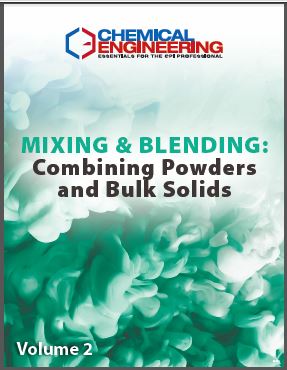
| Mixing and Blending: Volume 2 — Combining Powders and Bulk Solids |
| This selection of practical tutorial-style engineering articles provides informative, actionable information for process engineers and other technical professionals throughout the CPI. Several topics discuss different mixer and blender options. Others provide targeted engineering recommendations on how to manage specific safety issues— such as the risk of dust explosions — that can arise when handling powders and other bulk solids. |
|
 |
|
|
| |
|
|
© 2020 Access Intelligence, LLC. All rights reserved.
|