This motor reduces energy use with a.c.-to-a.c. approach
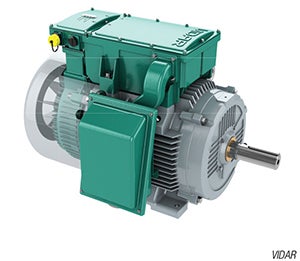 The VIDAR (photo) is a new type of motor that lowers energy usage and CO2 emissions, reduces costs, increases equipment lifespan and enhances process controls, resulting in decreased utility bills, maintenance expenses and downtime. VIDAR’s benefits stem from its patented AC-Link technology, which replaces conventional a.c.-to-d.c.-to-a.c. variable frequency drive (VFD) technology with a streamlined a.c.-to-a.c. approach. By removing the d.c. stage, bulky capacitors are eliminated, shrinking the VFD by 60%, and enabling the motor and VFD to be combined into a single, compact solution. This design enables VIDAR to fit seamlessly into the footprint of a conventional motor and eliminates the need for special wiring, additional enclosures or extra space requirements with traditional VFD and motor setups. VIDAR is purpose-built for industrial facilities. It uses a high-efficiency synchronous-reluctance magnet-assisted motor designed using IEEE-841 specifications, meets CSA Class 1 Division 2 for hazardous areas, and meets IEEE-519 power quality standards for dependable performance, even in the toughest environments. By embedding variable-speed intelligence directly into the motor, VIDAR eliminates the need for inefficient and failure-prone mechanical controls, such as throttled valves or dampers. By using exactly the amount of energy required for the task, VIDAR reduces energy use and CO2 emissions by up to 50% as compared to a fixed speed motor and mechanical control. — VIDAR, Syracuse, N.Y.