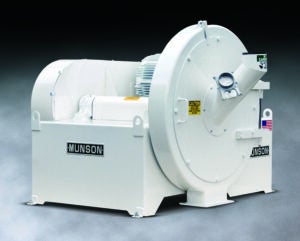
Source: Munson Machinery
This company’s centrifugal impact mill grinds friable materials, reduces flakes and de-agglomerates materials at rates to 5 cu ft (142 L) per minute, yielding narrow particle size ranges without the use of screens. High-speed rotation of the inner disc creates centrifugal force that accelerates bulk material entering the central inlet of the opposing stationary disc. As material travels from the center to the periphery of the discs at high speed, it crosses five intermeshing rows of rotating and stationary pins, yielding desired tight particle size distribution. Materials remain cooler than in other types of mills since retention is minimal and air is constantly drawn through the mill chamber. Setting the infinitely-variable rotor speed from several hundred rpm to 5,400 rpm provides the flexibility for coarse grinding and de-agglomerating, or fine grinding to 325 mesh. Also known as a pin mill, the unit features smooth interior surfaces with no crevices, and hinged, vertically-oriented outer discs, permitting unobstructed access to the interior for rapid cleaning. Typical industrial applications include grinding of ceramic filter media, chalks, coal, friable resins, dry clay, gypsum, pigments, and powdered metals. Sanitary stainless steel models are utilized for bulk pharmaceutical ingredients, nutraceuticals, flour, fish food, grains, spices, salt and sugars, as well as contamination-sensitive bulk chemicals. — Munson Machinery Company, Inc., Utica, N.Y.