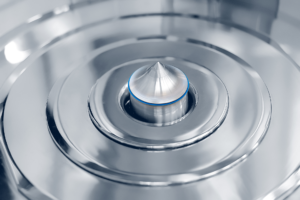
This new, simpler handling is partly due to the design of the spray gap, in which a flexible plastic membrane seals the circular gap from above. The flexible cap lifts solely through the pressure of the incoming liquid, and ensures excellent distribution even at low spray rates. If the process has to be interrupted, the spray liquid is pumped back, causing the membrane to be sucked in and to securely seal the spray gap. This prevents the gap from drying out and deposits from forming, which could block the nozzle when the machinery is restarted and therefore put the process at risk. Maintenance of the FLEXIJET is also easier because all nozzle components and wearing parts are available to reorder at any time and can be replaced by users themselves without the need for specialists. Besides granulation, the FLEXIJET® nozzle is also recommended for hot-melt coating applications, as no liquid evaporates here and batch processing times are relatively short. — Romaco Group, Karlsruhe, Germany
A new nozzle technology for fluid-bed granulation
| By Mary Bailey