WEVOSIL 20000 A/B is a silicone sealant designed for use in the alkaline environments of anion exchange membrane (AEM) electrolyzers and flow batteries. In addition to its chemical resistance, the material offers mechanical stability and optimized electrical properties. Application can be manual, semi- or fully automated. Alkaline electrolytes, elevated operating temperatures, sustained compression – in AEM electrolyzers and certain flow batteries (such as organic redox flow batteries), conditions for sealants and adhesives are highly demanding. WEVOSIL 20000 A/B has been specially developed for these environments and ensures the reliable sealing of stack components. The product can also be used as an adhesive if required.
Source: Wevo
For initial testing and manual applications, WEVOSIL 20000 A/B can be applied in liquid form with standard twin-cartridge systems thanks to its 1:1 mixing ratio. In series production, the material is usually applied directly to cell components such as bipolar plates, the gas diffusion layer, the flow frame or the membrane electrode assembly (MEA). Depending on the groove configuration and component design, different sealing geometries with variable widths and heights can be achieved. Due to its low viscosity, WEVOSIL 20000 A/B can also flow into undercuts. Processing via dispensing or screen printing also supports an efficient, scalable production process. Moreover, curing at elevated temperatures of 100 to 140 °C in a convection oven or in combination with an IR (infrared) heater can shorten cycle times. The material then cures tack-free within 1 to 2 minutes.
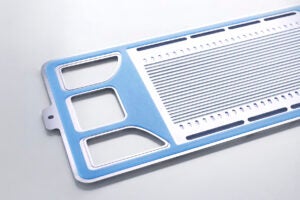
Additionally, in collaboration with Laufenberg, flat gaskets made from WEVOSIL 20000 A/B can be manufactured using a continuous roll-to-roll (R2R) process, with or without a carrier film. The coating process makes it possible to produce very thin and flexible gaskets. The material is applied in a layer approximately 50–500 µm onto either an adhesive or a non-adhesive carrier film. Adhesive carrier films can be coated on both sides with the silicone sealant, which allows for greater layer thicknesses. If a non-adhesive film is used, for example a fluorine-based one, the WEVOSIL layer can be peeled off the film after curing. This creates a flat gasket without a carrier film. Users can cut individual seals in the required design from this prefabricated sheet material and install them in the stack, making it a simple matter to produce test cells and short stacks. On request, Laufenberg also manufactures flat gaskets according to individual customer and component requirements.
Alongside the processing characteristics and chemical resistance, the mechanical properties contribute to long-term sealing performance. In order to withstand the continuous compression within the stack, WEVOSIL 20000 A/B exhibits a low hardness, a low compression set of 2% at room temperature and <10% at 100°C. The good dielectric properties support both electrical insulation and voltage resistance. — Wevo-Chemie GmbH, Stuttgart, Germany