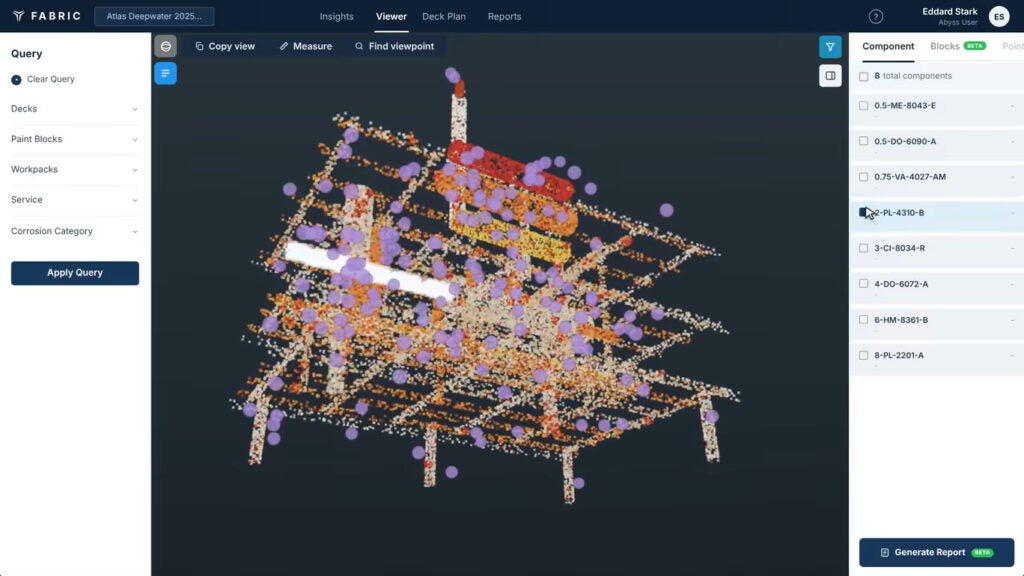
The Digital Isometrics function for the ABYSS Fabric™ platform is a new product line that generates piping isometrics directly from a scan of the asset, replacing the practice of sending people into the field to trace lines by hand. Operators of critical infrastructure do not usually have access to one place where the real, physical condition of their assets is understood and connected to the systems, teams and decisions that depend on it. Integrity, maintenance, engineering and operations have always worked from different understandings of the same asset: drawings out of date, inspection reports in PDFs, a risk model in one system and a work order system in another, none of them agreeing about what is reality. ABYSS Fabric captures the real condition of the asset at a level of detail traditional methods cannot, and connects that reality across every team.
Source: ABYSS
ABYSS Fabric™ enables operators to capture up to 85% of an asset in months rather than the average 20% a year achieved by conventional inspection, says the company. Digital Isometrics in ABYSS Fabric™ generates the isometric from the operator’s reality capture model, with no manual drafting and no additional site time. Inspectors then carry the isometric onto the deck on a tablet, mark findings straight onto the drawing, over inspection photos or on the 3D model, and every finding syncs back to the 3D record and the anomaly register. Paper and PDF markups land on the same drawing. Nothing is retyped. Drawings are built to the operator’s own drafting standard from a configurable symbol library, checked against live 3D as they are drawn, and exported to DWG, DXF, SVG or PDF so they drop into existing CAD and document control. Digital Isometrics also marks a shift in what an inspection record is. By digitizing every line and its components as a network in 3D space, ABYSS Fabric™ brings spatial intelligence to the inspection program: a model of the piping system that knows where each line runs, what sits around it, and which corroded or damaged lines are in its proximity. Historical findings and anomalies from existing inspection reports are located in 3D alongside the drawings, with their inspection history, photos and NDE records attached. Inspection programs can be planned and executed against the asset as it is physically laid out rather than one drawing at a time, with adjacent lines suggested for inclusion in the same campaign. Findings captured on the tablet become part of that spatial record the moment they are recorded in the field. The result is an inspection program that covers more of the asset per campaign, spends less time on reporting, and builds a record that grows more valuable with every inspection. — ABYSS, Houston