Demand for bitumen as a binding agent for road asphalt is growing, but supplies are not expected to keep pace. Startup company Uberbinder (Seattle, Wash.; www.uberbinder.com) has developed a manufacturing platform for making an alternative: a sustainable, high-performance, sulfur-based binder for road building.
The process is based on inverse vulcanization, a mirror image of traditional vulcanization, where instead of sulfur as a crosslinking agent, sulfur is the monomer and crosslinks are made from organic molecules. Inverse vulcanization was demonstrated in laboratory studies over a decade ago, but several key challenges have prevented commercial-scale inverse vulcanization. The reaction is highly exothermic and prone to thermal runaway, and it is difficult to control, leading to inconsistent product quality. Buildup of toxic H2S is a third challenge.
Source: Uberbinder
Uberbinder’s process overcomes these hurdles through an intensified, modular manufacturing platform that carefully manages heat and mass transfer and byproduct formation by design, explains company CEO Jett Yang, allowing the reaction to run with aggressive conditions that cut reaction times from several hours to minutes. “It came down to controlling the physics of the reaction without changing the chemistry,” Yang notes.
The process is a bulk free-radical copolymerization in which sulfur is positioned as the initiator, monomer and reaction medium. Cyclooctasulfur (cyclo-S8) undergoes homolytic ring opening to generate reactive polysulfide di-radicals, which then either extend existing sulfur chains or attack C=C bonds in the fatty-acid copolymer to form a crosslinked polysulfide network with organic bridges. Polysulfide is unstable, and will revert to cyclo-S8 spontaneously, but the C–S bonds in the crosslinks stabilize the molecules and inhibit the reversion back to cyclo-S8.
“The resulting material is not a static thermoset. S–S bonds are dynamic and reversible under heat, giving the binder self-healing potential and enabling reprocessing,” Yang says. “This chemistry allows for a binder that can match or exceed bitumen performance while incorporating 30–90 wt.% sulfur, a waste stream from refinery desulfurization, and plant or waste oils as organic cross-links,” he adds.
Scaleup is achieved by replicating validated, small reaction modules in parallel — not by enlarging a single vessel, the company says, and the platform retains H2S by keeping most dissolved in the liquid phase.
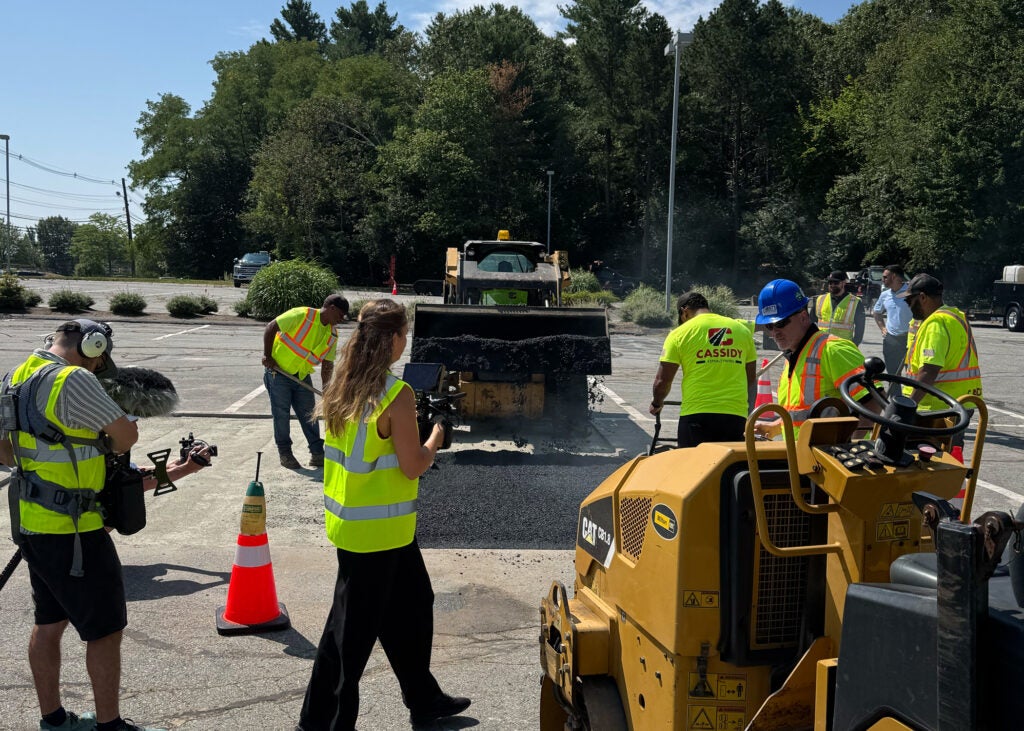
Uberbinder completed a pilot project at a Waltham, Mass. parking lot last year and is currently undertaking field trials on a load-bearing road service. The company is working with a well-known advanced materials company on scaling its modular system.