Aliplast S.p.A. (Ospedaletto di Istrana, Italy) inaugurated its rigid plastics recycling plant in Modena, Italy, on Oct. 22. The official opening of R3GID (Recover Recycle Regenerate Plastic) was attended by Gilberto Pichetto Fratin, Italy’s Minister of the Environment and Energy Security.
It is one of the first facilities in Europe equipped to meet the growing demand for recycled plastics expected in the short to medium term under new EU regulations, including the Packaging and Packaging Waste Regulation (PPWR) and the End-of-Life Vehicles (ELV) Regulation.
Construction of Aliplast’s recycling plant began in 2024. Already operational for several months, the facility will employ 80 people at full capacity. It is among the most innovative plants in its sector in Europe and can process up to 30,000 tons of high-quality recycled polymers annually, with properties comparable to virgin materials derived from fossil feedstocks and a certified purity level of over 99%.
With an investment totaling €48.8 million, including €7.7 million in direct funding from Italy’s National Recovery and Resilience Plan (NRRP), Aliplast is providing Italian industry with a facility capable of recycling rigid plastic waste from both municipal and industrial sources. This includes sectors such as automotive, cosmetics, home and personal care, consumer electronics and furniture, which generate materials that are generally not recyclable and would therefore be sent for energy recovery or to landfill. At the Modena plant, Aliplast instead regenerates this waste into high-quality, traceable and certified polymers produced in Italy. These can be reused by the same industries to manufacture a wide range of products, including plastic components for televisions, computers and household appliances, make-up containers, tanks and bumpers, and garden furniture.
“R3GID is a clear example of how Italy can anticipate the challenges posed by new European regulations, from the PPWR to the ELV Regulation, and turn them into opportunities for industrial growth,” said Gilberto Pichetto Fratin, Minister of the Environment and Energy Security. “This plant combines Italian technology, an entirely Italian supply chain and a certified, traceable product with quality comparable to virgin raw materials. Producing secondary raw materials locally means strengthening the country’s competitiveness, reducing dependence on foreign markets and making our supply chains more secure, even in the face of geopolitical tensions and price volatility. Facilities such as this benefit the country as a whole.”
“Europe faces a structural gap in recycling: capacity is stagnant or declining, while new regulations will increase demand for recycled plastics with quality equivalent to virgin polymers,” said Orazio Iacono, chief executive officer of Hera S.p.A. (Bologna, Italy). “The figures speak for themselves. Europe currently has plastics recycling capacity of 13.5 million tons, but only 3.5 million tons for rigid plastics, including approximately 440,000 tons. By 2040, an additional 5.7 million tons of recycled rigid plastics will be needed: a substantial gap. R3GID is our response as a first mover. It provides Italian manufacturers with high-quality, locally produced materials, reducing import costs and ensuring security of supply. There is also a benefit for the country: Italy pays the European Union around €800 million each year in plastic tax on non-recycled plastic packaging, while the Modena plant alone could generate savings of approximately €24 million if its entire output were used for packaging.”
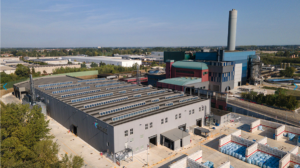
Source: Aliplast
Aliplast developed the plant using best available technologies. NEXTCHEM S.p.A. (Rome, Italy), a MAIRE S.p.A. (Rome, Italy) company, participated in the project as a technology partner, providing its proprietary NX Replast™ technology, an advanced solution for plastics upcycling. More broadly, the plant’s equipment and technologies enable the production of high-purity recycled polymers and compounds designed to replace virgin fossil-based materials in high-value-added applications. They also enable the development of tailor-made materials to meet specific functional, mechanical, aesthetic and regulatory requirements, expanding the potential uses of recycled plastics even in the most demanding market segments.
R3GID is located at Hera Group’s industrial hub on Via Cavazza in Modena, which already houses a waste-to-energy plant and a wastewater treatment plant. These existing facilities have enabled the creation of a circular system with Aliplast’s new plant: treated water supplies the rigid plastics recycling process before returning to the wastewater treatment plant, while electricity generated by the waste-to-energy plant powers the new business activities.
This reduces energy costs, which, even before the energy crisis, accounted for around 30% of production costs in Italy’s recycling sector, excluding raw materials. The plant also avoids approximately 30,000 tons of CO₂ equivalent emissions compared with production from virgin plastics, on a like-for-like production cycle basis.
The Modena plant, the expansion of the facility in Borgolavezzaro