Ansaldo Green Tech S.p.A. (Genoa, Italy) has completed its new high-volume production line for AEM (anion exchange membrane) electrolyzer stacks at its Genoa facility. With a production capacity exceeding 300 MW per year, the plant marks a significant step in the industrialization of Ansaldo Green Tech’s electrolyzer technology, reinforcing Ansaldo Energia Group’s S.p.A. industrial footprint in emerging energy technologies and supporting the growth of Europe’s hydrogen value chain.
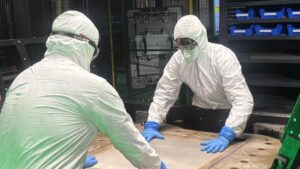
Source: Ansaldo Green Tech
The production line has been developed as part of the “Turnkey Electrochemical Plants for H2 Production” project, supported under Italy’s National Recovery and Resilience Plan (PNRR) and the European IPCEI Hydrogen program. The broader initiative benefits from more than $300 million in public funding supporting the development and industrial production of AEM electrolyzers. The project is also generating significant employment opportunities for Ansaldo Energia Group.
Ansaldo Green Tech’s proprietary AEM electrolyzers are designed to operate efficiently alongside renewable energy sources, dynamically adapting to fluctuations in power generation while delivering pressurized hydrogen. Based on a modular architecture, the portfolio ranges from a 1-MW containerized solution producing about 500 kg of hydrogen per day to multi-MW systems, based on an open design solution, capable of delivering green hydrogen for large-scale industrial applications.
“The completion of our high-volume manufacturing line demonstrates our commitment to translate innovation into industrial capability,” said Vittorio Olcese, CEO of Ansaldo Green Tech. “This achievement provides the foundation for scaling up electrolyzer production developed in Italy and strengthens our contribution to the growth of a competitive European hydrogen industry.”
Commissioning and optimization activities will continue over the coming months ahead of the start of industrial production.