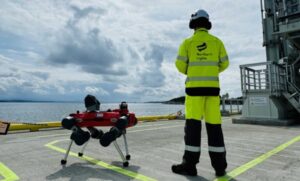
A robot named Roberta is now an integral part of operations at the Equinor-operated Northern Lights Carbon Capture and Storage (CCS) facility in Øygarden, on Norway’s west coast. The robot equips Equinor’s team with autonomous inspection capabilities, allowing for continuous monitoring of CO2 concentration levels and a significant reduction in unnecessary personnel callouts to this not-normally manned facility.
The Challenge: Remote monitoring and cost efficiency
Despite the facility being unmanned, inspections must uphold the same rigorous standards as those at continuously staffed sites. However, without a constant human presence, conducting ad-hoc inspections presented a substantial operational hurdle for Equinor. A solution was needed to enhance operational efficiency and safety by providing:
- Frequent, remote and repetitive inspections within the unmanned facility.
- Enhanced safety for employees through continuous monitoring of CO2
- Reduced on-site visits, directly improving operational efficiency.
The Solution: Deploying a robot for autonomous inspections
In November of 2024, Equinor initiated the deployment of “Roberta,” a four-legged robot from ANYbotics (Zurich, Switzerland), at the new Northern Lights receiving terminal.
Equinor chose the autonomous ANYmal D robot model following stringent testing at its K-Lab full-scale oil and gas test facility. Although the Northern Lights facility has only recently commenced operations, Roberta has been active for nearly a year. Her training involved cloud-based assignments, enabling her to identify equipment errors and even learn from simulated malfunctions, given the rarity of real incidents.
Equinor utilizes Roberta for tasks deemed dull, dirty, distant or dangerous. Her primary responsibilities at the facility include monitoring CO2 levels and performing frequent, on-demand inspections, thereby minimizing personnel travel to and from the site.
Arnt Erik Stene, senior software engineer at Equinor, highlights Roberta’s utility: “Being able to measure in more locations, more often than you would do before, autonomously, without having to send someone out to do that, makes Roberta very useful.” He elaborated on her efficiency: “For example, on any given day, Roberta completes around 180 inspections. That’s 180 different photos or point measurements which are exactly in the position you expect them to be. To send someone out with the correct equipment to the exact, correct location, to get the exact photo with the exact angle you were looking for 180 times in one day, and then to do it again on a daily basis, is a complex operation.”
Roberta’s benefits
By integrating autonomous robots, Equinor observes reduced operational costs associated with routine and ad-hoc inspections, increased intervals for manual inspections, and improved asset integrity through enhanced monitoring and preventive maintenance.
Equinor also intends to expand Roberta’s responsibilities in the near future, assigning her more complex tasks, such as capturing images of oil level indicators that lack full instrumentation.
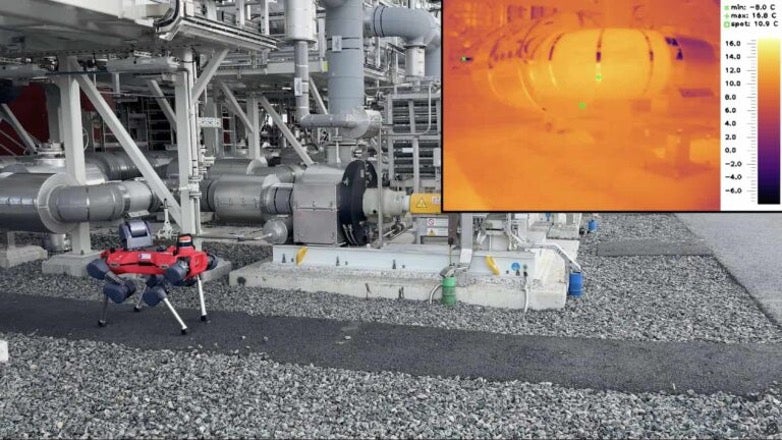
Stene confirms Roberta’s mobility: “Northern Lights is a relatively simple facility, and the robot can basically go anywhere. It can traverse stairs, and we find that using legs makes the robot quite agile and nimble. It can reach places you perhaps couldn’t with robots that are propelled using tracks, although I would say both options, legs or tracks, are valid and reliable.”
Source: Anybotics
How Roberta works
Roberta navigates the complex industrial facility using Pharos, ANYbotics’ 3D software for simultaneous localization and mapping (SLAM). This system achieves centimeter-accurate mapping through a sensor fusion of lidar and depth cameras. Area-wide mapping is possible with a range of 4 km in a single pass, and continuous operation requires no navigation markers, QR codes or GPS.
Edge computing facilitates intelligent inspection, delivering the highest data quality and instantaneous interpretation with precise contextualization of inspection time, location and viewpoint data.
Roberta autonomously gathers health and anomaly data, encrypts it, and transfers it via the ANYmal API to Equinor’s Flotilla open-source fleet-management software. Furthermore, Roberta has been integrated into Equinor’s internal digital twin, which provides facility context and supports high-level mission planning for the robot.
To meet stringent cybersecurity requirements, ANYbotics’ software resides within Equinor’s cloud tenant. This arrangement ensures secure communication and operation of the entire system within the IT domain, allowing operators to safely control and observe the robot from their mobile devices.
Key Applications: CO2 concentration, perimeter survey and frequent inspections
At the Northern Lights facility, Roberta’s most prominent applications include the following:
- Monitoring CO₂ concentration in the air and proactively alerting operations in the event of dangerous levels
- Surveying the perimeter of the harbor, which eliminates the need for personnel to travel to and from the unmanned facility
- Performing frequent and ad-hoc inspections without requiring human travel
However, ANYmal’s deployment at Northern Lights remains an evolving project, and Roberta’s capabilities are continually expanding. While the primary objective is to ensure the robot can reliably operate autonomously, analyzing data and reporting unusual activity to the operations team, Equinor’s team consistently identifies new ways to enhance Roberta’s value. Examples include monitoring high-pressure pump testing, further improving safety by keeping human operators out of high-risk areas.
Scaling robotics in oil-and-gas operations
For a major energy company like Equinor, the broad deployment of robots hinges on the technology’s ability to operate safely in hazardous, hydrocarbon-producing environments. While Equinor leads in CCS through Northern Lights, a majority of its assets are offshore oil and gas installations.
Equinor is actively testing robots like Roberta at these offshore locations. However, before the company can scale and widely adopt this technology, it requires certified robots and charging stations that can safely function in explosive atmospheres. A critical enabler for widespread adoption is the continued development of ATEX-certified robots, as most of Equinor’s facilities are hydrocarbon-based.
ANYbotics is directly addressing this challenge with its prototype, the ANYmal X. This robot has already demonstrated its capabilities in several deployments and holds certification for use in hazardous environments (ATEX/IECEx Zone 1 IIB). ANYbotics plans a formal launch of the ANYmal X in 2026. ♦
Edited by Mary Page Bailey
Author
 Alessandro Norscia is ANYbotics’ chief product officer. He has a 20+ year track record at the forefront of autonomy. His deep product leadership expertise and strategic vision are instrumental as ANYbotics continue delivering transformative value through cutting-edge robotics and intelligent automation. Norscia previously held senior roles with May Mobility, Intel Corp. and Qualcomm. He combines customer centricity with deep technical expertise and sharp strategic vision, and is focused on building impactful products that bring real value to our customers.