Physical scalability in fermentation was established decades ago. The decisions that determine whether a bioprocess for making a specialty chemical becomes a profitable one are made earlier, and they focus on deployment execution and commercial position of the product
Ask a room of process engineers whether fermentation can compete with petrochemical routes for specialty chemicals, and a familiar skepticism surfaces. The skepticism boils down to a recurring question: can the process scale? The question combines two separate engineering problems, and answering them together can produce confusion in both directions.
The first problem concerns whether biological production can reach industrial volume. That question was resolved decades ago. The second problem concerns whether a specific molecule, produced by fermentation, can hold a market and support the capital required to manufacture it. Put another way, the question is: Does it scale economically? That question remains open, and understanding the distinction between the two is often the difference between dismissing a biomanufacturing process and deploying it well. This area is often where development programs fail.
The distinction matters because the two problems carry different failure modes and different remedies. Recent failures among well-funded biomanufacturing companies are frequently cited as evidence that fermentation does not scale. In most of those cases, the plants operated as designed. What failed was the commercial position of the product.
This article treats the two problems separately and concentrates on the second, where engineering effort currently produces the most return, framed as performance per dollar, which is often tied to molecular or process novelty.
Fermentation scalability is settled
The premise that fermentation cannot reach industrial volume collapses on contact with the existing chemical supply chain (Figure 1). Fermentation currently produces several of the largest-volume fine and specialty chemicals available. Monosodium glutamate production exceeds 3.5 million metric tons per year worldwide. It is produced via aerobic fermentation of Corynebacterium glutamicum on sugar substrates, with glutamic acid accumulating in the broth at concentrations near 150 g/L. The process has operated at industrial scale since the 1950s [1, 2]. Feed amino acids represent a domestic megaton business, with a single complex in Decatur, Ill. configured for approximately 340,000 metric tons per year (m.t./yr) of lysine or threonine [3]. The leading lactic acid producer operates plants on four continents and commissioned a facility rated near 125,000 m.t./yr in 2024 [4] (Figure 2).
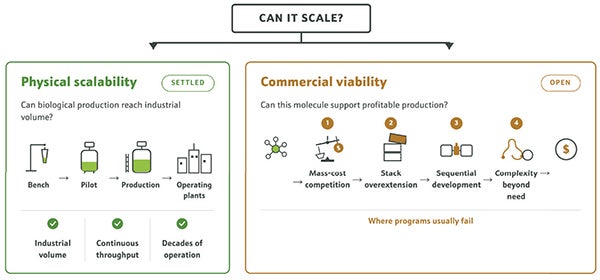
FIGURE 1. The question “can it scale?” requires separating physical scalability from commercial viability. There are distinct failure modes associated with each component
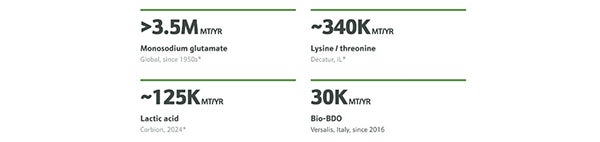
FIGURE 2. Continued production, across unrelated molecules and geographies, is evidence that the physical-scale question for fermentation processes is closed
Chemical intermediates follow a similar pattern, which matters for readers who work with them rather than with food and feed products. Genomatica developed and licensed fermentation routes to chemicals conventionally derived from fossil feedstocks, including 1,4-butanediol (BDO) and nylon precursors. Novamont (a wholly owned subsidiary of Versalis) has operated a 30,000-metric-ton-per-year bio-BDO plant at Bottrighe di Adria, Italy using that technology since 2016, and Qore produces bio-based BDO from sugar at its Iowa facility [5, 6]. Genomatica was acquired by Again (www.again.bio), a carbon dioxide-to-chemicals company, in August 2026 [6].
This pattern holds in specialty chemicals as well. The authors’ company has produced glycolipid at a centralized facility in Solon, Ohio since 2023. Demand for glycolipid has grown several-fold and the plant has absorbed that growth without a capacity redesign.
There are many examples of successful fermentation-based products across the broader chemicals and ingredients landscape that are manufactured and sold at commodity scale. More importantly, these bioprocesses have cleared the economic threshold at that scale. Continued production is itself the evidence.
Where programs fail
When bioprocesses fail, it is easy to conflate reasons for that failure at the surface level. Several prominent synthetic biology and biomanufacturing companies have indeed failed over the past few years. However, the postmortems of those failures are more instructive than the media coverage was. In many cases, the fermentation operated at scale, producing on-specification molecules, in some instances across multiple contract manufacturers or following substantial process development investment [7]. However, in these cases, the failures occurred elsewhere. When failures occur, four recurring patterns often emerge to the extent that it justifies screening against them.
Competing on mass cost. Fermentation competing against optimized petrochemical routes in commodity applications faces a structural disadvantage: the buyer specifies the molecule rather than the production route. Several companies with functioning process technology have failed in fuels and bulk oils for this reason. While it may be obvious, considering the market, value drivers, where there is true differentiation on several axes (performance, novelty, regulatory) is still a best practice.
Overextension at the ends of the stack. Owning the technical stack, from strain development and molecular biology through fermentation scale-up and downstream processing, is normal and generally necessary. Exposure develops at the two ends. Extending beyond, or forward, into consumer-brand markets introduces commercial capabilities, capital requirements and timelines that differ from those of a specialty chemical manufacturer. Extending sideways across multiple microbiological systems introduces a separate strain library, process behavior and learning curve for each platform. Genomatica’s approach illustrated a common alternative, having retained the technical layer and transferred manufacturing and commercialization to partners with existing assets [6].
Sequential development. Upstream development is completed before downstream design begins. The separation train inherits whatever process media the fermenter produces, and the governing decisions are fixed by that point.
Complexity beyond specification. Elaborate strain engineering applied where a simpler organism or a simpler process would meet the same requirement is another failure mode. Put another way, why throw expensive molecular biology at a problem that can be solved more simply with fundamental microbiology?
None of these four failure patterns has to do with scale-up physics, but addressing them can avoid unnecessary loss of time, money or both.
Engineering decides outcome
Three sets of decisions determine whether a bioprocess reaches production in a condition worth operating.
Configuration, decided per unit operation. Batch operations are simple, flexible and traceable, which keeps them in service for many secondary metabolites and regulated products. Fed-batch operation (feeding substrate throughout the run to reach high cell density under control) is the industrial standard for most amino-acid and organic-acid production. Continuous operation delivers higher volumetric productivity in a smaller footprint and with more consistent output. However, it also introduces increased contamination exposure and a requirement for genetic stability over extended runs.
The common error is selecting one mode for the entire production train (Figure 3). Configuration is properly a unit-operation decision. Growth conditions and production conditions for a bioprocess rarely share an operating point, which is the standard basis for two-stage and cascade arrangements. Additionally, separation conditions rarely match fermentation conditions. Monoclonal antibody manufacture demonstrates the effect quantitatively. A hybrid of fed-batch upstream with continuous chromatography downstream proved more cost-effective than fully continuous operation, where perfusion consumed more medium than fed-batch operation at equivalent output [8].
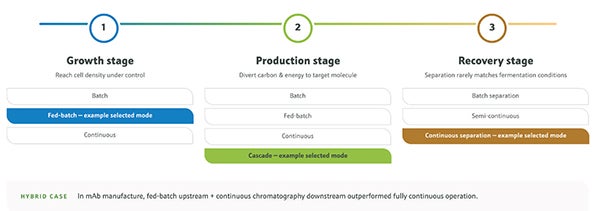
FIGURE 3. Growth, production and recovery rarely share an operating point. The common error is picking one mode for the whole train
What changes between the bench and the plant? The first question is which transport limitation governs, and the answer depends on the process. In aerobic fermentation, oxygen transfer usually binds first, because oxygen is sparingly soluble and demand is high. A volumetric mass-transfer coefficient easily satisfied in a 10-L vessel becomes a design constraint at 200,000 L, and dissolved-oxygen gradients develop across a vessel of that size (Figure 4). In anaerobic and microaerobic systems, including much organic-acid production, oxygen transfer does not govern. Heat removal, pH control and dissolved carbon dioxide accumulation are more important, and neutralizing agent addition produces local excursions that persist longer as mixing times extend. In gas fermentation, the mass-transfer limitation returns in a different form, because hydrogen and carbon monoxide are less soluble than oxygen and their delivery rate can set productivity.
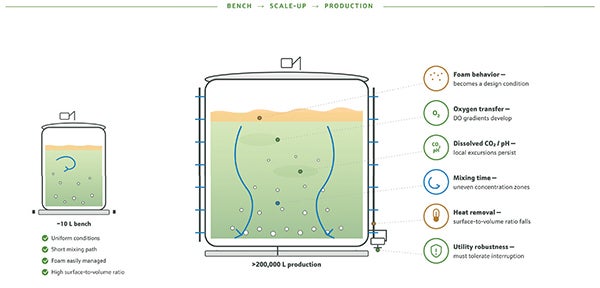
FIGURE 4. A condition easily satisfied at 10 L becomes a design constraint at 200,000 L. Reproducing these deliberately at pilot scale is more reliable than extrapolating from bench data
Other conditions change regardless of oxygen requirement. Mixing times lengthen, so cells cycle through zones of varying substrate and gas concentration rather than experiencing uniform conditions. Foam behavior changes with sparging rate or gas-evolution rate. Heat removal becomes more difficult as the surface-to-volume ratio falls. Hydrostatic head raises dissolved gas concentrations at the base of a tall vessel above those at the surface. A production process must also tolerate a utility interruption without loss of the batch, a condition bench work usually does not test.
Reproducing these conditions deliberately at pilot scale, including the upsets, is more reliable than assuming laboratory performance will translate.
Downstream, designed in parallel. Fermentation delivers a dilute aqueous broth. For many products, recovery and purification represent a major, but product-dependent, share of operating cost and installed capital [9]. While titers are typically a governing metric, a titer improvement that complicates separation can produce a net loss. Teams that complete strain development before transferring the broth to a separations group typically identify the problem after the process has become difficult to change. Placing a separations engineer in strain-selection review is the least expensive correction available.
Surface-active products example
Products that reduce interfacial tension generate foam, and aerobic fermentation supplies the gas and agitation for entrainment. Foam control is a design condition in these systems, rather than an operating exception, because surface activity, combined with aeration, produces foam continuously. The same phenomenon functions as both an operating constraint and a separation opportunity, since the foam phase is enriched in product. Three approaches are used to manage foam.
Suppression. Suppression of foam formation with chemical antifoams and mechanical breakers trades foam control against oxygen transfer, because antifoams alter interfacial behavior and bubble coalescence, and it can add downstream load.
Exploitation. This strategy converts the foam into a first separation stage, and the design question is where the column sits. Banat and colleagues developed a recirculating fractionation arrangement in which column feed rate and airflow rate are set independently of fermentation parameters, so aeration can be matched to biological oxygen demand while the column operates at its own optimum. In fed-batch fermentation producing the hydrophobin protein HFBII, uncontrolled overflow from the fermenter fell from 770 g to 44.8 g, and dry matter retained in the fermenter rose from 88% to 95% [10]. Later work applied external-column decoupling to rhamnolipid production with recombinant Pseudomonas putida, where space-time yield increased 31% on scale-up from 2 L to 9 L [11].
Avoidance. Foam can be avoided through two-phase fermentation with in-situ liquid-liquid extraction, which removes product into a second phase before foam develops.
Each approach is defensible on its merits. What does not work is treating the selection as either a fermentation decision or a separation decision, because it is both. Downstream separation has been reported to account for as much as 60% of total biosurfactant production cost [10], which places the configuration question and the recovery question in the same review.
• The engineering takeaway here is to identify which transport limitation governs the system in question, rather than assuming oxygen transfer, fix configuration per unit operation rather than per plant, characterize the large-scale physics at pilot scale rather than extrapolating from bench data, and treat upstream and downstream as a single design problem with two halves.
Selecting the product
Product selection determines outcomes more than process development does, and it typically receives less engineering scrutiny.
The default comparison between bioprocess and petrochemical routes is cost per kilogram. For a true drop-in, where the molecule is identical regardless of production route, that comparison is appropriate, and fermentation is exposed on it. Decades of petrochemical optimization are difficult to overcome on mass cost alone.
Drop-in production can succeed where a structural advantage exists beyond mass cost. Regional feedstock access, supply-chain security and customer requirements for bio-based content all function in this way. The commercial bio-BDO plants noted earlier operate on that basis. However, absent such an advantage, the comparison favors the incumbent route.
Specialty markets apply different criteria. A surfactant, a chiral intermediate, or a functional additive earns specification by function: the concentration required, the ingredients it displaces, the performance it enables and the costs it avoids in energy, capital, waste handling and regulatory exposure. The operative benchmark in specialty chemistry is performance per dollar delivered, or value in use.
Often, it is molecular novelty, in some cases process-output novelty, that generates the performance premium that makes this comparison favorable. Fermentation and biocatalysis construct architectures that petrochemical routes reach only with difficulty or not at all, including defined stereocenters, complex glycolipids and selectively functionalized backbones. This capability represents a distinct and worthwhile branch of synthetic strategy.
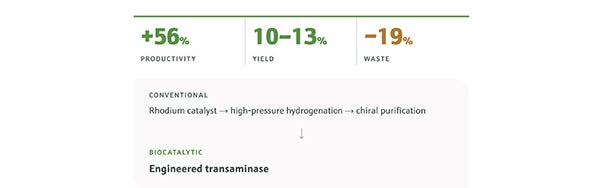
FIGURE 5. For sitagliptin synthesis, an engineered transaminase replaced a rhodium-catalyzed asymmetric hydrogenation. The comparison was never enzyme cost per kg versus rhodium cost per kg
Sitagliptin manufacture provides a clear published illustration (Figure 5). An engineered transaminase replaced a rhodium-catalyzed high-pressure asymmetric hydrogenation, eliminating the metal catalyst, the high-pressure equipment, and a chiral purification step. Productivity improved by approximately 56%, yield increased 10 to 13%, and waste declined by approximately 19%. The route also accessed chiral amine chemistry previously available only through resolution [12, 13]. The evaluation did not compare enzyme cost per kilogram against rhodium cost per kilogram. The bioprocess was selected on whole-process economics and on the chemistry that the alternative route could not deliver.
• The engineering takeaway here is to evaluate candidate molecules on price per unit performance (ROI) and on whether the structure is accessible by another route. A molecule that is only less expensive is a weak candidate. A molecule that performs better and resists substitution will support a higher production cost.
Self-funding gates
The binding constraint on development is rarely tank capacity. It is the queue ahead of the pilot plant, the analytical backlog in quality control (QC) and the availability of a small number of senior process engineers. Loading these resources with parallel programs produces the same condition observed on a production floor carrying excessive work in process. Cycle times extend across every program and with few reaching completion.
The authors have applied this concept at two scales within their organization, and have observed a third case elsewhere. At the program level, a glycolipid development effort was underway that a preliminary profitability analysis indicated would not clear in the short term. It was consuming approximately half of research and development (R&D) capacity and a quarter of QC capacity. The program was discontinued and those resources were redirected to reducing cost in a different glycolipid process already in production. The decision followed from arithmetic, rather than from a technical failure, and the analysis that produced it required an afternoon and could have been performed considerably earlier.
At the business-unit level, the company discontinued its consumer brands division in the first half of 2025 for the same reason. Consumer brand development requires capital, timelines and commercial capabilities that differ from those of a specialty chemical manufacturer, and the division was consuming resources that returned more value applied to the core business.
A third case, at a company one of the authors worked with previously, ran no fewer than twenty new-product initiatives while the business was losing money. The portfolio was reduced to two or three products with a near-term path to profitability and staffing was adjusted accordingly. The business became profitable three years after that reset.
The gate is not a completed process. Optimization proceeds against a specific commercial target and does not fully stop. The gate is self-funding: the product generates cash and no longer requires a disproportionate share of technical and quality capacity. Optimization continues past that point, but ceases to constrain everything else the organization intends to do.
The restriction applies to committed resources rather than to evaluation. Bounded assessment of a subsequent molecule is inexpensive and appropriate. Pilot time, QC capacity and dedicated headcount are what cannot be allocated until the first product supports itself.
• The engineering takeaway in this case is to count active programs against the constrained resource, rather than against total headcount. If no program has cleared a decision gate within a target timeframe, then the portfolio exceeds available capacity.
Structure as process design
A small biomanufacturer cannot staff like a large one. One engineer commonly owns the process from strain through separation, and frequently through the plant trial as well. Individuals carry multiple roles that a larger organization would assign separately.
This constraint produces an engineering advantage. The handoff failure described earlier (where upstream development precedes downstream design and the separation train inherits the consequences) is a structural product of groups holding separate objectives. When a single engineer owns the full train, a titer improvement that compromises filtration is identified by the person who proposed it.
The tradeoff is depth. Under the small-company structure, no individual is a specialist in every unit operation. The appropriate response is to acquire that expertise narrowly through consultants, equipment vendors and contract analytical services, rather than through permanent hiring.
• The engineering takeaway is to assign ownership by process train rather than by discipline. Broad ownership identifies coupling between unit operations that specialized groups routinely miss.
Questions worth asking
Fermentation reached industrial scale decades ago. Plants producing amino acids, organic acids, chemical intermediates, specialty ingredients, antibiotics and enzymes today operate on established process engineering, and the question of whether the technology scales has been settled. The open questions are more specific:
• Which molecule should be produced, evaluated on delivered performance rather than on cost per kg?
• Which configuration should be adopted, selected per unit operation?
• Which separation technique should be used, designed alongside the strain profile?
• How many programs can an organization support before its own queue stops advancing?
Addressed in that order, biomanufacturing functions as a working industrial strategy for specialty chemicals, and the operating record at scale supports it. If addressed out of order, the strategy often reproduces the failures that keep the scalability argument in circulation.
Edited by Scott Jenkins
References
1. Market Growth Reports. Monosodium Glutamate (MSG) Market Size, Share & Forecast Report, 2035, marketgrowthreports.com.
2. ChemFYI. MSG Production: Industrial Fermentation of Monosodium Glutamate, chemfyi.com.
3. All About Feed. “ADM to expand lysine and threonine production,” allaboutfeed.net.
4. Corbion, Lactic Acid Solutions for a More Sustainable Future, (RMC25 abstract). renewable-materials.eu.
5. Chemical Engineering, “Again acquires Genomatica, targets biochemicals scale-up,” August 13, 2026.
6. Chemical & Engineering News, “Again acquires industrial biotech veteran Genomatica,” cen.acs.org, August 2026.
7. Hill, P. et al., Clean manufacturing powered by biology. NCBI PMC (PMC7695652).
8. BioPharm International, “Achieving Cost-Effective Bioprocesses,” biopharminternational.com.
9. Straathof, A. J. J., The Proportion of Downstream Costs in Fermentative Production Processes, Comprehensive Biotechnology, 2011, pp. 811–814.
10. Banat, I. M. et al., Cost Effective Technologies and Renewable Substrates for Biosurfactants’ Production, Frontiers in Microbiology, 2014, 5, 697. doi:10.3389/fmicb.2014.00697.
11. Blesken, C. C., Strümpfler, T., Tiso, T., and Blank, L. M., Uncoupling Foam Fractionation and Foam Adsorption for Enhanced Biosurfactant Synthesis and Recovery, Microorganisms, 2020, 8(12), 2029. doi:10.3390/microorganisms8122029.
12. U.S. Environmental Protecction Agency, “Presidential Green Chemistry Challenge: 2010 Greener Reaction Conditions Award” (sitagliptin), epa.gov/greenchemistry.
13. Savile, C. K., et al., Biocatalytic Asymmetric Synthesis of Chiral Amines from Ketones Applied to Sitagliptin Manufacture. Science, 2010.
Authors
 Matt Prissel is vice president of strategic sales and marketing at Locus Fermentation Solutions (Solon, Ohio; www.locusfs.com; Email: mprissel@locusfs.com). His work covers partnerships, commercial strategy and product positioning for fermentation-derived specialty chemicals. He has held commercial and product leadership roles across the chemical value chain, including at Xenon Arc, BluePallet and CAS, where he was a founding member of a life sciences digital services organization. He holds an M.S. in chemistry from Montana State University.
 Renan Stefanini Lopes is fermentation R&D manager at Locus FS (Email: rlopes@locusfs.com). His work covers fermentation process development and scale-up, from strain and media design through production, with emphasis on the coupling between upstream conditions and downstream recovery. He holds a Ph.D. in biological systems engineering from Washington State University and an M.S. in chemical and biological technologies from the University of Brasília. He was a Foundation for Food and Agriculture Research Fellow from 2020 to 2023.
 Bryan Hunt is vice president of operations at Locus FS (Email: bhunt@locusfs.com). He has more than three decades of experience in industrial fermentation operations across pharmaceutical, food and specialty chemical production. He previously served as site director at Corbion, leading algae and food fermentation operations in Peoria, Ill., and spent nearly 12 years at Archer Daniels Midland, first as fermentation superintendent and later as refinery superintendent. Earlier in his career, he was site director at Alpharma and provided start-up engineering for a renewable ethyl acetate production facility.