The guidance offered here provides a practical route from feedstock and operating regime to validation, energy use and process decisions
A pyrolysis model is useful only when it helps an engineer make a real decision. That decision may involve selecting an operating window, estimating the rate of conversion, comparing product routes, sizing a thermal system, judging whether more experiments are needed, or deciding whether a higher-fidelity model is worth the effort.
The common mistake is to start from the model already available. A team may have a first-order kinetic expression, a distributed activation energy modeling (DAEM) fit, a detailed reaction mechanism or a computational fluid dynamics (CFD) model, and then force the process question into that structure. A better sequence is the opposite: define the decision first, define the information needed for that decision, then choose the lowest model fidelity that can provide that information with adequate evidence (Figure 1).
This matters because pyrolysis is a coupled reaction-and-transport problem. Feedstock identity, thermal history, particle scale, vapor residence time and reactor operation can all change the result. More equations do not automatically produce a better engineering answer. This article provides guidance on how to answer processing questions using a model that will provide the necessary information for the least amount of effort and time.
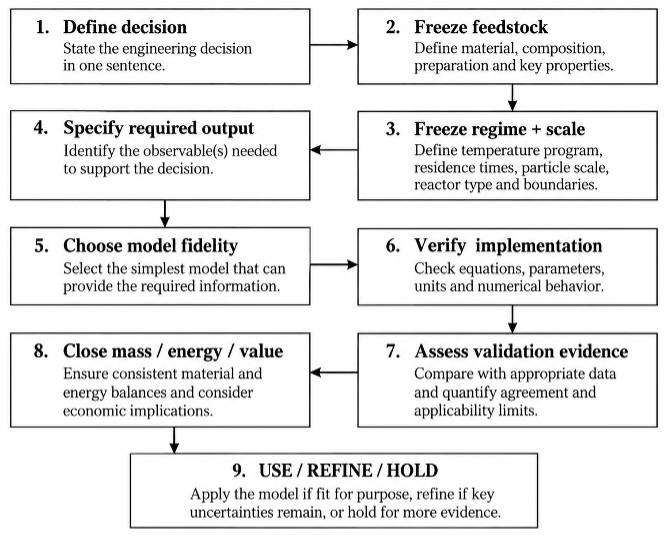
FIGURE 1. Shown here is a decision-backward workflow for selecting, qualifying and using a pyrolysis model. The workflow is generic; each model remains limited to its own feedstock, regime and evidence domain
1. Freeze the process question and boundary
Start by writing the decision in one sentence. Examples include to following questions: “What temperature range gives the required char yield?”; “Can this polymer grade reach the target conversion within the available residence time?”; or “Do we need product-species chemistry, or is total volatile release enough for reactor sizing?”
Next, define the process boundary. State whether the calculation concerns intrinsic kinetics, one particle, a laboratory reactor, a pilot unit or a plant section. This simple step prevents a frequent error: using a laboratory kinetic model as if it already contained particle heating, reactor mixing and plant energy integration.
The process boundary also determines what must close. At minimum, product yields should use a consistent feed basis and unresolved material should be explicit. When product quality or emissions matter, elemental fate can become as important as total mass. When economics matter, the thermal boundary must include drying, feed heating, reaction duty, recoverable heat and major losses.
2. Treat feedstock identity as model input, not a label
“Biomass,” “plastic” and “waste” are useful market labels, but they are weak kinetic definitions. Wood can vary in cellulose, hemicellulose, lignin, extractives, moisture and minerals, for example. Agricultural residues can carry much more ash and catalytically active inorganic matter. Manure, sludge and food waste add proteins, lipids, salts and strong batch-to-batch variation. Plastics differ by polymer backbone, molecular architecture, grade, additives and contamination.
Prepare a feedstock passport before calculating. Record the material and preparation history, wet or dry basis, moisture, relevant organic composition, ash or minerals, polymer identity or mixture fractions, particle form and any pretreatment that can change reactivity. The passport does not need to be elaborate. It needs to be detailed enough for the model being used.
This is especially important for fitted Arrhenius parameters. Global kinetic parameters are often effective descriptors of a selected material, conversion range and temperature program. They should not be treated as universal elementary constants and transferred silently to another feedstock.
3. Freeze the regime and physical scale
Pyrolysis is controlled by thermal history, not by one temperature value. Heating rate, final temperature, solid residence time, vapor residence time, atmosphere, pressure where relevant, particle size and heat-transfer conditions can all change the apparent response.
A thermogravimetric analysis (TGA) model may describe conversion under a known temperature program. It does not automatically describe a large particle with an internal temperature gradient. A detailed chemistry model may describe primary products at the local particle temperature, but it does not automatically predict what happens after vapors remain in a hot reactor long enough for cracking, reforming or condensation reactions.
Build a regime passport beside the feedstock passport. State the temperature program, heating-rate basis, gas environment, relevant residence times, particle scale and reactor conditions. If the plant case lies outside that passport, call the result extrapolation and decide whether new evidence is needed.
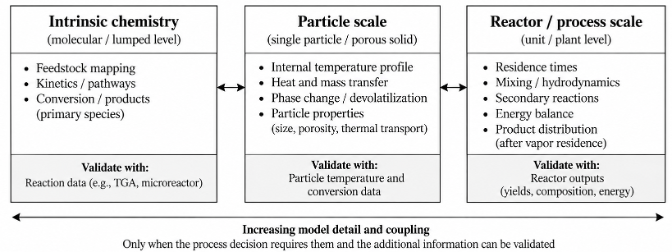
FIGURE 2. Intrinsic chemistry, particle transport and reactor/process behavior are different modeling layers and require different validation evidence
4. Choose the required observable before model fidelity
“Pyrolysis performance” is not sufficient to act an observable outcome. The engineer must name the quantity that drives the decision: total conversion, mass-loss rate, volatile-release rate, char yield, liquid yield, permanent gas, elemental fate, individual species, product-quality indicators, particle temperature or reactor output.
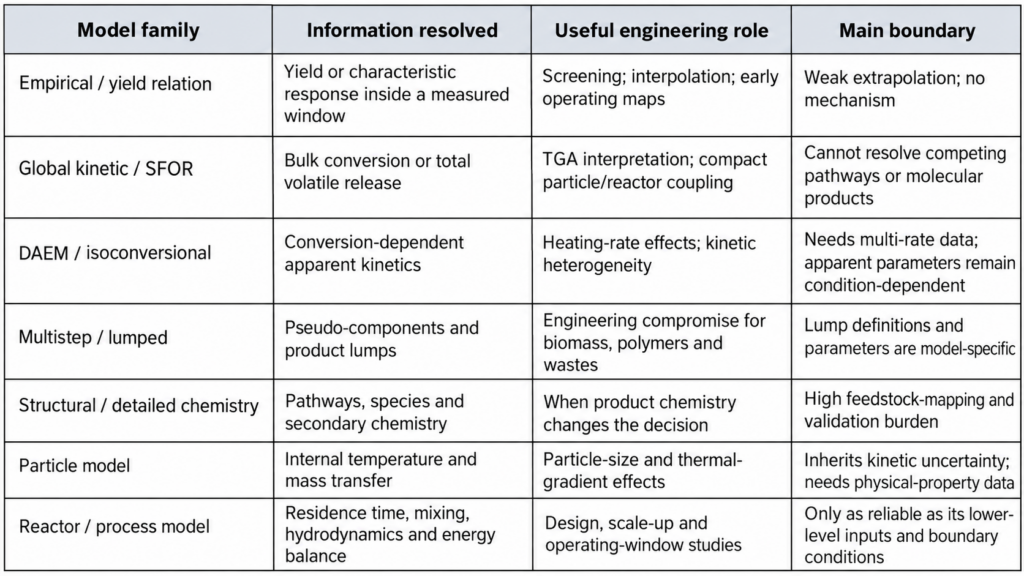
These approaches are not mutually exclusive. Kinetic models describe chemical conversion at different levels of detail, while particle and reactor models account for physical transport and operating conditions (Table 1). An engineering application may combine them, provided the coupling assumptions and supporting evidence are appropriate.
Table 1 is not a quality ranking. A simpler model can be the stronger engineering tool if it resolves the required quantity inside a validated domain. A more detailed model is justified only when the extra information can change the decision. For example, a bulk-conversion problem may need only compact kinetics. A liquids project may need product-class or molecular information because downstream separation and upgrading depend on composition. A large-particle scale-up problem may need heat and mass transfer even if the intrinsic chemistry remains simple.
Table 1. Different types of models resolve different information and have different limitations
5. Verify implementation before judging the physics
Before comparing a model with experiment, freeze its scientific identity: source, equation or reaction network, parameters and units, feedstock definition, operating conditions and numerical interpretation. Then check unit conversions, mass or element closure where applicable, solver behavior and deterministic reproducibility.
This order is important. A stable calculation can still be scientifically wrong because an equation was transcribed incorrectly, a parameter basis was changed, or a time-history convention was misunderstood. Implementation defects should be removed before a mismatch is blamed on chemistry or transport.
6. Validate the exact observable and state the evidence class
A fit is not the same as a validation. Reproducing data used to build a model is weaker evidence than a same-study holdout. A no-refit transfer to a different material, heating rate, reactor or dataset is more demanding. Cross-model literature comparison can be valuable, but it is not independent validation.
The evidence must also match the observable. Examples from the Pyrolysis Modeling Framework (https://github.com/saylamah/pyrolysis-modelling-framework), an open research and engineering development project, illustrate why validation must be linked to a specific output and application. The framework examines different pyrolysis modeling approaches across defined feedstocks, operating conditions and physical scales, while distinguishing implementation verification, model calibration, holdout testing and transfer assessment.
Three documented comparisons illustrate different levels of evidence. A biomass product-yield holdout produced a root-mean-square error (RMSE) of approximately 2.49 percentage points within its specified evaluation conditions. A separate no-refit transfer assessment involving high-density polyethylene (HDPE) produced a peak-temperature RMSE of approximately 15.74 K. In a published food-waste CFD study used as a reactor-level reference, the reported deviations were approximately −7.4% for hydrogen, −6.8% for bio-oil and +33% for biochar. This comparison provides partial, output-specific evidence rather than comprehensive reactor validation.
These values are not directly comparable measures of overall model quality. They refer to different materials, model applications, observables and evaluation conditions. Their practical lesson is that a model may provide adequate information for one engineering decision while remaining insufficient for another. The relevant question is therefore not whether a model has a low error in general, but whether its evidence supports the particular output, operating domain and decision for which it will be used (Table 3).
Mixed feeds need the same discipline. For biomass-plastic mixtures, establish an additive or other physically defined null baseline before introducing an interaction term. A residual from the null model is evidence of departure from additivity under those conditions; it is not automatically a chemical “synergy coefficient.”
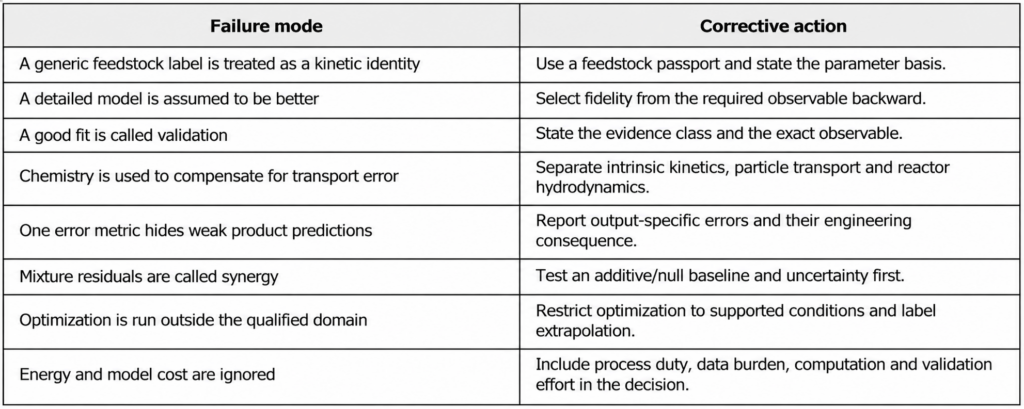
Table 2. There are several common mistakes when using pyrolysis models and ways to avoid them
7. Close the engineering balance before optimizing
Once a model is qualified for the required observable, connect it to the process balance. A useful minimum screen asks four questions: What mass enters and leaves? Where do key elements go? What external heat is required? Which product properties determine value or downstream cost?
For an initial engineering assessment, the external heat requirement can be organized into drying, sensible heating, reaction and phase-change duties, heat losses and recoverable process heat. This is a conceptual screening balance; the terms and system boundaries must be defined for the specific process before any quantitative calculation.
Moisture is a good example. Wet feed can raise drying and vapor-handling duty even if the dry-solid kinetics are unchanged. Higher temperature may increase conversion but also increase sensible heat demand and secondary cracking. Longer vapor residence may change product composition and downstream separation. A char-oriented process values carbon retention and solid quality differently from a liquids process. A plastics process may be limited by product upgrading or contaminants rather than by conversion alone.
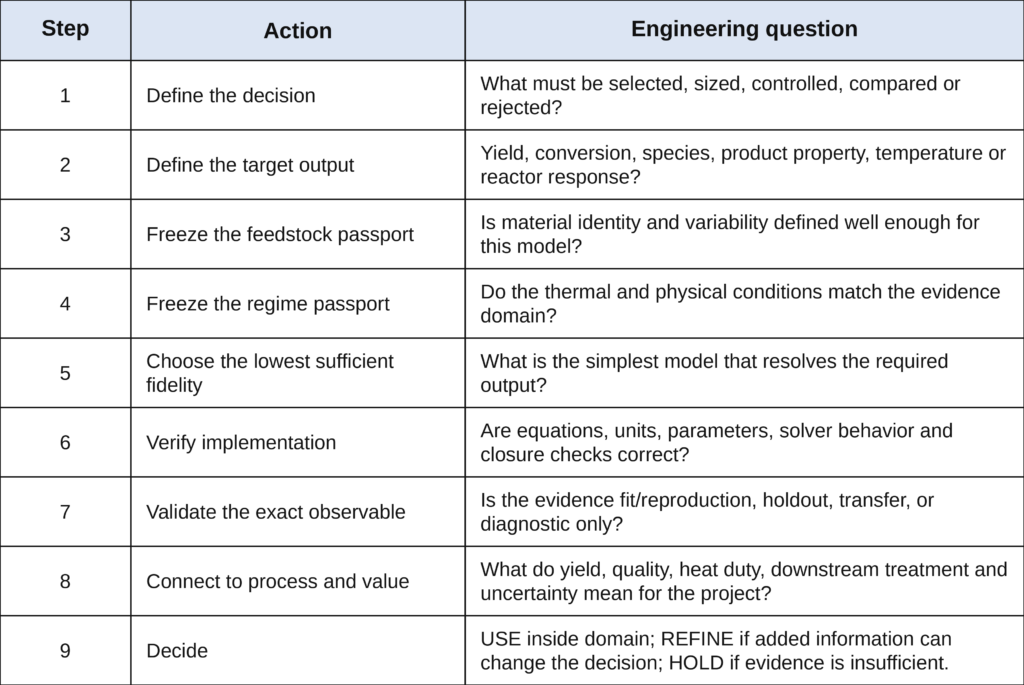
Model cost also belongs in the decision. Higher fidelity requires more feedstock characterization, parameters, computation and validation. That effort is justified when the added information reduces a real design, product or scale-up risk. It is not justified simply because a more complex model is available (Table 3).
Table 3. The “use-refine-hold” scheme can be useful when selecting models
The useful model is the one that supports the decision
Pyrolysis modeling now offers many levels of detail. The engineering challenge is not necessarily to use the highest level. It is to use the right level, with the right feedstock and operating definition, for the quantity that actually drives the process decision.
A strong workflow is selective: verify first, validate the required observable, couple physical scales only when needed, close the material and energy implications, and stop when the evidence is sufficient. When the process leaves the qualified domain, call it extrapolation and decide whether new validation is worth its cost.
Edited by Scott Jenkins
References
Pielsticker, S. et al. (2024). Comparative analysis of pyrolysis models including SFOR, CRECK, and Bio-CPD to predict reaction kinetics and products from extracted biomass components, Fuel 371(A), 131867.
Anca-Couce, A.; Zobel, N. (2012). Numerical analysis of a biomass pyrolysis particle model: solution method optimized for coupling to reactor models. Fuel 97, 80-88.
Fonseca, F.G. et al. (2019). Moisture content as a design and operational parameter for fast pyrolysis. Journal of Analytical and Applied Pyrolysis, 139, 73-86.
Gao, X. et al. (2021). Assessment of a detailed biomass pyrolysis kinetic scheme in multiscale simulations of a single-particle pyrolyzer and a pilot-scale entrained flow pyrolyzer. Chemical Engineering Journal 418, 129347.
Yasir, N.; Makkawi, Y.; Ahmed, B.; Masek, O. (2025). Food Waste Devolatilization Kinetics with Demonstration of Its Implementation in Computational Modeling of a Fluidized Bed Pyrolysis Reactor. BioEnergy Research 18, article 32. DOI: 10.1007/s12155-025-10835-x.
Saylam, A. (2026). Pyrolysis Modelling for Process Optimization across Feedstocks and Scales: Principles, Development, Quantitative Validation, and Open Python Tools. Zenodo DOI 10.5281/zenodo.22708031.
Pyrolysis Modelling Framework v0.2.0 (2026). Open software archive. Zenodo DOI 10.5281/zenodo.22707516.
Author
 Dr. Ahmad Saylam is a physical chemist and independent scientific and engineering consultant based in Duisburg, Germany. He has more than 35 years of international experience in research, industrial process development and technology assessment. His work includes chemical kinetics, combustion, thermochemical conversion, pyrolysis, process modelling, experimental validation and scale-up. Through SCIENTAVIA, he supports applied R&D, engineering assessment and technology development, with an emphasis on practical decisions grounded in scientific evidence.