Effectively dispersing powders into liquids can be a challenge. Utilizing vacuum in the correct ways can help with wetting and dispersion
When introducing powdered materials into liquids, the goal is always to achieve an air-free dispersion of solids in the liquid, where possible. Innovative powder-in-liquid dispersion technologies deliberately harness air’s expansive behavior under vacuum to wet and disperse each particle individually. Even agglomerates can be effectively broken down using vacuum force combined with intense shear forces simultaneously.
Air content in powders
Powder is essentially a dispersion of solid particles in air, and powders often contain a substantial amount of it. Air fills the spaces between individual solid particles, and porous or hollow powder particles contain air both between and within themselves. Depending on particle size, distribution and shape, powders can contain varying amounts of air. When powders are loosened, conveyed and fluidized, air content can increase further.
Compact powder flows poorly, or not at all. Particles touch one another in arrangements that enable the total volume to take up the least possible space. Irregularly shaped particles hook and wedge together in this way, while small particles fill the gaps between larger ones. When powder is mechanically fluidized, transferred, transported or dosed into vessels, moving particles space themselves further apart, enabling the loosened powder to take up a greater volume.
The air content in powders is not constant. When powder is delivered in palletized sacks, for example, the sacks at the bottom often contain more compacted and compressed powder due to transport stresses, so they contain less air than the sacks at the top. The situation is similar with powder in containers, bulk bags and silos – heavily compressed powder contains less air.
Mechanical movement, such as fluidization, transport or material transfer, loosens particle structures. The briefly agitated particles space themselves further apart, enabling the powder to take up greater bulk volumes.
Fluidization factor (fF). When powder is loosened by mechanical movement or fluidization, or during conveying or dosing, the particles move and require more space, causing the powder to immediately expand in volume, thus absorbing more air. The fluidization factor fF describes the ratio between loosened and compact powder volumes.
Most powders without flow enhancer have fluidization factors between 1.1 and 1.5. However, very fine powders with high specific surface areas fluidize much more dramatically. Pyrogenic silicas like Aerosil® reach fluidization factors of 1.6 to 2. Powders containing powdery free-flow agents to improve their flow behavior even achieve fluidization factors between 1.5 and 2.5. Only non-porous powders with relatively large, spherical, smooth particles and minimal fines approach a fluidization factor of 1.
Air content (VAir). The air content VAir in compact powder can be calculated from the parameters bulk density ρb and density ρ. Bulk density is derived from the powder’s mass and bulk volume, while density describes the solid density of the actual solid, excluding pores and inter-particle spaces — essentially solid density without the air content. Air mass is negligible here. The air volume VAir in compact powder thus follows Equation (1).
VAir, compact = (m/ρb) – (m/ρ) (1)
Loosened powder absorbs additional air. Sometimes it is even aerated by fluidizing air or inert gas. The air content in loosened powder is therefore greater, as shown in Equation (2).
VAir, loosened = m/ρb × fF – m/ρ (2)
The air volume per kilogram or ton of compact powder is the result of the reciprocal bulk density and actual solid density (Equation (3)).
VAir, compact / m = 1/ρb – 1/ρ (3)
For loosened powder, the powder volume increases according to the fluidization factor (Equation (4)).
VAir, loosened / m = 1/ρb × fF – 1/ρ (4)
If we use this formula to calculate the air content for a solid like titanium dioxide — a relatively heavy powder with a bulk density of approximately 1.1 kg/L and a solid density of approximately 4.2 kg/L, we find that despite the powder appearing very heavy and compact, each ton contains only 240 L of solid, but 670 L of air. When loosened by transfer or screw conveying, titanium dioxide’s air content reaches an astonishing 940 L, meaning that 85% of the powder volume is air, and only 15% is solid.
Even heavy spar (barium sulfate-containing powders) contain nearly 700 L of air per ton when loosened and free-flowing. Light powders have a much higher air content. Activated carbon contains approximately 4.5 L of air per kilogram. Pyrogenic silicas, like Aerosil, contain an astonishing 25 L of air per kilogram of powder. These are precisely the amounts of air that are undesirable in final products.
Table 1 shows fluidization factors for several powder types, as well as the solid and air volume fractions in both compact and loosened states.The data in this table clearly reveal that powder induction introduces air volumes that are often several times larger than solid volumes into liquids — even without counting air that is introduced as a result of transport or fluidizing. During powder wetting in liquid, the liquid must displace this entire air volume and fill the spaces in between the solid particles. All the air must ultimately escape the powder-liquid mixture.
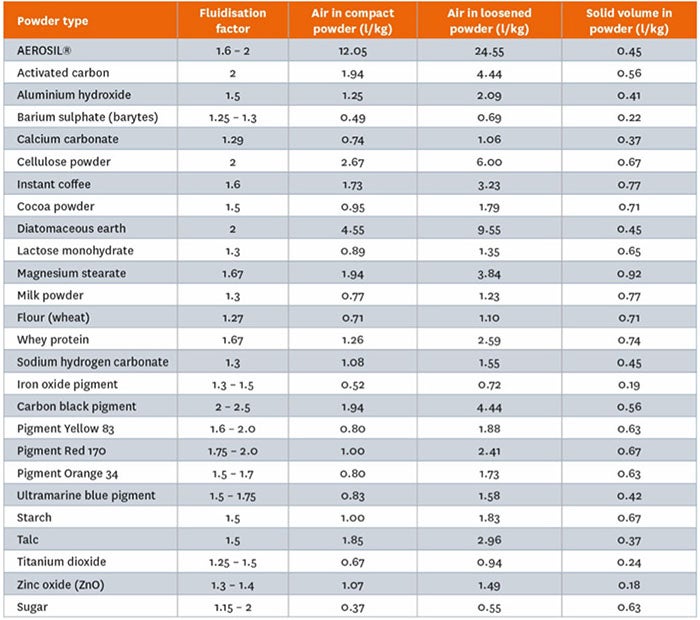
TABLE 1: Typical fluidization factors, and solid and air volume fractions, in powder. Source: ystral
This situation raises a question: Does powder always have to be loosened for induction into liquid? The answer is no. There is no need to loosen powder when using innovative technologies for powder dispersion in liquids. Powder can be drawn directly from bulk bags, containers, hoppers or silos and into the liquid. This may seem surprising at first glance, since compact powder does not flow.
Vacuum expansion
Air located within the inter-particle spaces of a powder can be exploited to aid in blending solids into liquids. Air expands under vacuum, increasing in volume. Vacuum expansion technology exploits this helpful property in two areas — during induction and during complete powder wetting.
The isothermal state change equation (Equation (5)) is a perfect illustration of how powerfully air expands under vacuum:
p1 × V1 = p2 × V2 (5)
Actually, the state change isn’t truly isothermal with this technology either — the air cools under vacuum — but this additional effect is irrelevant to this example.
A powder’s air volume changes inversely with absolute pressure. Increase the absolute pressure (that is, subject the powder to overpressure) and the air volume in the powder compresses, making the powder more compact and dense. Some powder pigments densify so severely under pressure that it is even impossible to penetrate them with a screwdriver. Overpressure is therefore counterproductive.
The opposite occurs under vacuum. During induction with dispersing machines using the vacuum-expansion principle, the air in the powder expands dramatically (Figure 1). At an induction vacuum of 50%, the air volume in the powder doubles. At 75% vacuum, it quadruples. At 90%, it increases tenfold. The maximum vacuum that can be achieved using this technology is limited by liquid vapor pressure at the operating temperature.
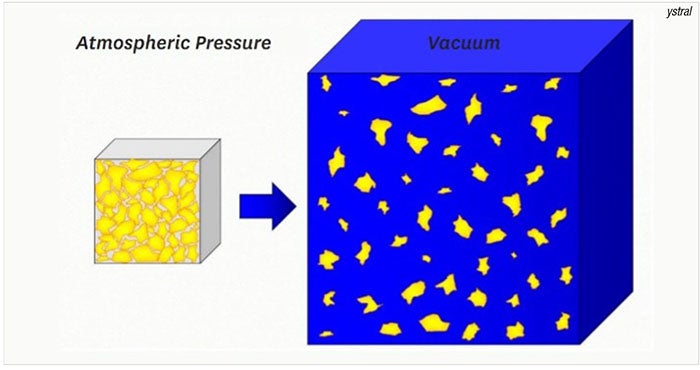
FIGURE 1. The vacuum expansion method utilizes the compressibility of the air under pressure and its expansion under vacuum to separate powder particles and break them up colloidally
For water at 25°C, this pressure is 3.17 kPa absolute. Under this level of vacuum, the air volume expands 30-fold. Distances between the powder particles increase enormously, enabling complete external wetting of every single particle within the dispersing zone where liquid and powder come into intense contact with each another under maximum turbulence and shear. Note that the described effect of distance increasing between the particles only occurs in rapidly flowing powder. Static or slow-moving powder exhibits no changes in particle spacing under vacuum.
Compact powder stored in a container remains compact at the bottom due to gravity, even under vacuum, although the air expanded by the vacuum escapes from it. Only when the powder is moved so quickly that it can no longer settle or sink down due to gravity does the principle of vacuum expansion take effect and the particles separate. The air contained in the powder simply cannot escape anywhere in the fast-flowing powder and multiplies its volume in the spaces between the moving particles.
Unlike pneumatic or mechanical conveying, vacuum expansion fluidizes powder without the need to add extra fluidizing air (Figure 2). This minimizes air intake into the dispersion, while the vacuum enables fluidization of even the most compact powders.
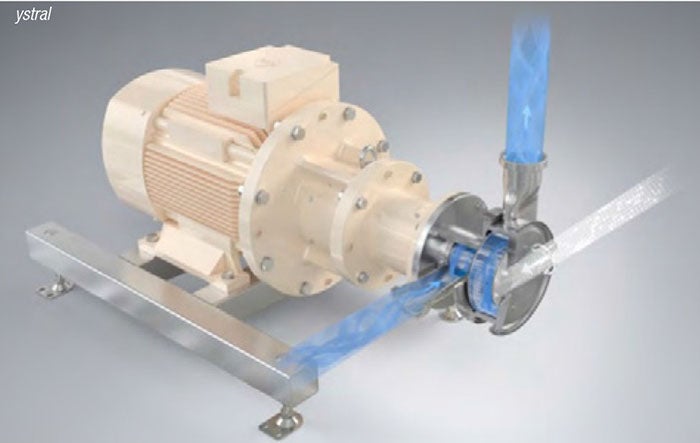
FIGURE 2. Dispersing machines like this one can use vacuum-expansion
Vacuum from inlet to shear zone
When inducting powder through suction hoses over a certain distance, normal atmospheric pressure prevails in the inlet area, where powder enters the suction line from normal bulk storage. The vacuum increases continuously along the suction line, peaking at the inlet to the dispersing zone.
Suction lines or hoses typically maintain a constant cross-section. As the air volume increases, the powder’s flow speed thus increases continuously up to the dispersing zone. For example, inducting 300 kg of compact titanium dioxide with a bulk density of 1,100 kg/m³ from a big bag in one minute under 90% vacuum through a hose measuring 50 mm in diameter increases the air volume tenfold between entry and exit. The compact powder’s mean flow speed increases from 2.3 m/s at the suction hose inlet to 17.6 m/s at the exit leading to the dispersing zone.
This air-expansion effect in a fluid stream inducted under vacuum can be observed when using sufficiently long and transparent suction hoses: the flow speed increases continuously from the suction point to the wetting machine.
During powder induction, the induction vacuum increases only until the powder is flowing at an adequately fast speed, then the vacuum stabilizes. A powder’s density and flow behavior vary. If the powder becomes somewhat more compact, the induction vacuum automatically increases. Dense powder immediately creates a higher induction vacuum; loose powder a lower vacuum. If the powder contains extremely poorly flowing agglomerates, the vacuum temporarily goes up to its maximum. When more easily flowing powder follows, the vacuum goes back down again. The result is that the induction effect remains constant regardless of whether the powder is loose or compact. The powder’s own flow properties regulate the induction vacuum. There is no need for operator adjustment.
Air coalescence into bubbles
The air contained in the powder immediately coalesces into large bubbles after passing through the dispersing zone. This harnesses centrifugal effects that separate media of different densities. The dispersion density is approximately 1,000 times higher than the air density. The centrifugal acceleration ranges between 1,100 and 2,800 g. Under this acceleration, air instantly separates from the dispersion and coalescences into large bubbles. It is important that no further dispersing occurs after this phase separation. If dispersion went on after the phase separation, it would create a microfoam, a phenomenon that happens with many other powder-wetting technologies.
When liquid with centrifugally separated air bubbles flows back into the vessel, air rises as large bubbles to the surface of the liquid. The dispersion de-aerates particularly efficiently due to the size of the bubbles.
Agglomerates
In most cases, powders are agglomerated. The finer the powder, the more it tends to agglomerate. There are many causes for this: physical and electrostatic forces (van der Waals forces, Coulomb forces, sintering bridges), not to mention numerous everyday production-related factors. Temperature increases above the glass transition temperature during transport cause particle fusion (caking). Cool storage can cause temperatures to drop below the dewpoint, creating condensation within the powder and thus causing liquid bridges to form between particles. Transport vibration can compact powders so severely that stable agglomerates form. Some powders are even agglomerated intentionally to reduce harmful dust.
Agglomerates always contain air between their primary particles. However, compact agglomerates do not simply disintegrate under vacuum. This requires localized concentrated shear stress during dispersion, plus minimum power for agglomerate breakdown.
The best possible dispersing results require immediate agglomerate breakdown during powder induction, while preventing formation of new agglomerates.
Vacuum with shearing
Agglomerate breakdown under vacuum with intense shearing at the same time occurs in four to eight steps (Figures 3 and 4)
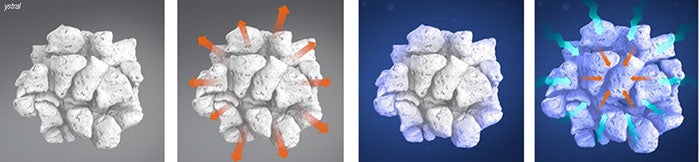
FIGURE 3. The series of diagrams shows agglomerate breakdown under vacuum and dispersion
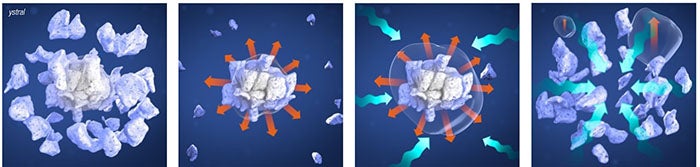
FIGURE 4. Shown here is the breakdown of particularly large agglomerates during the second passage
In the first step, the dry, solid agglomerates move with vacuum suction toward the dispersing zone. The vacuum increases to its maximum as the dispersing zone is reached. The higher the vacuum, the more severely the air expands both outside and inside the agglomerates. Nevertheless, stable agglomerates retain their shape without disintegrating, but internal air expands and largely escapes.
In the dispersing zone, contact with liquid occurs under maximum vacuum. Intense dispersing completely wets agglomerates from the outside. Air that had escaped previously through expansion now separates completely from agglomerates. Liquid can only penetrate agglomerates minimally through capillary action. The insides of agglomerates remain dry and filled with air. However, inter-particle spaces now contain highly expanded air.
Immediately after passing through the vacuum dispersing zone, the dispersion enters the machine’s outer centrifugal area under maximum overpressure. The abrupt transition from maximum vacuum to maximum overpressure within agglomerates causes the previously expanded air to not only contract, but also to compress to a much smaller volume under overpressure. The air volume inside the agglomerates (which previously expanded roughly 30-fold) contracts implosively to a fraction of its initial volume, while drawing all the surrounding liquid into the agglomerates at the same time. This effect causes agglomerates to disintegrate into primary particles. Intense shearing during this phase supports deagglomeration and agglomerate destruction.
Persistent agglomerates
In most cases, passing through vacuum-dispersing zones once is enough to achieve complete deagglomeration. But occasionally, agglomerates are large or persistent enough that passing through the vacuum dispersion zone a single time doesn’t completely disintegrate them (Figures 5 to 8). Residual agglomerates survive. In this case, dispersing continues with four additional steps.
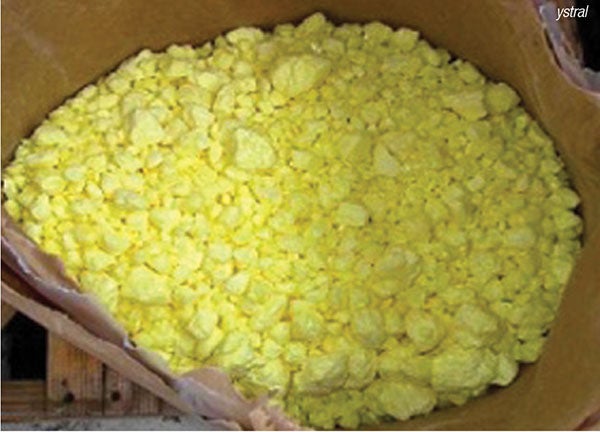
FIGURE 5. Ground sulfur contains very hard and stable agglomerates
The surviving residual agglomerates re-enter the vacuum-dispersing zones by means of circulation, now completely surrounded by liquid but containing unwetted zones with a small amount of residual air.
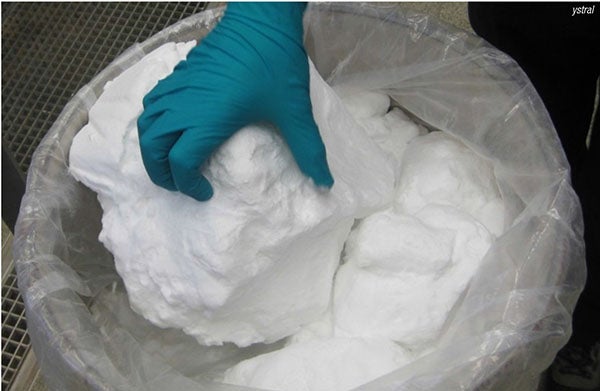
FIGURE 6. Agglomeration behavior is shown here for a vitamin powder
Under vacuum, this remaining air again expands several times over and escapes from the residual agglomerates. Intense shearing under vacuum again separates excess air and completely wets the outside of remaining agglomerates. Right afterward, the dispersion returns to maximum overpressure. Residual agglomerates also disintegrate implosively.
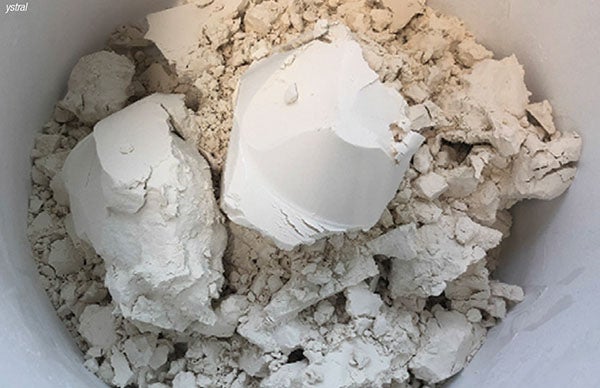
FIGURE 7. The photo shows oat flour with compact structures that can be inducted
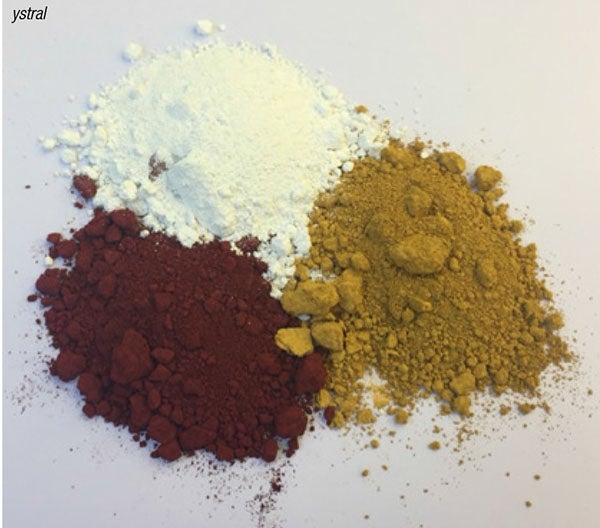
FIGURE 8. Finer powders have a greater tendency to agglomerate. Shown here are titanium dioxide, red iron oxide and yellow iron oxide
Delamination with expansion
Vacuum expansion does more than break down agglomerates. It also can delaminate layered silicates. Phyllosilicates like kaolin, talc, mica, bentonite, vermiculite, Bentone, hectorite, laponite and many others are made up of tightly packed layers of silicate. These layers are generally thin — often single molecular layers — held together by cations and water molecules. Phyllosilicates that are used as inorganic thickeners and rheological additives in particular must be completely delaminated to achieve maximum thixotropy and prevent subsequent thickening.
Conventional powder-induction methods are not able to achieve this. They generally rely on the corresponding powder’s swelling capacity. Swelling leads only to uncontrolled breakdown. In these cases, the particle size and viscosity could not be precisely controlled, giving rise to end products that showed unpredictable viscosity increases in retail packaging due to unstable rheological structure from uncontrolled phyllosilicate breakdown. Manufacturers of adhesives, wood stains, paints, deodorant and cleaning products have faced complaints as a result, and have often stored products for weeks before packaging to anticipate post-thickening in the retail packaging.
Vacuum-expansion technology is capable of completely delaminating phyllosilicates, with no post-thickening occurring in retail packaging. The products immediately achieve their maximum thixotropy (time-dependent shear-thinning). This technology enables these inorganic thickeners to reach previously unattainable viscosity values. This is due to truly complete dispersion of powdered phyllosilicates, allowing them to fully reach their rheological potential. In some cases, the thickener content could be reduced by 10 to 25%, and occasionally even 50%, while improving rheology at the same time.
Internal wetting
Vacuum-expansion technology completely fills even porous powders like silica gel, diatomaceous earth or zeolites with liquid internally. Conventional methods that rely solely on a powder’s capillary action cannot achieve this. Liquid could only penetrate minimally until the capillary pressure balanced with the internal air partial pressure. Moreover, the principle of competitive absorption worked with liquid mixtures — only liquids with the highest powder affinity entered the powder structures.
In contrast, innovative dispersing technology achieves complete internal wetting through internal structural vacuums. The liquid composition within highly porous powders is also controlled. Vacuum expansion can thus be used to specifically draw ions, catalysts, volatile components, organic molecules and more into particle interiors, enabling new product properties. Some applications draw in only water, which later evaporates in final products, leaving behind particle structures that are filled with air again. Wall paints use this effect as an opacifier, for example — an affordable alternative to expensive white pigments.
Economic benefits
Vacuum-expansion methods offer major economic benefits. Paint manufacturing costs can be cut by over 90%, for example, while resins dissolve in 1/50th of the time — always with improved product quality. In the food industry, proteins and thickeners are broken down more effectively. Despite reduced usage quantities, this improves the texture and intensifies flavor development. In the chemicals industry and in the manufacture of cleaning products, hydrolysis and saponification reactions can be achieved considerably faster and with reduced equipment complexity.
Edited by Scott Jenkins
Author
 Dr. Hans-Joachim Jacob is a senior expert in process and applications with ystral gmbh maschinenbau + processtechnik (Wettelbrunner Strasse 7, 79282 Ballrechten-Dottingen, Germany; Email: hans-joachim.jacob@ystral.de; Phone: +49 (0)7634 5603 30). Dr. Jacob is a specialist in mixing and dispersing technologies, with a focus on powders in liquids. He has experience with more than 10,000 different types of powders. Dr. Jacob holds an undergraduate degree and a Ph.D. from TU Dresden.