Proactive culture evaluation closes the gap between root causes and cultural factors to promote sustainable safety leadership while also preventing recurring accidents and chronic incidents
Incident investigations commonly show that human factors have led to process safety issues. Yet, despite the industry’s best efforts to address human behavior, situations often reoccur, with individuals failing to behave as expected.
Challenges lie in identifying leading indicators for process safety culture, and correcting these in the same manner the chemical industry does for leading indicators of process-safety management systems.
Taking a culture-centered approach enables organizations to improve performance through a better understanding of cultural issues that contribute to accidents and chronic issues. Using such a model, process safety teams can systematically analyze cultural issues from across the organization and from a variety of performance areas, including safety, reliability and quality. This investigation methodology goes beyond typical root cause analysis (RCA) methodologies by mapping process safety incidents to culture-based causes.
A closer look at safety culture
In major incidents where an external body, such as a third-party safety and risk management consultancy, performs the investigation, safety culture is given a closer look. Often, that is where the most significant underlying causes are identified.
Most incident investigations and RCAs from the past few decades have identified issues related to human behavior, and understanding of human factors and performance influencing factors (PIFs) has improved.
The U.K. Health and Safety Executive (U.K. HSE; www.hse.gov.uk) provides guidance on understanding human factors and how they affect workplace health and safety [1, 2, 3]. It breaks down human factors into the following three distinct areas that influence performance: the individual; the job; and the organization (Table 1).
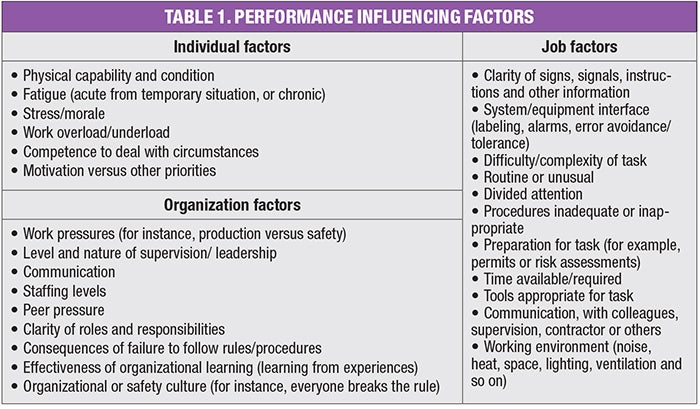
Following incidents, less mature organizations tend to focus on the individual in their investigations. More mature organizations also investigate issues associated with job factors. However, experience shows that only the most mature companies investigate deeply into the organizational factors to identify underlying cultural causes.
According to the U.K. HSE, “organizational factors have the greatest influence on individual and group behavior, yet they are often overlooked during the design of work and during investigation of accidents and incidents.”
Another publication from IChemE (www.icheme.org) [4] identified issues with the following process safety cultural areas across many of the major incidents included in its study. These views indicate that some organizations struggle to address issues in the organizational PIFs related to process safety culture:
- Supervision and leadership
- Production over safety
- Normalization of deviation
- Failure to learn
- Hazard and risk awareness
Assessing safety culture
There are several methodologies for improving organizational culture, and they generally involve a cyclic process continuously moving between the following steps:
- Assess culture against a model
- Implement cultural change plan
- Monitor safety performance
Cultural assessment is generally based on the output from questionnaire responses, management system reviews, workshops and focus groups. While these approaches are successful, there are a few potential issues to consider:
- Cultural surveys and workshops are generally a “snapshot” and only reflect opinions at that point in time
- Cultural assessments can be costly and disruptive to perform. Therefore, they are done infrequently and provide limited indication of progress until the next survey
- The output is often the “perception” of safety culture by the workforce, which is important, but it may not reflect the aspects of poor safety culture that results in poor safety performance
- Often there is little or no causal link between cultural improvement strategies and safety performance, making it difficult to prioritize on which cultural areas to focus
Process safety teams use these generalized approaches to proactively implement performance improvement initiatives. But due to their periodic nature, they can be limited in their ability to identify cultural issues in actual performance or develop process safety culture leading indicators.
Culture leading indicators
The American Petroleum Institute (API; www.api.org) Recommended Practice (RP) 754, Process Safety Performance Indicators for the Refining and Petrochemical Industries [5], defines leading and lagging process safety indicators that are useful for improving safety performance.
Figure 1 presents a simplified tiered pyramid displaying performance indicators. In the context of safety culture, major incidents in Tier 1 are investigated and cultural issues often identified — however, this is a reactive assessment.
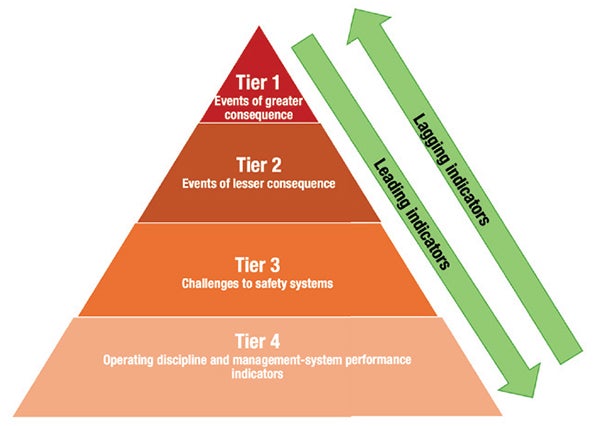
FIGURE 1. Based on the Process Safety Triangle presented in API RP 754, cultural issues identified in major (Tier 1) incidents include: problems related to supervision and leadership; prioritization of production over leadership; normalization of deviation; failure to learn; and gaps in hazard and risk awareness
So, how can organizations be proactive and identify the “soft” signals of poor or deteriorating safety culture? What are effective leading cultural indicators in Tiers 3 and 4?
Taking foundations from the Process Safety Culture Essential Features (PSCEF) listed in the CCPS Risk Based Process Safety Guidelines [6], a culture-centered process safety assessment framework should include the following considerations, to help improve safety performance through a better understanding of perceived and actualized safety culture:
- Establishing safety as a core value
- Providing strong leadership
- Establishing and enforcing high standards of performance
- Formalizing safety culture emphasis and approach
- Maintaining a sense of vulnerability
- Empowering people to successfully fulfill their safety responsibilities
- Deferring to expertise
- Ensuring open and effective communications
- Establishing a questioning and learning environment
- Fostering mutual trust
- Providing timely responses to safety issues and concerns
- Providing continuous monitoring of safety performance
Process safety survey
The following case studies outline the process safety culture assessment and approaches and how to develop process safety culture leading performance indicators. These real-world scenarios demonstrate:
- A proactive approach based on culture surveys and workshops
- A reactive approach investigating cultural issues in incidents
- A combined approach
Case Study 1 (Proactive approach). Multiple employees in various roles contributed to the results of the survey and workshop responses from nine companies shown in Figure 2. The goal was to identify weaknesses in the PSCEFs, which were ranked for each company; 1 being the PSCEF perceived by the companies to be their highest priority, and 12 being the PSCEF perceived to be their lowest priority.
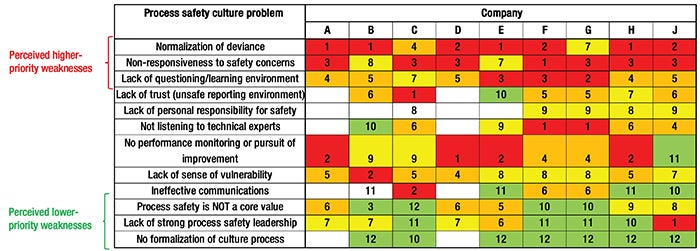
FIGURE 2. Results from a survey on process safety culture (based on PSCEF ranking) show that there is a disconnect between prioritization of weaknesses and emphasis on leadership
“Normalization of Deviation,” “Non-Responsiveness to Safety Concerns” and “Lack of a Questioning/Learning Environment” generally came out as the perceived cultural weaknesses. However, “Lack of Strong Leadership,” “Process Safety not a Core Value” and “No Formalization of Culture Process” were not identified as weaknesses. Intuitively, this should not be the case. Strong leadership that embeds and continually demonstrates that process safety is a core value should lead to a questioning organization, which responds quickly to safety issues and does not tolerate deviation from expected practices.
Results further revealed insight into where to focus cultural change efforts initially and where to develop process safety culture leading indicators to monitor progress. These insights stemmed from the number of observations, audit findings or incident findings that indicated deviation from expected practice, as well as close-out time for identified safety concerns and the number of process safety observations raised.
Case Study 2 (Reactive approach). Figure 2 indicated that organizations can be more aware of some weaknesses than others. Based on these practical observations, a hierarchical, culture-centered map can be developed, as shown at the PSCEF level in Figure 3. The PSCEF hierarchy chart represents how essential features are linked together. For example, if there is an issue embedding process safety as a core value (Level 4), this is likely to create sense of vulnerability issues in the organization (Level 3) and subsequent issues with normalization of deviation, or a lack of people questioning things they should feel uncomfortable about (Level 2). It’s also likely to create an organization that does not effectively monitor performance or respond to safety issues in a timely fashion (Level 1).
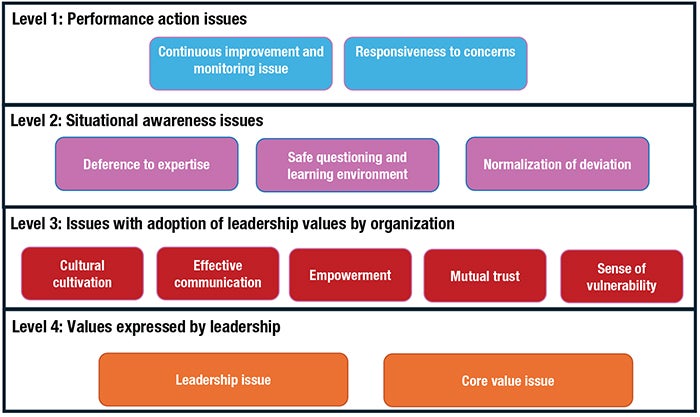
FIGURE 3. A cultural-cause hierarchy of safety issues can be developed based on PSCEF level
This culture-focused approach assists investigators in looking at actual process safety performance from safety observations, audit findings, incident reports, management of KPIs and so on. Each instance of poor safety performance can be initially mapped on the PSCEF hierarchy chart. This requires the investigator to consider which essential features were involved.
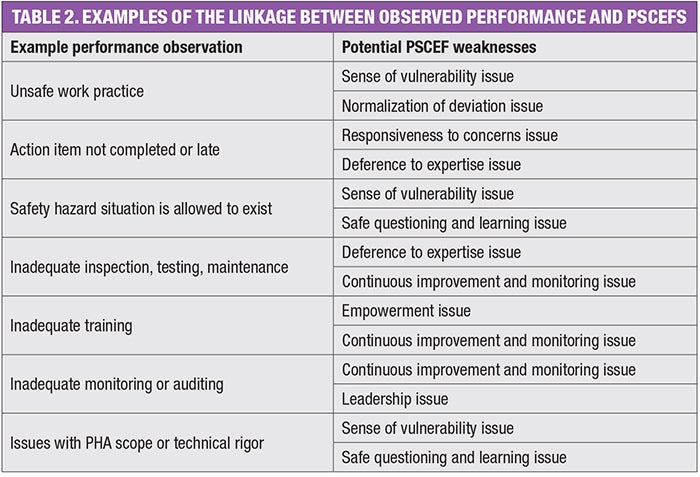
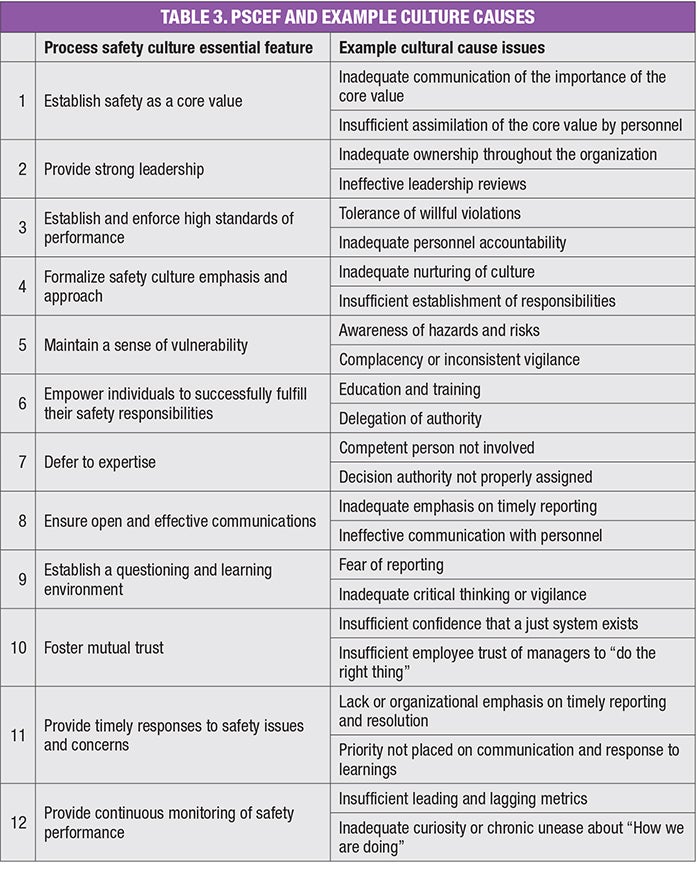
Table 2 provides some examples of how potential PSCEF weaknesses are linked to safety performance observations. To provide further guidance to investigators, each PSCEF is broken down into sub-issues, examples of which can be found in Table 3.
The hierarchy map in Figure 3 can be used in two ways — to ‘hot-spot’ PSCEFs on a simple tally basis (for instance, represented in a bar chart) and to identify pathways through the hierarchy, as shown in Figure 4.
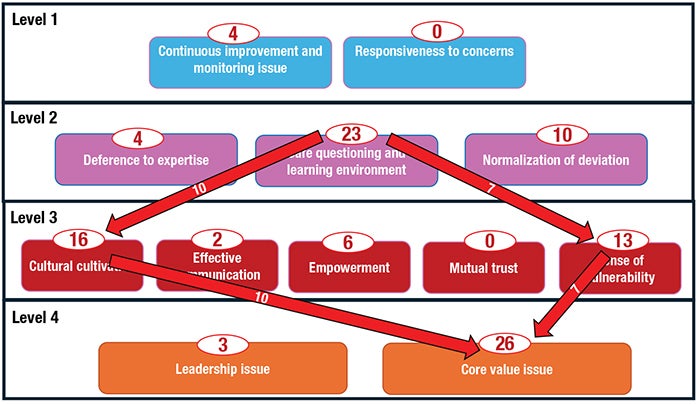
FIGURE 4. This example shows how audit findings and OFIs can be plotted as pathways on the PSCEF chart
PSCEF hot-spotting indicated that “Safe Questioning and Learning Environment” and, in particular, the subcategory “Inadequate critical thinking or vigilance” could be identified in most of the audit findings and opportunities for improvement (OFIs).
In Figure 4, two significant pathways were identified that indicated issues with creating and maintaining a sense of vulnerability and culture cultivation, which led back to issues with embedding process safety as a core value. Process safety teams can act on these routes and process safety cultural leading indicators based on the number of times the same PSCEFs and roots are identified in future audit findings, observations, incidents and so on.
Case Study 3 (Combined approach). The following case study relates to a culture-improvement program applied in a large downstream oil-and-gas company across three refineries. The study was conducted over a five-year period, with follow-up studies in the second and fifth years after the initial benchmarking study. The work involved two main several pillars: employee engagement and performance observations.
Employee engagement included employee surveys, interviews, small-group workshops and focus group workshops. In each iteration of the assessment, between 2,000 and 2,700 employees participated.
Performance observations involved site inspections, worker observations, focused employee interviews, reviews of management reports, process safety performance indicators, incident investigations, reported incidents and evaluations of unsafe behavior and conditions.
The overall cultural evaluation was based on a combination of employee engagement survey results and performance observation findings. Table 4 presents the initial and final findings that set the study’s benchmark. Each essential feature was classified as either “Strong,” “Weak” or “Moderate.”
Below are a few key points of the initial baseline study:
- The Employee Engagement survey and Performance Observations produced a similar result in eight of the 12 PSCEFs
- For four cases, the employee perception of the PSCEFs was different at the time of the survey to what was suggested by the performance observations
- These differences between employee engagement and performance observation findings support the view that there is often no causal link between the two
Based on the findings of the initial study, more than 100 recommendations were made as part of the cultural improvement program, which were grouped into recommendation categories, including “Better Housekeeping,” “Improved policies and procedures,” “More effective leading metrics,” “Rule enforcement” and several others.
Cultural differences among the facilities were apparent, and facility specific recommendations were tailored to each. Facility comparisons also provided an opportunity to share existing good practices.
As performance data are generated continuously, performance observation reviews using the culture-first approach provided a means to monitor improvement, or otherwise, as a check on the effectiveness of cultural change initiatives. PSCEFs identified in culture-first reviews were used as leading indicators.
Follow-up employee engagement surveys and performance observations were undertaken after two and five years. At each stage, the company reviewed recommendations depending on progress in each of the targeted essential features.
In the final cultural assessment in Table 4, the findings showed:
- An overall improvement in the employee-engagement survey results over the study period; eight measures improved and four stayed the same
- An overall improvement in the performance observations over the study period; seven improved and five remained the same. The changes overall were encouraging; however, a few of the essential features remained in the “Moderate” classification (having some room for improvement)
- Again, in four cases, the employee perception of the organization’s culture was different at the time of the survey from what was suggested by the performance observations
- By using the culture-focused approach and PSCEFs as leading indicators, the cultural improvement program was effectively self-sustainable over the five-year period
Corrective actions
Organizational PIFs are generally the most challenging to address when trying to improve behavioral safety, especially ones relating to safety culture. As a foundation, RCA gave organizations the ability to assess gaps in performance that they can control, such as gaps in policies and administrative controls. CCA, combined with RCA, provides the methods and tools for an organization to systematically assess, analyze, trend and influence the root and cultural issues driving performance issues.
A CCA approach to safety performance allows process safety leading indicators to be developed based on PSCEF improvement initiatives. This allows companies to continuously monitor performance and reprioritize their culture change initiatives, with driving process safety incidents down to zero as a number one priority. ■
Acknowledgement
Figures and tables provided by author
References
1. U.K. Health and Safety Executive, Reducing Error and Influencing Behavior, HSG48, 2nd Ed., HSE Books, 1999, pp 5–6.
2. U.K. Health and Safety Executive, Performance Influencing Factors, https://www.hse.gov.uk/humanfactors/assets/docs/pifs.pdf, Accessed February 18, 2025.
3. Hackitt, J., Speeches of Dame Judith Hackitt, Retrieved from http://www.hse.gov.uk/aboutus/speeches/transcripts/hackitt300615.htm.
4. IChemE, “Learning Lessons for Major Incidents. IChemE Lessons Learned Database.,” Rev. 11, E-book, 2022.
5. The American Petroleum Institute, Recommended Practice 754: Process Safety Performance Indicators for the Refining and Petrochemical Industries. 3rd Ed., 2021.
6. CCPS, “Guidelines for Risk Based Process Safety (RBPS),” Hoboken, N.J., John Wiley & Sons, 2007.
7. ABSG Consulting, “Cultural Cause Analysis,” proceedings of the 15th Global Conference on Process Safety, New Orleans, 2019.
Author
 Brad Eccles has over 25 years of experience in risk management across the oil, gas, chemical and utilities sectors. Throughout his career, he has supported a wide range of clients in understanding, managing, and reducing operational and process safety risks in complex, high-hazard environments. His work has spanned risk assessments, assurance activities and leadership engagement, with a focus on improving the robustness and reliability of risk controls. Eccles currently manages the ABS Consulting Process Safety consulting and audit teams, providing leadership, technical guidance and strategic direction. In this role, he oversees the delivery of process safety studies, independent audits and advisory services that help organizations benchmark their performance, meet regulatory requirements, and strengthen their internal risk management frameworks. He is particularly passionate about helping organizations understand how culture, behaviors and decision-making influence risk, and about translating technical findings into practical actions.