Initiatives to increase electrification and build digital infrastructure for artificial intelligence are among the trends increasing demand for copper (and other critical materials), prompting efforts to identify new sources of the metal. The startup company SiTration (Watertown, Mass.; www.sitration.com), a spinout from the Massachusetts Institute of Technology (MIT; Cambridge, Mass.; www.mit.edu), has developed a method for economically recovering copper and other metals from mining waste streams using electrochemistry.
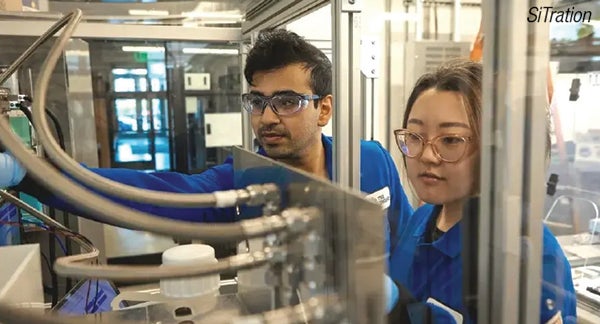
SiTration’s patented technology uses electricity to extract different metals from solution in complex streams and plate them onto electrodes, similar to electrowinning (EW). “Our technology is designed to directly recover high-purity copper and other critical minerals from relatively dilute waste and processing streams with low energy consumption,” says Brendan Smith, SiTration co-founder and CEO. “The technology represents an alternative to more resource-intensive mining by utilizing traditionally inaccessible or uneconomical sources, such as tailings water, acid mine drainage and raffinate.”
To accomplish this, SiTration focused on two areas of innovation. The company has developed proprietary surface-modified silicon-based electrodes that replace the stainless-steel cathodes and lead-based anodes in conventional electrowinning. “Chemical and physical modifications of the silicon electrode enable a unique combination of durability in harsh acidic conditions, along with extraction efficiency and selectivity,” Smith says.
A second area of innovation involves the design of the extraction cell where the copper ions are removed from solution. In conventional EW, electrodes are spaced relatively far apart and metals are extracted from stagnant electrolytes in tank houses. In contrast, SiTration deploys a flow-though process, where the copper electrolyte solution flows actively past the electrodes to maximize the reaction kinetics, Smith says. “We also minimize gaps between the electrodes, and the combination of these two elements allows very efficient extraction at concentrations of copper well below 1 g/L,” Smith explains.
Being able to extract metals efficiently without the input of chemicals or thermal energy at such concentrations unlocks copper sources, such as low-grade ore, tailings or waste leachate, that are not economically viable using traditional technologies.
SiTration recently completed a five-week field trial of the technology in South Australia. In collaboration with BHP Invent and Copper South Australia, the SiTration system was tested on local copper samples. The testing focused on extracting gold and copper from mining waste streams. SiTration successfully recovered 99.9% pure copper from residual waste liquids, as well as bullion-grade gold (99.99% purity) from gold-containing streams using a simplified process.
The company is scaling up its now validated technology, and is working with global mining leaders to deploy pilot systems.