Increased concern around per- and polyfluoroalkyl substances (PFAS) in water is necessitating more robust mitigation techniques. There are many technologies that can effectively capture or destroy PFAS, but challenges remain surrounding large volumes of PFAS-laden solid waste and fluorinated byproducts. An aqueous electrostatic concentration (AEC) process can selectively capture PFAS across an enclosed membrane module, creating a tiny fraction of the waste generated using granular activated carbon (GAC) for the same water throughput. Developed by BioLargo, Inc. (Westminster, Calif.; www.biolargo.com), the AEC process has been shown to remove not only long- and short-chain PFAS, but also ultra-short chains, with high efficiency, a feat that has proven elusive for other treatment methods.
Source: BioLargo
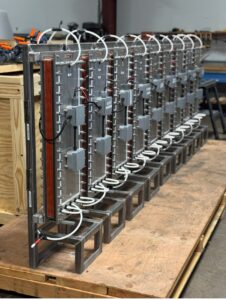
The AEC module includes an anodic chamber and a cathodic chamber separated by a proprietary membrane, across which an electrolytic field is created. “We differ from other technologies because our anode and cathode are non-sacrificial. They are only used to create the electrolytic field and do not contact the water, where they could start breaking PFAS and other contaminants down. In the module, the PFAS naturally migrate toward the anode, compelled by the electrolytic field, but the membrane blocks them. Once they hit the membrane, they ‘fuse’ to the membrane, and they can’t come off,” explains Tonya Chandler, president of BioLargo’s Equipment Solutions and Technologies division.
The bond between the PFAS and membrane is so strong that dissolving the membrane is the only way to remove it, which is what BioLargo does once an AEC module reaches the end of its useful life, typically after 1–3 years of continuous use. The spent modules are taken to a dedicated BioLargo facility where an energy-dense electro-oxidation destroys the PFAS, leaving behind only a small quantity of inert salts. This offsite destruction model also reduces user liability and costs associated with storage and transport of PFAS-containing waste.
“Since destruction of PFAS is a complicated process with many potential issues to manage, it is critical that operators monitor the byproducts that are potentially produced, the composition of the waste stream and volatile emissions to the atmosphere. The amount of waste that our AEC generates is so small, we believe that there’s no purpose in performing destruction on site, although we can accommodate the request as required,” notes Chandler.
BioLargo has utilized various laboratories through contracts and partnerships, including with the University of Tennessee and SGS S.A., to validate that its technologies can achieve non-detectable (below 1 ppt) levels of PFAS in a large range of waters, including leachate, foamate from fractionation units, groundwater, industrial wastewater and more. The company is currently installing its first commercial unit in New Jersey, which will provide treatment for potable drinking water at a scale of 30–50 gal/min. Scalable commercial designs for the modular AEC have been developed for over 10,000 gal/min capacity.