Decommissioning nuclear sites is a complex technical and environmental challenge. A recent project undertaken by Pacific Northwest National Laboratory (PNNL; Richland, Wash.; www.pnnl.gov) has demonstrated a method for immobilizing radioactive contaminants on surfaces. The approach would reduce the spread of contamination and mitigate the associated exposure risks during decommissioning activities.
Source: AAT
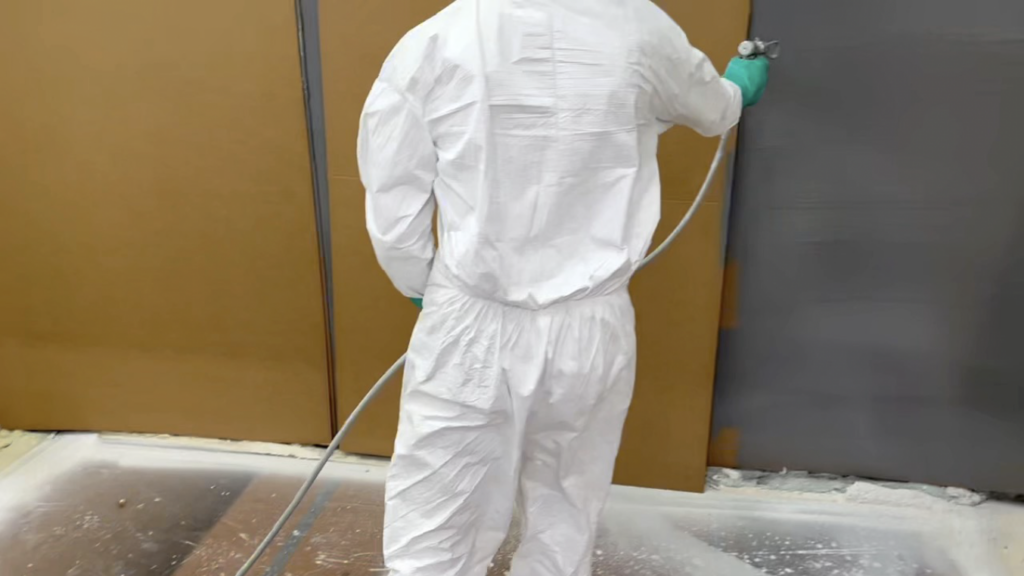
The approach involves a composite material, known as AF-1000, which is sprayed onto structural and other surfaces, where it cures quickly to physically sequester contaminants onto the surface. Depending on the additives and thickness, selected fillers can also provide radiation attenuation. “The AF-1000 material has some distinct advantages over other potential materials used for decommissioning applications, such as cement or glass, because it is lightweight, easy to apply with a commercial paint sprayer and the cure time can be adjusted depending on the particular site needs,” explains PNNL senior scientist Sarah Saslow, one of the lead investigators on the project.
AF-1000 is one formulation of a remarkable proprietary binder, known as AT2LAS, being developed by Advanced American Technologies (AAT; Huntsville, Ala.; www.atlasaat.com). AT2LAS is an epoxy resin that serves as a versatile matrix for a wide range of aggregates and additives, allowing customizable composite materials for different applications.
“AT2LAS holds impregnated metals, ceramics, silica, carbon fibers and other aggregates within a matrix that allows us to control their dispersion and orientation,” explains Rob Grigsby, a retired U.S. Army Colonel who is now president of AAT. “By selecting the metal particulates, additives and curing agents, we can build composites with unique properties and characteristics,” he says.
The AT2LAS resin can be used to create structural materials for aerospace components, ballistics shields, thermal management, anti-corrosion coatings and many others. The epoxy matrix performs over a wide temperature range, including cryogenic, where laboratory tests demonstrated increased impact and fracture resistance, Grigsby says.
In addition to application by spray, as in the decommissioning of radioactively contaminated surfaces example, AT2LAS-based composites can be cast into specific shapes via 3D molds, or ingots, and machined to desired specifications. AAT is also developing various formulations and curing methods for use in additive manufacturing devices.