Most modern chemical processes require some means of rejecting heat for maintaining process efficiency, product quality and plant safety. Examples of heat rejection include cooling crystallization liquid, cooling reactor effluent, condensing material from a distillation column and cooling steps in manufacturing processes.
Heat-transfer fluids, including water, can absorb heat from machinery or heated process material in circulating cooling systems in industrial facilities, but the water must be cooled before it can be recirculated through the system. Cooling towers provide a means to release this excess heat into the atmosphere, allowing the water to return to a suitable temperature for reuse in the process. This one-page reference reviews the basic operating principles and performance parameters for industrial cooling towers.
Evaporative cooling
Industrial cooling towers are special types of heat-transfer equipment designed to reject heat from water to air by direct contact. Water is usually chosen as the cooling medium because it is the least expensive and most widely available option. Cooling towers receive warm water from the process and return cooled water at a specific design temperature. The water’s temperature is lowered via evaporative cooling, where evaporating liquid carries heat away from the bulk liquid. Contact between warm water and cooler air releases the latent heat of vaporization, causing the water to cool. Ambient air carries the evaporated water out of the cooling tower.
The warm water is often sprayed to increase air-to-water contact and evaporation. The sprayed water contacts ambient air, evaporation occurs and and the humidity of the outgoing air increases (Figure 1). Maximizing the water-to-air weight ratio increases the evaporation of the water.
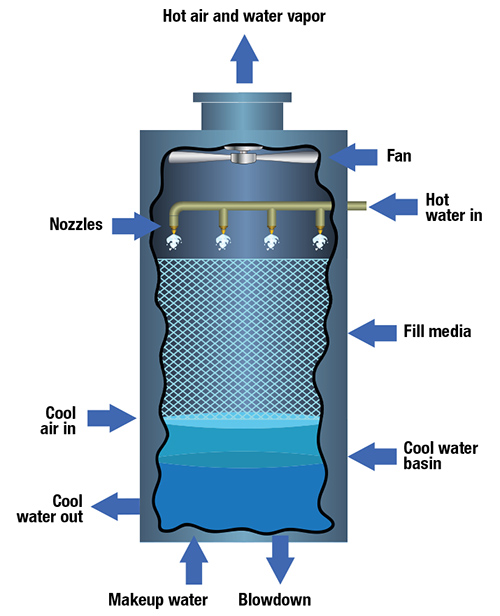
FIGURE 1. Cooling towers provide a means of releasing excess heat to the environment so cooling water can be recirculated through a system
Since an increased quantity of water evaporating generates more cooling, airflow in the cooling tower is an important parameter. In mechanically induced-draft cooling towers, a fan is used to force air upward through the fill media. Natural-draft cooling towers use natural convective flow to circulate air.
Cooling-tower elements
There are several different commonly used cooling tower arrangements. But most have the following basic components.
Distribution system: Spray nozzles distribute warmed water over the fill media.
Fill media: Fill media are structured materials designed to maximize the contact area between air and water. Often made from polyvinyl chloride (PVC) or other materials, such as stainless steel, polypropylene or fiberglass, the fill media provide a high surface area for air-water contact.
Cooled water basin: After passing through the fill media, cooled water is collected in a basin at the bottom of the cooling tower.
Fans. Fans are often used in cooling towers to induce airflow and increase the rate of evaporation.
Drift eliminator: Drift eliminators are parallel blades arranged on the air-discharge side of the cooling tower. They are designed to reduce the loss of entrained water exiting the cooling tower with the airstream. Air passes through drift eliminators relatively unhindered, but water droplets contact the blades and drip back to the basin.
Cooling tower key terms
The following terms are relevant for describing cooling-tower operation and performance.
Cooling range. Cooling range is the difference in temperature between the hot water entering the tower and the cooled water leaving the tower.
Approach. The approach represents the difference between the temperature of the cooled water leaving the tower and the wet-bulb temperature of the surrounding air. The establishment of the approach fixes the operating temperature of the tower and is the most important parameter in deter-mining both tower size and cost.
Dry-bulb temperature. Dry-bulb temperature is the ambient air temperature.
Wet-bulb temperature. The wet-bulb temperature is lowest possible temperature the air can reach when air and water come into contact with each other, and is an indication of the heat content of the air.
Relative humidity. Relative humidity (RH) is the ratio between the amount of water vapor actually present in the air, and the maximum amount of moisture the air can hold at that temperature. At 100% RH, no more water can evaporate into the air from the surrounding environment.
L/G ratio. This is the liquid (water) to gas (air) mass flow ratio.
Blowdown: As cooling-tower water is circulated and water evaporates, total dissolved solids, including salts and scaling minerals concentrate in the water. Before the concentration gets too high, some water is removed and replaced with fresh water. This process is termed blowdown.
Drift. Drift refers to the water entrained in the airflow and discharged into the atmosphere. Drift loss does not include water lost by evaporation.
Makeup water. Makeup water is the amount of water required to replace normal losses caused by bleed-off, drift and evaporation.