A new metal-oxide additive technology is taking a different approach to extend battery performance and lifecycle. Developed by Ten-Nine Technologies (Tulsa, Okla.; www.ten-ninetech.com), the TENIX nanoscale additive formulation features specialized surface chemistry that selectively intervenes in key battery-degradation pathways that can wreak havoc on battery life and thermal stability. “When it comes to the materials in batteries, most of the research and development has focused on bulk chemical reactions and intercalation of ions. We wanted to see how performance pain points could be addressed with surface chemistry. Our product is really designed to intervene in the degradation process that a battery naturally undergoes, and keep the slope of degradation flatter. That’s really not an approach that anybody else in the field is taking,” explains Paige Johnson, founder and CEO of Ten-Nine Technologies.
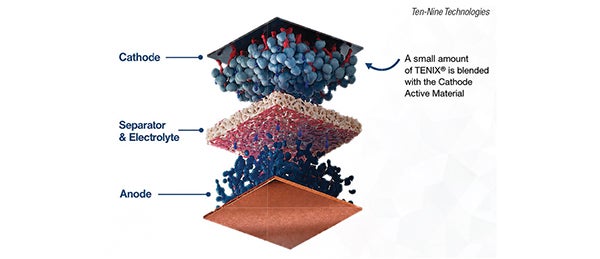
TENIX powder is added at a very small percentage directly into existing cathode manufacturing processes, meaning that material improvements can be realized without new battery architectures or production changes. TENIX consists of a mixture of metal oxides with functionalized surface chemistry that promotes interaction with degradation products in the battery, trapping these nuisance molecules and isolating them from the battery cycle to avoid further degradation. “For example, the electrolyte salt in batteries often breaks down to make HF, which is a bad actor, even in tiny quantities, because it causes cathode particles to break down. TENIX can interfere with the process that produces HF,” adds Johnson.
She also points out that the technology is compatible with different battery chemistries and that TENIX is currently undergoing validation with customers spanning a wide breadth of commercial battery technologies, including nickel-manganese-cobalt (NMC), manganese-rich, sodium-ion and more. The company has recently transitioned its TENIX production technology from batch reactors to continuous, taking another important step toward full commercialization. “We have a pilot plant in Tulsa that has about a 40-ton annual capacity, and so far we’ve produced between two and three tons for evaluation trials,” notes Johnson, adding that the move to continuous production is supporting an eventual scaleup to around 400 tons/yr of capacity. Ten-Nine has over 50 deals in its evaluation pipeline with global battery companies to test TENIX technology. Next steps also include investigation of additional applications for specialty functionalized metal-oxide materials beyond battery use.