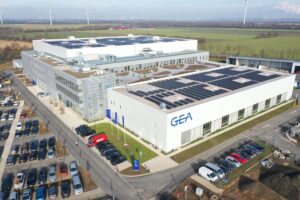
GEA AG (Düsseldorf, Germany) has opened a new technology center for pharmaceutical freeze-drying systems in Elsdorf, Germany. GEA employs approximately 260 people at the facility, which combines research and development with production and service under one roof. The site is carbon-neutral thanks to power supplied by photovoltaic systems. The investment of more than €80 million underscores GEA’s commitment to strengthening its position as a technology partner for the growing global pharmaceutical industry. At the same time, the company is making a positive contribution to structural change in Germany’s Rhineland lignite mining region.
Source: GEA
At the opening ceremony, GEA CEO Stefan Klebert said: “With our new technology center in Elsdorf, we are investing in one of our key growth areas and further strengthening our innovative capabilities in the pharmaceutical sector. We are also significantly expanding our production capacities. Together, these measures help us expand our leading position in this highly innovative market segment.”
Mona Neubaur, Deputy Minister President and Minister of Economic Affairs of the German state of North Rhine-Westphalia, was a guest at the opening. “Today is a good day for the future of Elsdorf and the entire region. From the heart of North Rhine-Westphalia, GEA Group is driving the global transformation towards climate-neutral production. Efficient, digitally networked production methods and sustainable technologies are helping to drive the transition toward a resilient and climate-neutral economy. Elsdorf demonstrates that North Rhine-Westphalia offers reliable framework conditions to enable investments with significant impact. This way, we secure good jobs, industrial value creation, and competitiveness, even in challenging times.”
The new building in Elsdorf replaces an existing GEA freeze-drying plant in neighboring Hürth, where production capacities had reached their limits. The more than 260 employees will find ideal conditions for their work in development, design, manufacturing, assembly, and service at the new location. Production capacities can be expanded, particularly through shorter production times.
Photovoltaic systems and green roofs on the production facilities and office buildings will ensure carbon-neutral operation. GEA uses the electricity from the roof to operate air-to-water heat pumps for freeze-drying, heating and cooling at the site. This can save up to 7,000 metric tons of CO₂ annually in production. Moreover, the photovoltaic system powers 30 charging stations for e-cars and fleet vehicles as well as six stations for e-bikes. As much of the approximately 45,000 square meter site as possible remained unsealed thanks to the use of grass pavers.
Freeze-drying is a necessary production step for many temperature-sensitive medicines to extend their shelf life or make them transportable in the first place. Alongside vaccines, these include antibiotics, serums, diagnostic agents, protein-based and biotechnological products, cells, tissues and chemicals. Production must meet the pharmaceutical industry’s exceptionally high quality and safety standards. Many of the corresponding manufacturing processes are traditionally energy-intensive. GEA significantly reduces this energy requirement through its innovative systems and processes. The company has been systematically expanding its capacities and capabilities in this growth market for years.