From cause statements to documenting scope to traceability, the value of HAZOP data depends strongly on how results are articulated and maintained
While the categorical structure of HAZOP records is well-established in industry, considerable variation exists in how causes, consequences and safeguards are described within that structure. Differences in phrasing, level of specificity and implicit assumptions can lead to materially different interpretations of entries that are, in principle, addressing similar safety issues. Improving the consistency with which HAZOP information is articulated does not require changes to the underlying methodology, but rather greater discipline in how conclusions reached during the workshop are expressed and preserved.
In practice, a useful discipline for consistent articulation of HAZOP information is to consider four dimensions:
- What is being described
- How it functions or fails
- When it is relevant or credible
- Who is affected or accountable
Not every dimension is applicable to every type of HAZOP entry. However, deliberately considering each one helps ensure that assumptions are made explicit and that critical context is not lost.
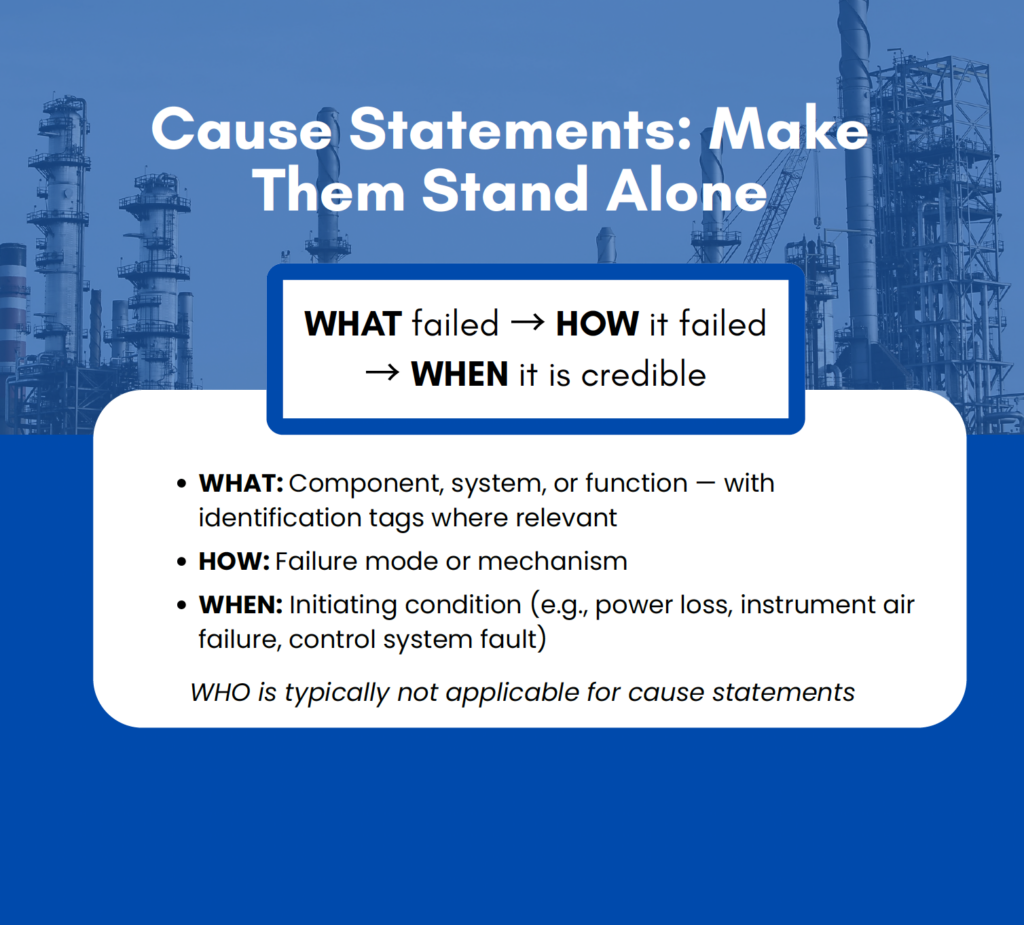
Cause: Structuring cause statements for technical specificity
Cause statements are intended to describe what went wrong with a considered HAZOP scenario — how a deviation could credibly arise under the conditions considered during the study. They form the starting point for the cause-consequence chain and provide the context against which safeguards and actions are evaluated.
In practice, cause statements are often recorded at a level of abstraction that assumes familiarity with the process or equipment under discussion. Phrases such as “valve failure,” “operator error” or “loss of control” may be sufficient for participants in the workshop, but they can be ambiguous to later readers who do not share that contextual understanding.
A more robust cause statement is articulated with sufficient specificity to stand alone, and is explicit about elements that may have been implicitly understood at the time of the study. In particular, it should clearly identify what failed or deviated, how that failure occurred, and the initiating condition under which it was considered credible.
For example, a cause recorded simply as “failure of inlet valve” may be reinterpreted in multiple ways. A more explicit articulation might describe the specific valve involved, its relative location, functional role and the initiating event considered during the workshop, such as loss of electrical power or instrument air.
Consistently articulated cause statements reduce reliance on assumed knowledge and make clear where judgement has been applied. They also support more reliable linkage to safeguards and follow-up actions, as the conditions under which those protections were judged effective are more clearly defined.
Consequence: Articulating the complete physical event chain
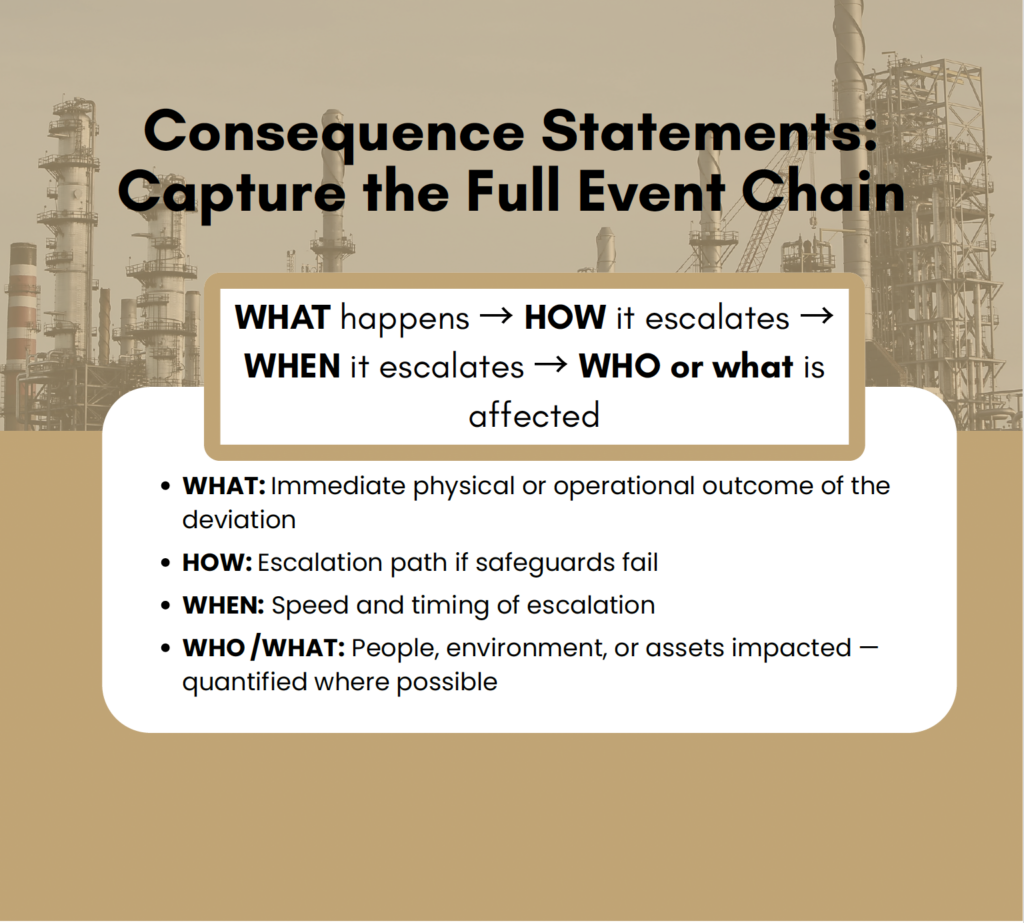
Consequence statements are intended to describe what happens as a result of what went wrong (the cause), and why that outcome matters. They translate an identified cause into a physical sequence of events that leads to a safety or operability impact, providing the basis for assessing the adequacy of existing safeguards and the need for further action.
In practice, consequences are often recorded in a highly compressed form. Entries such as “loss of containment,” “fire” or “personnel injury” are common and may accurately reflect the endpoint of the discussion. However, when intermediate steps are omitted, the consequence relies on implicit assumptions about how the event unfolds. Over time, this can obscure the reasoning that led the study team to judge the outcome credible.
A well-articulated consequence follows the physical progression of events from the initiating cause through to the point where the impact is clear. This includes the initial physical outcome of the deviation, the disposition of any released material or energy, and any escalation mechanisms that were considered credible during the workshop. The consequence is complete when it explains not only what happens, but how and why it leads to harm or loss.
For example, recording a consequence simply as “loss of containment” provides limited insight into the nature of the hazard. A more explicit articulation might describe whether the release results in a liquid spill to grade, a vapor release into an enclosed space, or accumulation within a vessel or building and whether escalation through ignition, explosion or other mechanisms was considered in reaching the final impact.
This approach does not imply that every consequence must be developed to a worst-case outcome. Rather, it ensures that the consequence recorded reflects the reasoning actually applied by the team, and that the path from cause to impact can be clearly understood. This clarity is particularly important when HAZOP records are later used to assess safeguard effectiveness or to inform further risk studies.
Safeguard: Recording scope, function and assumptions explicitly
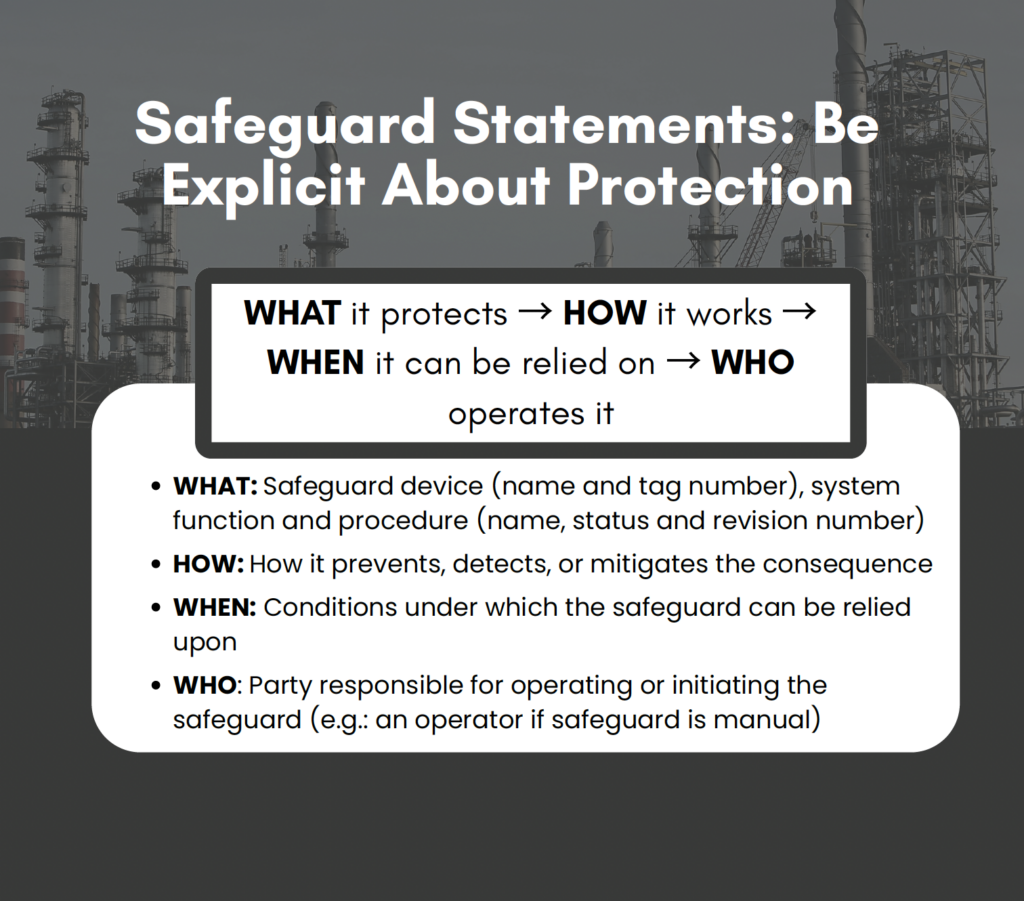
Safeguard statements are intended to describe the barriers that are put in place to prevent the occurrence of an identified scenario, or to prevent its escalation should the initiating event occur. They provide the link between the cause-consequence chain and the study team’s judgement on whether existing protections are adequate.
In practice, safeguards are frequently recorded as named systems or functions, with the expectation that their role and limitations are self-evident. Entries such as “control system,” “operator response” or “relief valve” are common, particularly as workshops progress and time pressure and fatigue increase. While this shorthand may be sufficient for participants at the time, it may rely on assumptions that are not explicitly captured in the record.
A well-articulated safeguard makes clear what the barrier does, where it acts within the cause-consequence chain, and under what conditions it is effective. This includes whether the safeguard prevents the initiating cause, detects the deviation or mitigates the consequence, as well as any dependencies on utilities, instrumentation, or human intervention. Without this clarity, later readers may infer levels of independence, availability, or effectiveness that were not intended by the study team.
Ambiguity in safeguard articulation is particularly problematic because safeguards are often relied upon when deciding what further actions are necessary to minimize risk. This includes their consideration during management of change, the prioritization of recommendations and other process hazard analysis activities that follow the HAZOP study. Where the assumptions underlying a safeguard are implicit rather than explicit, subsequent decisions may be based on an incomplete understanding of the protection actually in place.
Applying the same consistent discipline to safeguard articulation as to causes and consequences helps ensure that the HAZOP record reflects not just what protections exist, but how they were understood to function. This reduces reliance on tacit knowledge and supports more defensible use of the data throughout the asset lifecycle.
Action: Recording actions with context, intent and traceability
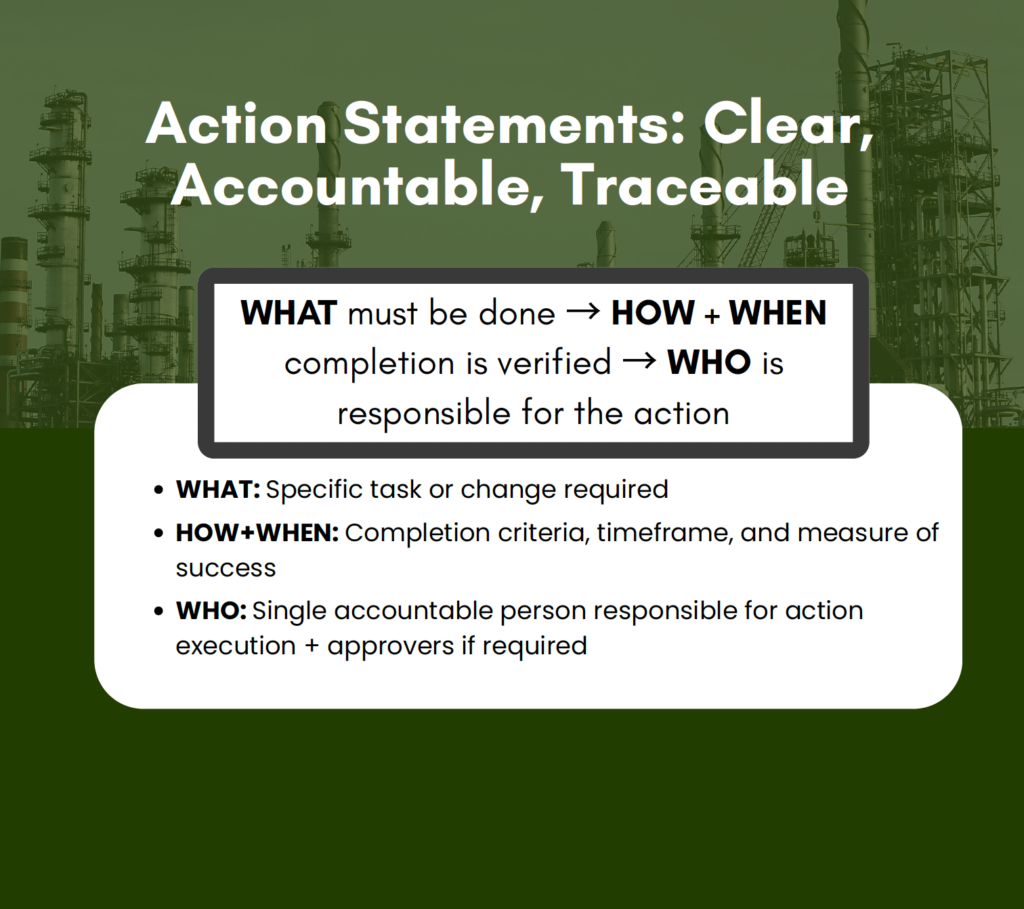
Actions are intended to capture what remains unresolved following the identification of causes, consequences and safeguards, and to define how that uncertainty will be addressed. They represent the study team’s agreement that further work is required to confirm adequacy, reduce risk or clarify assumptions identified during the HAZOP discussion.
In practice, as with other HAZOP data entries, actions are often recorded in concise form. Entries such as “review design,” “confirm adequacy” or “consider additional protection” are common, particularly toward the end of workshops when time pressure and fatigue are greatest. While such wording may be understood by participants at the time, it provides insufficient context for those non-participants responsible for completing the action after the study has concluded.
A well-articulated action should allow the assignee to understand not only what is to be done, but why it is required and how it relates to the specific HAZOP scenario that prompted it. This requires that actions are clearly linked to the relevant cause–consequence chain so that the intent of the action is made clear. Without this linkage, actions risk being interpreted, scoped, or closed based on individual judgement rather than the collective reasoning of the study team.
Clarity in action articulation also supports more consistent review and closure. Where the outcome or decision sought by an action is explicit, it becomes easier to determine whether the underlying concern has been adequately addressed. Conversely, actions that lack context or intent often drive informal reinterpretation of the HAZOP record, increasing pressure to modify original entries or to revisit discussions long after the workshop.
Applying the same discipline to actions as to causes, consequences and safeguards helps preserve the integrity of the HAZOP study as a coherent body of safety reasoning. By capturing intent at the point of creation, actions can function as a reliable bridge between the workshop and sub sequent engineering or operational activities, without requiring the original study record to be reinterpreted or rewritten.
Taken together, consistent articulation of causes, consequences, safeguards and actions strengthens the HAZOP record and reinforces the HAZOP record as a coherent body of safety reasoning. By making assumptions explicit at the time of recording, organizations can reduce ambiguity, limit the perceived need for post-workshop modification, and preserve the integrity of HAZOP data as a long-lived safety record. ♦ Edited by Mary Page Bailey
Editor’s note: This article is a companion piece to the feature article What HAZOP Information Really Represents — and How It Should Be Managed originally published in the April 2026 issue of Chemical Engineering.
All images provided by author
Author
 Ngozi Chinye (Email: nchinye@sotersafetyconsulting.com) is a chartered chemical engineer and safety specialist with experience in process safety, hazard identification, HAZOP facilitation and risk management across the energy and industrial sectors. She has led and advised on complex safety studies for both established operators and early-stage technology developers, with a focus on embedding robust safety practices throughout the lifecycle of new processes. Chinye founded Soter Safety Consulting to help startups and scale-ups navigate regulatory requirements, manage technical risk and accelerate innovation safely and responsibly. She is also the driving force behind HAZOP Edge®, a purpose-built software application designed to streamline HAZOP studies.