Sumitomo Chemical Co., Ltd. (Tokyo, Japan) has developed a technology that improves permeance while maintaining separation performance in ceramic separation membranes (microfiltration membranes). The technology uses the company’s high-performance alumina developed for separation membranes to increase the density of through-pores in the membrane structure.
This technology offers a new solution to a trade-off in separation membranes, in which improving permeance can reduce separation performance.
The mechanism of this technology was demonstrated through joint research with Kobe University (Kobe, Hyogo, Japan). The findings were published online in Journal of Membrane Science Letters on August 12, 2026.
The results of the study indicate that the newly developed alumina provides new guidance for developing high-performance separation membranes for applications prone to the adhesion and accumulation of contaminants — including food processing, biotechnology, fermentation, chemicals, and wastewater treatment. Going forward, Sumitomo Chemical will propose solutions that contribute to higher-value-added products, improved filtration system performance, and more stable operations for membrane and filtration system manufacturers.
Background
Ceramic separation membranes are used in a broad range of fields, including food processing, fermentation, biotechnology, chemicals, and wastewater treatment, because of their excellent mechanical strength, chemical resistance, and heat resistance. However, in applications involving suspensions, emulsions, and other fluids in which contaminants readily adhere to pores, membrane permeance tends to decline.
Conventionally, membrane performance has been evaluated primarily on the basis of average pore size, while the influence of membrane structure was considered limited. In practice, however, pore connectivity and the distribution of flow paths can substantially affect permeance and the behavior of contaminant adhesion within pores. This has created a need for structural indicators that go beyond average pore size alone.
Research results
In joint research with Kobe University, Sumitomo Chemical compared the internal three-dimensional structures and filtration performance for yeast suspensions of multilayer α-alumina tubular membranes.
Despite having nearly identical average pore sizes, membranes with high through-pore density made with the newly developed alumina distributed permeate flow across a greater number of flow paths. This suppressed the intrusion of contaminants into the membrane pores, lowered the likelihood of internal pore blockage, and reduced resistance caused by contaminant adhesion. As a result, the membranes with high through-pore density exhibited more than three times the steady-state permeance while maintaining comparable separation performance.
These findings demonstrate that ceramic membrane performance is influenced not only by average pore size, but is also substantially affected by how flow is distributed inside the membrane. They also show that the newly developed alumina is a material that contributes to high permeance through structural control of the membrane interior.
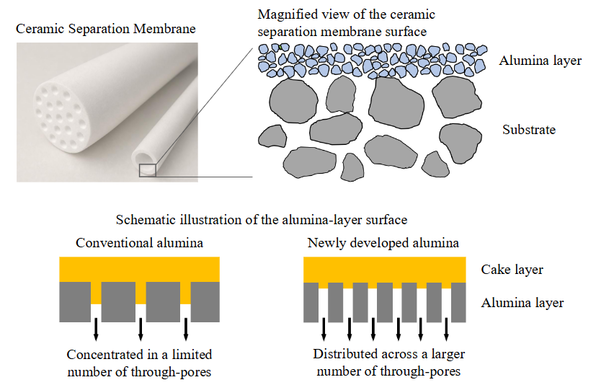
Source: Sumitomo Chemical
Societal significance
For membrane manufacturers, these findings provide valuable insights that can support the development of higher-value-added and differentiated ceramic separation membranes. For filtration system manufacturers, they can lead to proposals for higher throughput, reduced cleaning frequency, and more stable operation.
Next steps
Based on these findings, Sumitomo Chemical will further advance structural-control technologies using alumina. The company also plans to enhance its collaborations with membrane and filtration system manufacturers.
The company will also pursue broader application of its material solutions in fields such as food processing, fermentation, biotechnology, chemicals, and wastewater treatment, where declining permeance due to contaminant adhesion and accumulation remains a challenge.