Current recycling methods for recovering platinum-group metals (PGMs) from catalyst-coated membranes (CCMs) used in proton-exchange membrane (PEM) electrolyzers and fuel cells incinerate the highly valuable membrane material, requiring the manufacture of new material and the management of hydrogen fluoride offgas from the incineration.
In a new recycling process, developed by Johnson Matthey (JM; London, U.K.; www.matthey.com), PGMs are recovered from CCMs without incinerating the perfluorosulfonic acid-based ionomers on which the operation of PEM electrolyzers and fuel cells depend. In a complementary process, developed in parallel by Syensqo (Brussels, Belgium; www.syensqo.com), the ionomers are extracted, purified and reconditioned for reuse.
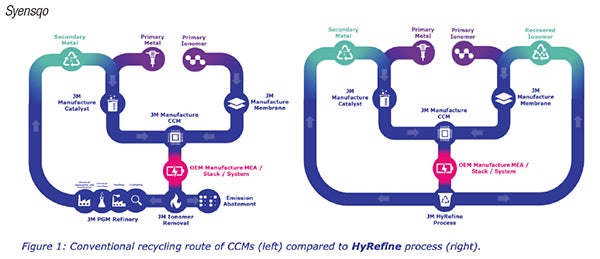
The JM process, known as HyRefine, is a purely chemical process that recovers PGMs at the kilogram scale, and avoids the incineration and smelting steps that destroy the ionomers. The Syensqo process leaches the ionomers from various materials (including membranes, electrodes and membrane-electrode assemblies (MEAs)), and follows that with purification and reconditioning steps to obtain ready-to-use ionomer dispersions. Pilot-scale validation has demonstrated that this process has no negative impact on the ionomer performance, Syenqo says.
Together, the processes can realize carbon-footprint reductions of up to 80% compared with conventional recycling routes that require new virgin material. According to the companies, the complementary processes reduce energy use in the recycling process by 80%, reduce water use by 65% and produce 84% less waste.
“These results demonstrate the feasibility of circular recovery from industrial scrap generated in hydrogen applications. This work represents a meaningful step toward expanding material circularity across PEM technologies,” says Imre Horvath, green hydrogen platform director at Syensqo.
Project leaders are now trying to better understand how much ionomer can be recovered from end-of-life materials, and assessing the quality of the remaining material in order to refine the appropriate recycling routes.