From fertilizer and petroleum to textiles and plastics, production of vital commodities around the world relies on the use of anhydrous ammonia. Operators of chemical plants and petroleum refineries are well acquainted with both the handling hazards of the compound and the precision measurement needed to ensure its water content remains in the narrow range of 0.2% and 0.5%. With product quality and the risk of corrosion at stake, regular and reliable ammonia testing a must.
Sampling ammonia is typically neither simple nor quick. Ammonia vapors are highly toxic, dangerous to both touch and inhale, and can cause burns to the skin, eyes and lungs. Anyone gathering a sample using traditional sampling methods needs a full set of personal protective equipment (PPE): a chemical suit, goggles, a respirator and gloves. The process of collecting and testing the sample is also time-consuming and requires demanding precision to deliver accurate results.
Taken together, these factors mean that traditional methods of ammonia sampling are not only hazardous, but have greater potential to provide inaccurate data and significantly hurt efficiency. One way of addressing all these impacts is to implement a sampling system that has been specifically engineered for ammonia testing.
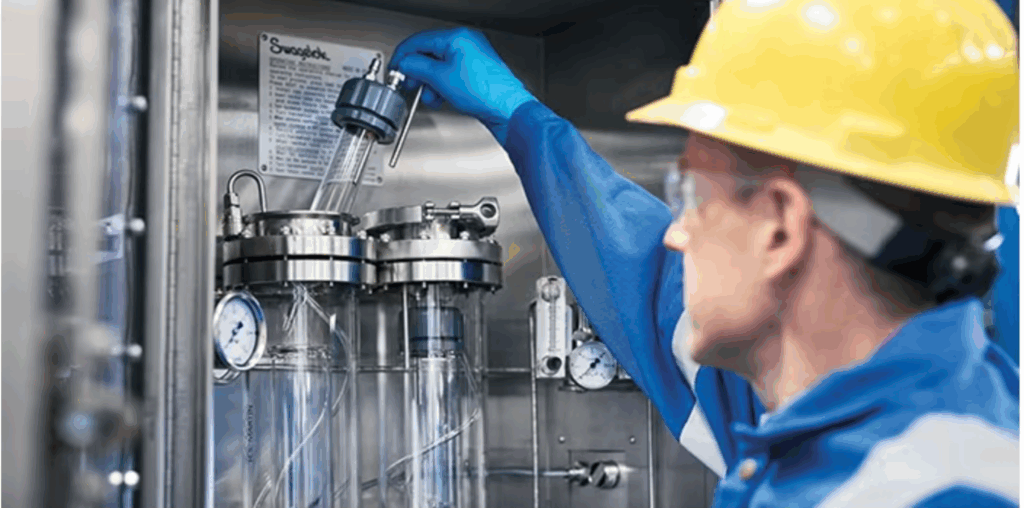
Safely and accurately sampling anhydrous ammonia can be a time-consuming challenge
Challenges of traditional sampling
It is critical for fluid-system operators to know exactly how much water content is in the anhydrous ammonia used in their processes. Why? The compound’s harsh nature can increase the chances of stress corrosion cracking in system components like storage tanks if its water concentration is below 0.2%. This type of cracking is difficult to detect as it’s happening, since it can destroy a component at stress levels below an alloy’s yield strength. A resulting failure can occur without warning and release the highly toxic ammonia. Recall the PPE and the need for spillage prevention previously mentioned — anhydrous ammonia exposure is very dangerous to workers and the environment.
At the other end of the water concentration range, any more than 0.5% water is excessive and dilutes the value of the ammonia to customers. That small window between 0.2% and 0.5% is where refineries and chemical plants need their anhydrous ammonia’s water content, so the need for quick, reliable, and safe testing is clear.
Ammonia sampling and testing is usually done with the CGA G-2.2 method developed by the Compressed Gas Association, Inc.: A 100 mL sample of liquid ammonia is dispensed from the fluid system and then allowed to evaporate. The residual water from the evaporated sample provides a means to measure the ammonia’s water content. It is a relatively straightforward system, but there are variables which can compromise its accuracy.
For one thing, anhydrous ammonia is cold: It boils at –28°F (–33°C), which means it begins to boil and evaporate as soon as the sample hits the warm glass container. This makes it difficult to fill tubes precisely to the graduation line, and as we’ve noted, accuracy is paramount. Similarly, inconsistent rates of the ammonia sample heating up and evaporating can lead to inconsistent sample results. Additionally, if the sampling tube and transport line aren’t flushed properly, residue can get into subsequent samples and lead to data that isn’t representative of the actual water concentration.
It’s challenging to perform this manually with the precision and safety needed, and even then, manual sampling procedures often require up to 8 hours before the water content measurement can be taken.
What distinguishes a better ammonia sampling system?
One route to safer and more reliable ammonia sampling is to incorporate a pre-engineered grab sampling system. These systems help expedite the sampling process and enhance operational consistency, and can be configured to meet a wide range of industrial fluid and specific application needs. For example, a pre-engineered system designed for ammonia sampling would ideally minimize operator exposure to liquid and vaporizing ammonia while also reducing the possibility of introducing operational errors or inaccurate measurements.
For instance, a sampling system with closed-sample fixtures reduces the need for excessive PPE precautions, since it limits the possibility for operator exposure and environmental impact. And if these closed fixtures are made of glass, the operator can also easily monitor the conditions within.
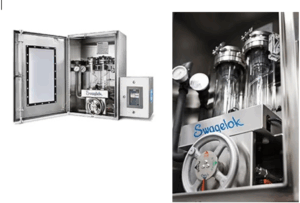
Pre-engineered sampling systems can be customized to meet specific application needs – including ammonia systems
Effective chilling mechanisms and semi-automated sample dispensing also deliver significant benefits in an ammonia sampling system. By including effective chilling technology, you minimize the potential for the excessive boiling that threatens fill accuracy. The consistency of sample sizes can be further improved with the addition of a cap assembly fitted to the residue tube, which assists with the filling process. When the sample is dispensed, the ammonia fills the residue tube only until the level reaches the bottom of the overflow tube, preventing overfill.
A good system is also user-friendly. Clear and simplified operation improves the experience and helps prevent missteps. A sampling system that uses a straightforward and intuitive touchscreen interface to control heater operations can keep the operator informed and at ease, and the ability to operate multiple sample control valves with the same handle enables the user to more easily select different functions.
When you’re sampling anhydrous ammonia, attention to detail matters — and features like these in a well-designed system can introduce new levels of efficiency, safety and usability. Petroleum refineries and chemical plants require consistent, accurate and timely results in their fluid systems, and the right ammonia sampling technology can deliver these, along with a safer environment for the teams who keep world production flowing. ♦
Edited by Mary Page Bailey
Acknowledgement
All images provided by author
Author
Matt Dixon is the global technical lead for Swagelok Company. He began his career with the company in 1998 as an engineering co-op student and has worked as an assembly, welding and manufacturing engineer in an array of capacities since, supporting the production of various product lines and the designing and building of assembly and test equipment. He has extensive experience in developing, testing and troubleshooting sampling systems.