Specially engineered nanostructured nickel- and copper-based composite materials are the cornerstone of a new technology that aims to provide emissions-free heat generation for industrial use. Clean Planet Inc. (Tokyo; www.cleanplanet.co.jp/en/) has developed the Quantum Hydrogen Energy (QHe) technology, which the company is progressively scaling up from laboratory-scale systems toward a commercial-scale unit designed to deliver 24 kW of thermal output and operate at temperatures up to 1,000°C. “An extremely small amount of hydrogen is introduced into the nanostructured metal, where it diffuses through the material under controlled temperature and pressure conditions. Through the interaction between hydrogen and the engineered nanostructure, the system generates heat in excess of the external energy supplied to initiate and maintain the process. Unlike conventional combustion, QHe does not burn hydrogen,” according to Hideki Yoshino, chief executive officer of Clean Planet Inc.
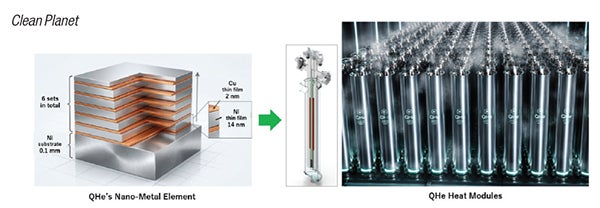
The company says that while its QHe process could be considered part of the broader research realm referred to as “solid-state fusion,” there are currently no commercially established technologies that are using the same type of material system and heat-generation approach. “One of the most distinctive aspects of QHe is its ability to generate heat using only a very small amount of hydrogen while operating at temperatures below 1,000°C. This enables a fundamentally different engineering approach: compact, modular heat sources that can potentially be installed close to where thermal energy is consumed. The core technological innovation is Clean Planet’s proprietary nanostructured metal material and its ability to control the interaction between hydrogen and the material to achieve stable and scalable heat generation,” adds Yoshino.
Clean Planet has demonstrated experimentally that QHe produces no CO2 emissions during operation, and that no background radiation or radioactive waste has been observed, according to Yoshino. The company has recently secured significant strategic investments from large industrial partners to further commercialization, including Tanaka Precious Metal Group Co. (Tokyo; tanaka-preciousmetals.com/en) and Gas One Holdings Co. (Saitama City, Japan; www.saisan.net), as well as a previously established partnership with boiler manufacturer Miura Co. (Matsuyama, Japan; www.miuraz.co.jp). “Drawing on its expertise in metals and materials, including surface engineering and analytical and evaluation technologies, Tanaka will explore synergies with Clean Planet’s QHe technology. The collaboration aims to enhance performance and reliability,” says Kazuharu Yoshida, a managing corporate officer at Tanaka Precious Metal. Clean Planet’s current focus is establishing a scalable and reproducible manufacturing process for the nanostructured materials used in the QHe system, while also continuing work to improve the stability and controllability of heat generation for practical industrial application.