Nanomox (London, U.K.; www.nanomox.net) has invented a synthesis platform for metal oxides where multifunctional ionic liquids enable high selectivity for specialized morphologies. While the technology can be tailored for a large number of metals, the company is currently targeting zinc oxide (ZnO) production, with initial applications in cosmetics and sunscreen products, and potential future use in rubber-compounding processes.
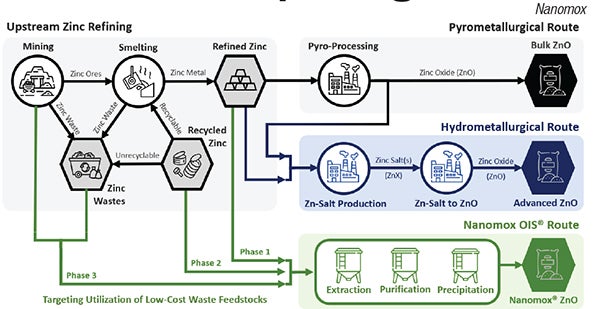
“Around 99% by volume of all ZnO is produced through high-temperature pyrometallurgical processes that basically are burning pure metallic zinc or vaporizing zinc-bearing feedstocks at high temperatures, so the ZnO crystals are growing in turbulent flow. This makes it very difficult to control the particle morphology,” explains Francisco Malaret, CEO and co-founder of Nanomox. This greatly limits the ability to produce particles with application-specific properties, such as optical transparency and UV blockage in sunscreens or improved kinetics in rubber manufacturing.
In Nanomox’s ionometallurgical process, a proprietary ionic liquid provides the reactive medium for oxidation and dissolution of zinc-containing materials, selectively bringing zinc directly into solution at relatively mild conditions. The dissolved zinc can then be converted into ZnO via controlled precipitation and conversion steps. “Here, the ionic liquid acts as a soft template — influencing nucleation and growth — so we can tune particle size, shape and porosity and produce a range of ZnO morphologies. The ionic liquids serve as the solvent and the catalyst, and they also are the templates to grow the crystals. They’re really multipurpose fluids,” says Malaret.
He also notes that Nanomox’s approach eliminates a key processing step of comparable processes, which often rely on preliminary conversion to soluble intermediate zinc salts, such as zinc chloride or zinc acetate, before precipitating the desired nanomaterials. “In contrast, our approach uses metallic zinc directly as the zinc source, converting it through the ionic-liquid wet process without relying on salt precursors.” This reduces the dependence on purchased specialty salts, and also opens the door to use more circular feedstocks, such as waste streams from the battery or steel industries. Further underlining the process’ circularity is the ionic liquid’s “closed loop” — the ionic liquid has been designed to be recovered, regenerated and recycled within the process.
Nanomox has completed an initial scaleup campaign for its ionic-liquid platform technology to validate materials synthsis, ionic-liquid recovery and purification in a semi-continuous setup using 20-L reactor systems, successfully producing on-specification materials. The next steps are to scale up the full end-to-end process in a phased pilot plant in London, with a target nameplate capacity of around 24 tons/yr in 2027.