A new approach to the traditional alkaline electrolyzers used to produce “green” hydrogen from water eliminates the membrane and introduces a new reaction mechanism at the anode, enabling the production of a high-value plastic precursor, 2,5-furandicarboxylic acid (FDCA). Developed at Keele University (Staffordshire, U.K.; www.keele.ac.uk), the new electrolyzer facilitates two different chemical reactions — the conventional conversion of water into hydrogen at the cathode; and the electrosynthesis of 5-hydroxymethylfurfural (HMF) into FDCA at the anode. “In typical water electrolysis, water is oxidized to produce oxygen. However, in this system, the reaction is replaced by the oxidation of HMF into FDCA. This alternative reaction requires less electrical energy than oxygen evolution, thereby reducing the voltage needed to operate the system. And instead of producing oxygen as a byproduct, the system produces a valuable chemical product in FDCA,” explains Charlie Creissen, senior lecturer in electrochemistry at Keele University.
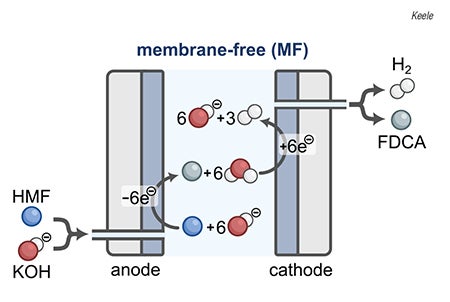
Avoiding the production of oxygen at the anode enables the system to eliminate the membrane typically required to separate oxygen and hydrogen, resulting in a simpler, safer and lower-cost system, says Creissen. “Conventional electrolyzers generally use a membrane or separator to keep the hydrogen and oxygen produced at the two electrodes apart. That is because if oxygen reaches the cathode, it can be reduced (wasting electricity) or can form explosive mixtures with hydrogen.”
So far, the technology has been demonstrated at the laboratory scale to establish its operating principles. Since electrolyzer cells are inherently modular, and the system uses abundant nickel-based catalysts, the potential for scaleup seems promising.
Current work has focused on the conversion of HMF at the anode, but the researchers envision future system adaptations for other renewable or waste-derived molecules. “This opens up the possibility of using molecules derived from biomass or food waste and plastics. There is also potential to combine this type of electrolysis with other chemical transformations, including carbon dioxide conversion. In the longer term, such approaches could allow renewable electricity to be used to produce hydrogen while also converting renewable or waste carbon sources into sustainable replacements for fossil fuels,” notes Creissen.
Details of this work were published in the journal ACS Electrochemistry.