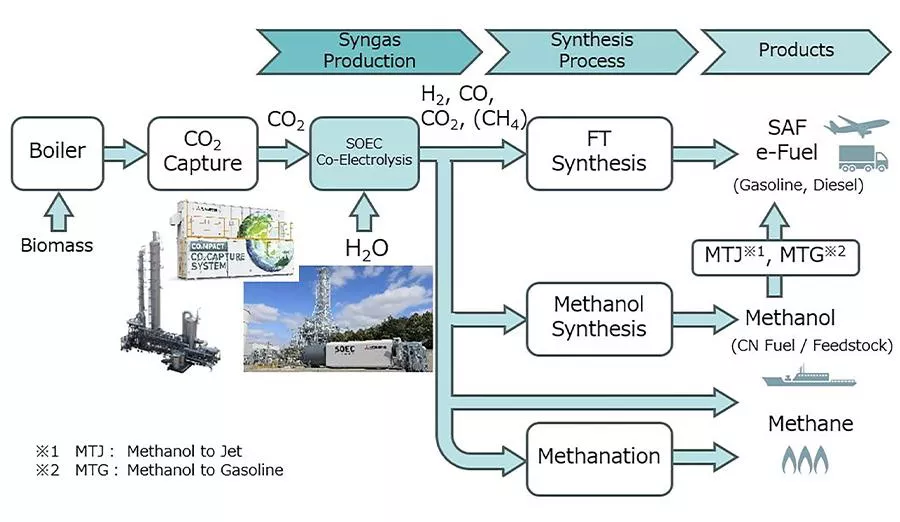
Mitsubishi Heavy Industries, Ltd. (MHI) has conducted a demonstration of an integrated production process for synthesizing liquid fuels from carbon dioxide, water, and electricity, successfully producing liquid synthetic fuels through an integrated production system. The demonstration was conducted at MHI’s Research & Innovation Center (Nagasaki District). In this process, SOEC (Solid Oxide Electrolysis Cell) co-electrolysis is employed to produce hydrogen and carbon monoxide, which are then used as the feedstock for production of liquid synthetic fuels using Fischer-Tropsch (FT) synthesis equipment. A chemical analysis of the synthesized liquid fuel confirmed that the demonstration had obtained components suitable for sustainable aviation fuel (SAF).
Source: MHI
Co-electrolysis is a process for electrolysis of both water vapor and carbon dioxide, allowing for simultaneous production of hydrogen and carbon monoxide, which are the feedstock for synthetic fuels. In addition, MHI is utilizing its proprietary technology to develop a tubular type SOEC cell stack. Co-electrolysis in this SOEC cell stack is expected to simplify the process and improve economic efficiency through highly efficient electrolysis, supporting the production of cost-competitive synthetic fuels.
The International Civil Aviation Organization (ICAO) has set a target to achieve net-zero CO2 emissions in the international aviation sector by 2050. To meet this target, low-carbon fuels such as SAF and carbon credits are expected to account for more than 70% of the offsetting and reduction , so the demand for SAF is forecast to increase significantly worldwide. MHI aims to offer high value-added SAF production systems that combine SOEC co-electrolysis with existing FT synthesis processes.
In addition to SAF, the hydrogen and carbon monoxide produced by SOEC co-electrolysis can also be used as feedstock for carbon-neutral synthetic fuels for automobiles and ships (gasoline, diesel fuel, methanol, methane), as well as city gas (methane). The many applications of SOEC co-electrolysis make it a promising technology, with potential to offer a broad range of options for the realization of a decarbonized world.