Subsurface sources are an area of emerging interest for producing low-carbon hydrogen. A microbiology-forward approach to subsurface hydrogen production developed by Eclipse Energy (Houston; www.eclipseenergy.co) is designed to recover hydrogen from depleted oil reservoirs. The RenovaStrata TM technology is centered around microbiological mechanisms and biotechnology formulations that cost-effectively convert residual hydrocarbons in underground reservoirs into hydrogen-rich gas — essentially creating an anaerobic bioreactor inside the reservoir. “We deploy the technology through existing wells and receive the hydrogen-rich gas through existing production infrastructure. The advantage is that the reservoir, feedstock, wells and much of the infrastructure already exist. No new drilling, electrolysis or surface reforming are necessary,” explains Eclipse CEO Prabhdeep Singh Sekhon.
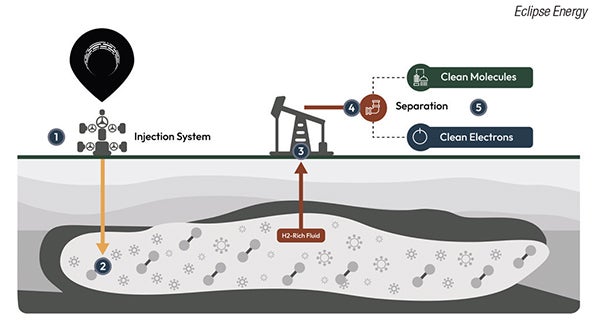
The proprietary microbial agents are delivered to the reservoir via existing oilfield-injection systems to stimulate hydrogen production in situ. The hydrogen-rich output stream may contain methane, CO2, water and other reservoir gases, which can be separated using established purification technologies used in oil-and-gas processing.
While there are many emerging approaches to obtaining subsurface hydrogen, none are currently operating commercially. Most activity right now is focusing on finding naturally occurring hydrogen or stimulating hydrogen-generating geologic reactions. “Conversely, Eclipse’s approach engineers hydrogen production inside mature oil reservoirs that operators already own, which removes several cost drivers of conventional hydrogen production,” notes Sekhon. Eclipse recently appointed engineering firm Wood Group Ltd. (Aberdeen, U.K.; www.woodgroup.com) to conduct an independent techno-economic assessment of the RenovaStrata technology. Wood’s models confirmed the potential for commercial-scale production of hydrogen at a levelized cost as low as $0.56/kg with an ultra-low carbon intensity of 0.076 kg CO2/kg H2.
In 2025, the company completed the first field trial of its technology in California’s San Joaquin basin, working with a prominent oil-and-gas operating company. This trial is likely the first-ever commercial deployment of bio-stimulated subsurface hydrogen production. In this trial, hydrogen reached a peak raw concentration of 40 mol % (approximately 400,000 ppm) and was physically recovered at the surface, according to Sekhon. Importantly, Sekhon states that the field trial saw no increase in H2S and no evidence of formation damage or formation souring. The next phase will involve larger, multi-well field deployments with global oilfield services company Weatherford International (Houston; www.weatherford.com) on board as an execution partner, as well as exploration of other production pathways beyond hydrogen. “Hydrogen is the first commercial product, but the platform is broader. We are also developing additional clean-molecule pathways using the same underlying subsurface biotechnology. The larger opportunity is to give mature oil-and-gas infrastructure a second productive life, rather than treating it solely as a retirement liability,” adds Sekhon.