Researchers at Texas A&M University (College Station; www.tamu.edu) have developed a fundamentally new route to graphene oxide (GO) synthesis using non-thermal atmospheric plasma — a method that sidesteps the toxic chemicals and scalability limitations that often constrain conventional production approaches.
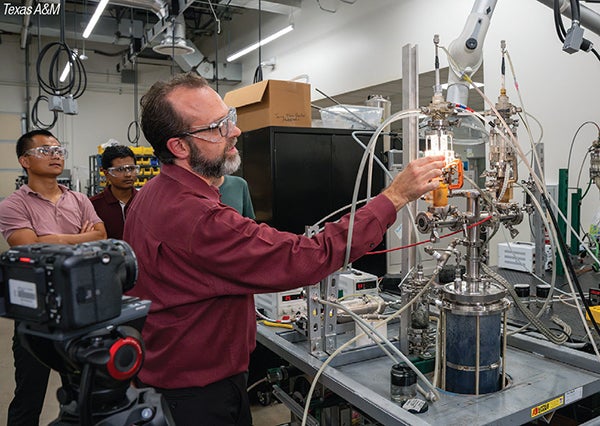
GO is an important nanomaterial that is sought after for its strength and conductivity in batteries, coatings, composites and other applications. Conventional production of GO relies on mined graphite as its main feedstock. The new method enables the direct conversion of methane and water into GO and hydrogen at ambient conditions, resulting in a product that is structurally comparable to commercially available GO, but with significantly lower production costs.
“The most important aspect of our technology is that it doesn’t use graphite as a feedstock. Bulk production of a sheetlike nanomaterial from something other than graphite is unprecedented,” says Micah Green, associate head of chemical engineering at Texas A&M.
Typical graphite-to-GO processes require concentrated acids, high temperatures and multiple processing steps that can take days to complete. The team’s non-thermal atmospheric nano-second pulsed plasma (NSPP) process only requires water and methane as inputs and can be run continuously. The plasma acts directly on or near the water surface to decompose methane, yielding high-purity, single-layer GO with controllable oxygen content and flake size.
At the methane-water interface, electrical discharge generates plasma that breaks methane into reactive carbon fragments while dissociating water into oxygen-containing species. These react at the liquid surface to deposit oxygen-functionalized carbon networks, building GO directly on water — a substrate that can be continuously replenished to support scalable production.