Nobian (Utrecht, the Netherlands) has officially opened a new fully electrified salt production facility in Mariager, Denmark. Based on mechanical vapor recompression (MVR) technology, the installation enables more energy-efficient production while increasing site capacity by approximately 60%.
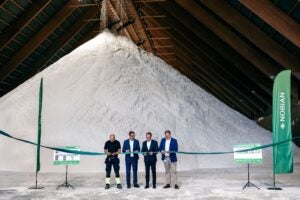
From left to right: Alex Thygesen (Technician, Nobian Dansk Salt), Jesper Skov Mikkelsen, Mayor of Mariagerfjord Municipality, Michael Koenig (CEO Nobian), Rienk Algra (Site director Mariager) Photo by: Pernille Thomsen
Operational since January 2026, the MVR installation replaces gas-based steam with electricity by compressing and reusing process steam within the system, similar to a heat pump. This keeps energy in the process, reducing overall energy consumption and lowering CO₂ emissions. The expansion strengthens Nobian Dansk Salt’s position as a supplier of high-purity vacuum salt in Europe.
The opening coincides with a milestone for the site, marking 60 years since the first brine delivery from the Hvornum salt dome to Mariager. Since then, salt production has remained a key industrial activity in the region. With the latest expansion, the site’s potential production capacity can reach up to one million tons of salt per year.
Michael Koenig, CEO of Nobian, said: “This investment marks a major next step in electrified and sustainable salt production in Mariager and reflects our confidence in the site’s future. It reduces energy use and CO₂ emissions, supports our customers’ decarbonization ambitions, and supports flexibility in the local energy system. At the same time, this investment reinforces local employment, and strategic industrial value chains. It also contributes to Denmark’s and Europe’s capacity to produce essential raw materials, such as salt, and the development of underground energy storage in salt caverns.”
The MVR installation builds on earlier electrification measures at the site, including a 37 MW electric boiler commissioned in 2022. Together, these assets improve operational flexibility, enabling the site to better align electricity demand with the availability of renewable energy. This strengthens the site’s e-flex capabilities, allowing it to respond to fluctuations in wind and solar power, support grid balancing, and contribute to a more resilient and flexible energy system.
In addition to increasing efficiency and capacity, this facility underscores Nobian’s long-term commitment to lower-carbon salt production and its role in supplying an essential raw material for applications ranging from food and water treatment to construction, automotive, and battery value chains.