Orica Ltd. (Vitcoria, Australia) announced the opening of a world-leading carbon utilization facility adjacent to its Kooragang Island site, developed by MCi Carbon with Orica support.
The facility marks a major milestone in the development of technologies to decarbonize heavy industry and is another initiative within Orica’s global low-carbon industrial ecosystem, supporting new technologies and solutions for the energy transition.
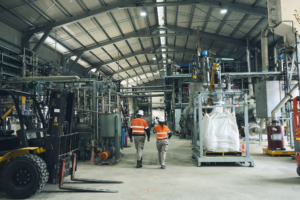
Inside the MCi carbon refinery on Kooragang Island. (Source: Orica)
Developed by MCi Carbon, the plant captures carbon dioxide from Orica’s ammonia production at Kooragang Island and converts it into carbon-embodied materials used in everyday products. These include concrete, plasterboard, paint, paper, glass and adhesives – permanently locking carbon into the raw materials the global economy already relies on.
The demonstration facility is capable of processing approximately 2,500 tons of CO2 per year, producing up to 10,000 tons of saleable materials, generating several tonnes of product for every tonne of CO2 processed.
Using mineral carbonation, the process combines CO2 with naturally occurring and industrial minerals to produce stable carbonates and other materials suitable for a range of applications. The facility is among the most advanced of its kind globally and demonstrates how industrial emissions can support a more circular, low-carbon economy.
Critically, the Myrtle facility represents a bridge to commercial scale, demonstrating how carbon utilisation technology can move from pilot to industrial deployment.
The opening ceremony was attended by Australia’s Minister for Climate Change and Energy, the Hon. Chris Bowen MP; Member for Newcastle, Sharon Claydon MP; Ambassador of Japan to Australia, Suzuki Kazuhiro; Ambassador of Austria to Australia, Elisabeth Kogler; and other dignitaries.
Orica Group Executive and President AUSPAC and Sustainability, Germán Morales: “MCi Carbon’s technology is designed to integrate with existing industrial processes, providing a scalable pathway to reduce emissions while creating new value streams for hard-to-abate sectors such as cement, steel and chemicals.
“Located within one of Australia’s key industrial hubs, the project reinforces the Hunter region’s role in advancing clean energy and low-emissions innovation, with strong potential for global application.”