A customized material-transfer unit was designed for the in-house supply and transport of raw materials, seamlessly linking the process steps of dietary supplement manufacturing while minimizing contamination and dust
The stringent demands of the food industry create significant challenges for internal raw-material transport — even when the substances being handled appear relatively benign. This is especially true when transporting bulk solids. In food processing, ensuring product purity is considered the highest-priority goal. This requires smooth transport between processing steps. Attention must also be paid to the handling of different types of bulk-solids containers, such as bulk bags, drums, containers or sacks, in order to ensure material transport with as little dust as possible (or, ideally, dust-free), while maintaining the necessary level of homogeneity. The use case discussed in this article involves a well-known Italian manufacturer of dietary supplements in various flavors, and how they achieved material-transfer success in exceedingly challenging conditions.
Process overview
At the manufacturer’s site, the product contains up to 15 different raw materials, depending on the recipe, and is typically fed to the process via bulk bags (Figure 1). Only two operators are employed to supply the production unit with raw materials and to change the packaging materials at the filling line. Process equipment specialist Hecht Technology B.V. (Delft, the Netherlands; www.hecht-technology.nl) provided technologies for the internal process steps and the mixer, which were fully automated during the upgrade.
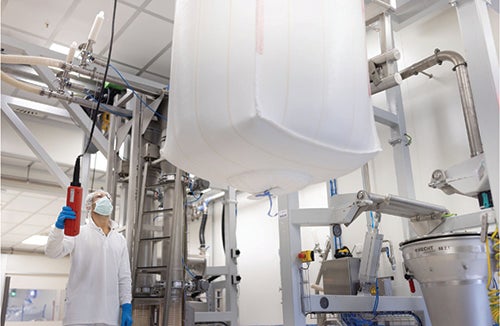
FIGURE 1. Food-processing sites frequently receive their raw materials in containers like bulk bags that must be securely discharged into the process to preserve product integrity
An in-house recipe-management system forms the interface to the existing merchandise-management system. From the product feed to the end of the last filling, a throughput of 2.25 ton/h is possible. The system’s cleaning process is carried out by dry cleaning with fructose and subsequent manual post-cleaning with removal of all parts that come into contact with the product. After receiving the goods, the bulk bags holding various raw materials are transported to the facilities, which are divided into two rooms. The product is fed via Hecht’s bulk-bag emptying stations (Figure 2).
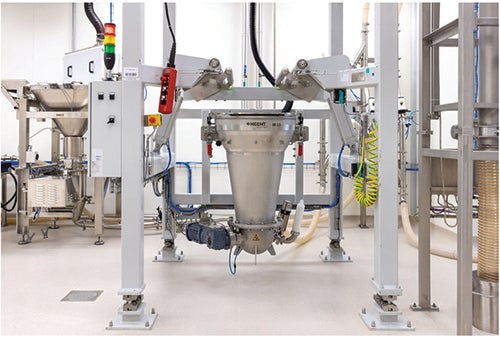
FIGURE 2. Bulk-bag emptying stations should be designed to provide seamless discharge of bulk materials without creating unsafe dust or contamination risks
In general, an emptying station consists of four components:
- The connection system is the core component. It ensures a safe and dust-free bulk-bag connection. The product to be emptied falls gravimetrically into extraction shoes, which serve as feeding stations for pneumatic conveying. They can either be connected directly under the process equipment, such as a mixer or centrifuge, or under bulk-bag emptying stations, drum-emptying stations or bag-emptying stations.
- The support table absorbs the weight of the bulk bag and is used to secure heavy loads.
- A boiled paddle serves as a massage unit and as a discharge aid for loosening up difficult-to-flow solid materials.
- The corresponding frame is used to attach the connection system and the bulk-bag support. A pneumatic clamping device is used to tighten the bulk-bag outlet. Depending on the area of application, operating height and installation measurements, there are various additional options.
Additionally, a raceway carrier with a chain hoist and a loading harness are necessary to safely lift the bulk bags and position them above the connection system for emptying.
The large volumes of raw materials in the manufacturer’s project required emptying stations that were equipped with a spout connection system and massage paddles. To loosen up the products, Hecht’s ball suction shoe with a built-in tuber crusher function was used.
The smaller ingredient components and flavors are added via two semi-open combined bag-barrel pours. One of the two pours is used to sieve hard crystalline products and break up lumps.
In the next process step, the raw materials are transferred from the bulk bags at the feeding stations via vacuum conveying using two Hecht PCC 700 ProClean conveyors to a mixer supplied by Gebrüder Lödige Maschinenbau GmbH (Paderborn, Germany; www.lodige.de). The transfer and entry into the mixer take place continuously via rotary valves at the outlet of the PCC 700 unit.
The PCC 700 system has been specially developed for the connection of mixers and filling systems with high production volumes. The vacuum conveyor unit meets the good manufacturing practices (GMP) and regulatory requirements of the manufacturer and creates a dust- and contamination-free environment. Its specialized design features a unique filter concept. At first glance, the operating principle of the conveyor is indistinguishable from conventional pneumatic conveyors: a vacuum conveyor is connected to a feeding point (such as the bulk-bag emptying stations) by means of a pipe connection or hose, and the bulk material is conveyed by the negative pressure generated by the pump. Notably, the flight speed of the conveyed material can be influenced by regulating the air supply — depending on the setting and product, different modes can be selected, including air conveyance, plug conveying or dense-phase conveying. Particularly in the case of plug conveyance, segregation can be avoided in advance.
The PCC 700 conveyors can achieve high-throughput performance (up to 10 ton/h depending on the product), mainly due to the four large filter elements and the sizable volume of the separation tanks. Since the suction of the product via negative pressure/vacuum and the pulse-controlled cleaning of the filters take place in parallel (two filters are cleaned in interaction or product is sucked in via them), the product can be conveyed for very long periods of time and over long distances, thereby filling the entire separation tank volume in a single suction cycle.
The large filter area (up to 3.6 m²) produces a low filter load, which in turn reduces pressure drop and supports effective conveying. This also enables effective conveying of very fine-grained products (<1μm). The low filter load also has a very positive effect on the service life of the individual filter elements. A filter change can be done quickly by the operator without tools and in just a few simple steps.
A ploughshare® mixer from Gebrüder Lödige is also used in the system, providing mixing via centrifugal movement and whirling action. In a horizontal, cylindrical drum, the mixer blades, which are arranged on a shaft in a special system, rotate as mixing elements. The size, number, positioning, geometric shape and circumferential speed of the mixing tools are coordinated in such a way that they induce three-dimensional motion of the components. The resulting turbulence in the mixture (as the mixing tools are constantly contacting the entire material) does not allow for the formation of dead or motionless zones in the mixing chamber and leads to fast and precise mixing. Due to the special shape of the tools, the mixture is lifted off the drum wall in the radial movement zone, and the particles avoid being crushed. In the case of certain specialized tasks, it may be necessary to provide additional support for the mixing effect of the centrifugal unit. Separately driven, high-speed cutter heads work in conjunction with the mixing tools to break down agglomerates and achieve targeted granulation during the process.
In order to protect the mixer from metallic foreign bodies, the conveyor line for bulk bags, raw materials and small components is equipped with horizontal metal separators.
After the mixing process, the emptying flap of the mixer opens automatically and the final product lands in another extraction shoe. From there, the product is cyclically transferred to the filling line via another PCC 700 conveyor system. Finally, both drums and bulk bags can be filled for further processing.
In order to ensure the most homogeneous mixture possible without clumping in the end product, an eddy-current screening machine is mounted under the PCC 700, which ensures that the oversized particles are separated. Another integrated gravimetric metal separator guarantees the highest level of safety for the final product.
Additionally, to avoid wasted product and ensure a low-dust environment, a filling head with an integrated back-trickle protection flap was installed to prevent the product from trickling onto the floor during a change of packaging material or when the system is at a standstill.
Production gains at a glance
The transfer-equipment setup described here delivered several operational benefits and greater processing flexibility to the manufacturer.
With this system setup, it is possible to convey raw materials from one of the bulk-bag emptying stations or bag pourers past the mixer via a switch in order to switch from packaging material A to packaging material B in the filling station. In the case of partially emptied containers, the process can also be “run empty” without emptying the bulk bags through the mixing plant.
The entire production process is digitally traceable and documented according to the latest industry guidelines. The raw materials are visually scanned using a scanner and subsequently released for entry into the mixer if they pass inspection. An incorrect raw material cannot be pumped pneumatically, meaning that a correct recipe can be guaranteed every time.
Only two operators supply the systems with raw materials and packaging materials; the rest of the process is fully automated.
The entire unit itself requires no planned downtime, as long as raw materials are deployed to the system and filled. The sophisticated recipe-management and time-management capabilities, as well as the interplay between raw-material feeding, mixing and filling, result in a semi-continuous process.
Across the complete system spanning low-dust filling, emptying and pneumatic conveying, all steps meet the very high standards of hygiene, safety and gentle handling required for the product. The stringent requirements for a closed process, which both ensures dust reduction and avoids cross-contamination, are sufficiently met by the system, providing ongoing material-transfer success. ■
Edited by Mary Page Bailey
Acknowledgement
All images provided by author
Author
 Joost van Velzen is CEO of Hecht Technology B.V., located in Delft, Netherlands (Email: jvv@hecht-technologie.nl). With more than 15 years of expertise in process technology and industrial engineering, he leads the design and implementation of advanced containment and bulk handling solutions for the pharmaceutical, chemical, food processing and battery recycling industries.