Ammonia cracking, decomposing ammonia into its constituent nitrogen and hydrogen molecules, is gaining traction as an emerging source for cleaner hydrogen. However, this reaction is very endothermic and requires heat and high temperature. In a proprietary technology developed by Duiker Clean Technologies (Wateringen, the Netherlands; www.duiker.com), the ammonia itself can serve as the direct fuel source for heating this reaction, via a technology called Stoichiometry Controlled Oxidation (SCO).
The SCO technology has been extensively demonstrated at the industrial scale for combusting ammonia streams from crude desulfurization processes at petroleum refineries, but the technology has now been optimized specifically for clean hydrogen production via ammonia cracking. “The high-temperature heat together with a commercially available cracking catalyst will be used to crack the ammonia into hydrogen and nitrogen. After cracking, the hydrogen will be purified to the required purity requirements in a pressure-swing absorption process [PSA],” says Albert Lanser, Duiker’s business development director.
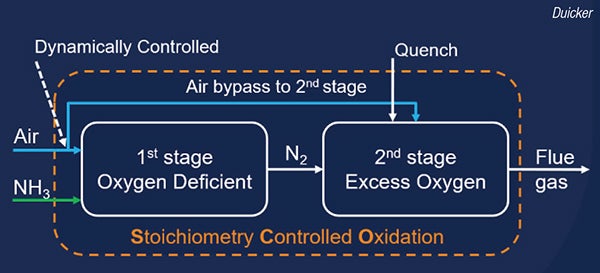
When compared to other ammonia-cracking methods, SCO produces very little emissions or waste, notes Lanser: “We have zero CO2 emissions when firing with ammonia, no water consumption nor ammonia waste streams, and result in very low NOx emissions.” He also points out that the process yields higher-pressure hydrogen than other technologies, which eliminates the need for energy-intensive post-cracking compression. “Due the very high heat integration in the system, we do not require quench water or steam production for the disposal of excess heat,” Lanser says. Duiker reports a greater than 90% energy efficiency of the process when operating at maximum hydrogen yields.
To demonstrate the technology as optimized specifically for ammonia cracking, Duiker is building a pilot plant, as part of the AMMONEX project, at the Port of Rotterdam. The AMMONEX project is supported by funding from the European Union (Just Transition Fund), the Demonstration Energy and Climate Innovation (DEI+) subsidy of the Ministry of Climate and Green Growth executed by RVO, and GroenvermogenNL.
Duiker’s simplified design, consisting of just three process units (SCO, cracking reactor and PSA), along with the high energy efficiency, mean that hydrogen production costs can be significantly lowered. “In comparison with hydrogen produced by electrolysis from electricity generated at the North Sea in the Netherlands, producing clean hydrogen from cracked imported ammonia can be 30–50% cheaper,” adds Lanser.