Pneumatic conveying is a versatile method for transporting powders and other solid materials within chemical process plants. Success depends on understanding science and applying specific experience
Undergraduate engineering programs include little instruction about powder handling. While there may be some cursory education about the mechanics of pneumatic technologies and the chemistry of powders, engineers entering industrial processing and manufacturing industries rarely have a knowledge base sufficient to tackle a powder-handling project without the guidance of an experienced engineer or the expertise of a trusted supplier (see part 1).
The science of pneumatic conveying involves formulas to determine parameters like airflow and vacuum pressure. However, after all the science and spreadsheets, the success in designing a system that delivers peak performance while preserving product quality lies in the ability to understand powder characteristics and how those characteristics interact with equipment design. This type of “tribal knowledge” is not formulaic and draws upon decades of experience with tens of thousands of different materials and their behaviors to complement scientific principles.
Negative versus positive pressure
Pneumatic conveying uses air to either push (positive pressure) or pull (negative pressure) solid material through a conveying line. Negative-pressure systems suck the material through the lines, while positive-pressure systems blow, or push, material down the line. Factors other than material characteristics, such as conveying distance and the need for higher conveying rates, dictate the choice between negative- and positive-pressure systems.
Negative-pressure pneumatic-conveying systems (which constitute the majority of pneumatic conveying applications) include a pickup point where material enters into the conveying system, conveying tubing where material is transferred between equipment; a vacuum receiver (filter receiver), which serves as an intermediate holding vessel for materials; a vacuum source that powers the system; and a control panel.
Pneumatic conveying systems are also categorized by dilute-phase conveying, where the air-to-product ratio is higher, and dense-phase conveying, which injects less air and more product into the conveying line (Figure 1). Most systems use dilute-phase conveying, but dense-phase systems are used as applications dictate. There are some instances where semi-dense or semi-dilute systems are appropriate. Dilute-phase systems employ higher velocity rates than dense phase systems.
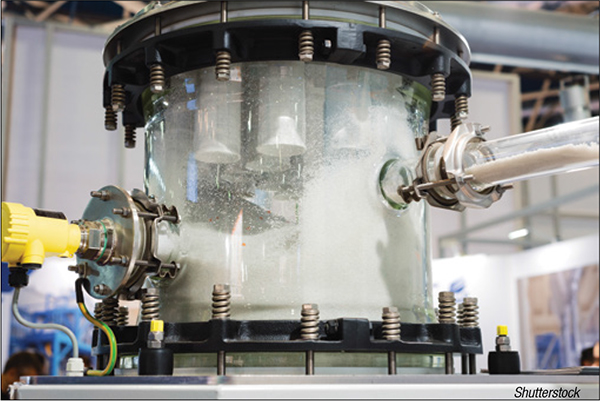
FIGURE 1. Pneumatic-conveying systems have varying air-to-product ratios
System selection and design
Pneumatic-conveyor manufacturers do not expect users to determine themselves which type of system is needed. Expert conveyor manufacturers determine, by compiling a great deal of information about the application, which type of system will best meet all the desired outcomes of the user. Whether employing vacuum technology for increased throughput, dust containment, labor savings, cleanliness, addressing complex convey routes, or safety and environmental reasons, the success in adding pneumatic technology lies in the ability to understand powder characteristics and how those characteristics interact with equipment design. While some conditions favor a specific pneumatic technology (such as conveying heavy materials at longer distances), in large part, material characteristics are the primary factor in determining system design across all types of pneumatic conveying systems.
The bulk density of a material is one of the first indicators of design in terms of sizing various system components, such as vacuum receivers and air sources. Bulk density leans toward the science end of design and helps determine how many cubic feet per minute (CFM) of air is necessary to move the material through the convey line. Generally speaking, materials with bulk densities between below 55 lb/ft3, but above 25 lb/ft3 are fairly easy to convey, while heavier materials require more power and larger vacuum receivers. Fine powders with low bulk density, such as fumed silica, present their own set of challenges and may require more filtration and therefore larger vacuum receivers than medium density powders.
Once solid material is in the conveying line, it often conveys without issue, even if the material is not free-flowing. However, introducing material into the conveying line or discharging material from the system can be problematic, and cannot be overlooked.
An understanding of how a particular substance will behave under certain conditions is essential when designing a vacuum transfer system. The behavior of a particular material – whether it is free-flowing, sluggish or non-free-flowing — is important data to relay to a conveyor manufacturer.
Non-free flowing materials require the most modifications at the pickup point. The pick-up point is the most customized component in a pneumatic conveying system because it is crucial for feeding material into the conveying system. Getting the air-to-solids ratio correct during the feeding process in order for material to feed into the line at proper velocity is crucial. Even free-flowing materials, like peanuts or gel caps, sometimes need extra consideration or require equipment modifications.
Cohesive and lightweight powders are prone to sticking and can cause bridging at the pickup point. Steady product flow into the material line and a proper solids-to-air ratio are critical with sticky materials. If the solids-to-air ratio is too high, the line will plug, and if it is too low, the system is just pulling air and not transporting enough material. Feed devices assist getting material into the line at a constant rate.
With challenging powders, specially designed agitative-feed devices regulate flow. These devices include one or several types of flow-promotion devices such as vibrators or impactors, aeration pads, headload deflectors or polished surfaces, but rotary or screw feeders are sometimes used when necessary.
With ultra-fine powders, such as carbon black, filters can clog and choke the entire conveying process. At the top of the material receiver housing, filters separate the product from the clean air traveling back to the vacuum producer. The filter media, the number of filters, placement and cleaning cycle is extremely important for challenging materials.
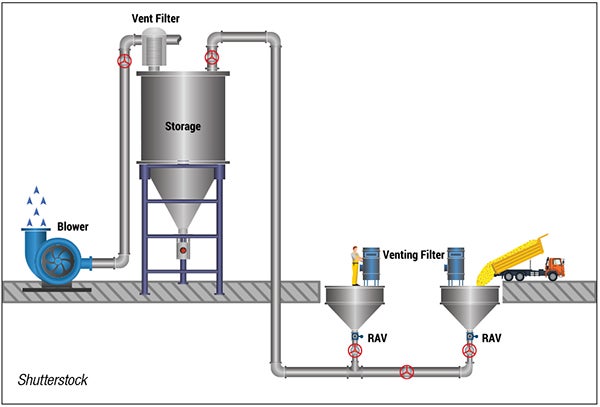
FIGURE 2. The introduction of material into a conveying system, and the discharge of that material, can cause processing problems
Product changes
While powders can affect equipment performance, equipment can also affect the product. When moving powders and dry materials, changes in particle size, density and texture can occur and potentially affect product performance. This is one of the most common challenges faced by packagers and why it is of utmost importance to use the specific materials of interest to test the performance of system’s design before it is sold. For example, peanuts impacting fixed metallic elbow sweeps (90-deg turns) in the conveying line can turn into peanut butter. To combat this, flexible hose is used to prevent material from impacting the same location repeatedly.
When pneumatically transferring gel caps, the capsules can hit the side of the hopper, creating additional noise in a facility. To combat this, vacuum conveyor manufacturers can add tangential inlets and internal soft baffles to eliminate noise and protect delicate solid products from damage.
Working with a seasoned expert in pneumatic transfer of powders and bulk solids costs more on the front end, but working out any issues that may arise before a system is installed on the production floor can save money in the long term.
Edited by Scott Jenkins
Author
 Doan Pendleton is president of Vac-U-Max (69 William Street, Belleville, NJ 07901; Phone: 973-759-4600; Email contact: noraashmen@vac-u-max.net). Pendleton’s professional experience includes over 30 years in the design, engineering, manufacturing and marketing of dry bulk-material transfer systems and industrial vacuum-cleaning systems. His application expertise extends across several industry sectors, including food, pharmaceuticals, plastics, chemicals and non-woven materials industries. Pendleton holds a B.S. degree in marketing and management from Suffolk University.