A materials-science breakthrough for the production of ultra-fine monofilaments is now being commercialized by startup firm Z-Polymers (Lowell, Mass.; www.z-polymers.com). The company’s Tullomer-branded monofilaments support exceptionally thin functional fibers with low creep and shrinkage, while exhibiting extremely high mechanical strength and elongation capabilities. “Tullomer is a new liquid-crystal polymer (LCP) fiber platform. Its uniqueness comes from combining highly oriented molecular structures with a catalytic chemistry that locks in very high strength, stiffness, heat resistance, chemical resistance and flame resistance. From a materials-science standpoint, it behaves more like an advanced structural fiber than a conventional polymer monofilament,” says Z-Polymers founder and CEO Mike Zimmerman. The Tullomer production process starts with precise monofilament extrusion, followed by a specialized catalytic step that increases molecular order and imbues the material with its performance properties. “The ability to make very thin monofilaments comes from tight control of melt flow, draw ratio, diameter control, tension, temperature and post-treatment conditions,” adds Zimmerman.
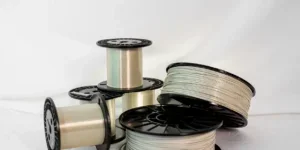
Source: Z Polymer
While there are other LCP fibers and monofilament materials commercially available, particularly in medical applications, Tullomer is differentiated by its monofilament form and its mechanical properties and thermal stability. The material is also readily customizable for emerging product formats for highly functionalized textiles and fabrics that can take advantage of its high surface area, low weight and ability to make strong and heat-resistant structures without the need for bulky fibers. According to the company, Tullomer can outperform commercial performance fibers in terms of mechanical strength and elongation, serving as a potential replacement for aluminum, steel, magnesium and a variety of polymers, including polyether ether ketone (PEEK) and polyaryletherketone (PAEK). Furthermore, the fibers are recyclable, and due to the material’s dimensional stability, there is no need for annealing during processing.
Z-Polymers’ production process has expanded from laboratory-scale coupons to production-relevant equipment, demonstrating thin monofilament and multifilament formats. The next steps will be to improve production volume and yield while bringing down costs. “Our focus now is on early commercial-launch applications, such as fibers for sporting equipment, 3D-printing reinforcement and technical fibers,” notes Zimmerman.