Isolating and purifying rare-earth elements (REEs) is extremely challenging and energy-intensive due to the difficulty in separating chemically similar REE ions. Traditional separation methods require solvent extraction or chelating agents and produce large volumes of hazardous waste, all with little guaranteed selectivity for desired REE species. A team of researchers from Battelle (Columbus, Ohio; www.battelle.org) has demonstrated a “highly selective recognition system” for REEs, taking advantage of the natural ion-binding characteristics of certain protein families. “REEs are very chemically similar to each other, which makes the conventional separations difficult, but biological molecules like proteins have a distinctive capability for discrimination among metals and other targets. We were able to develop this very unique immobilized-protein system that will not only recognize, but also bind and purify REEs from each other in complex mixtures. These complex mixtures not only contain REEs, but oftentimes impurities like aluminum, iron and lead, as well as radioactive elements like uranium and thorium,” explains Kate Kucharzyk, research leader at Battelle’s Operational Biotechnologies division. Since many REEs share certain physical and chemical characteristics with calcium ions, the process is designed so that REEs can be selectively attached to calcium-binding peptides and proteins.
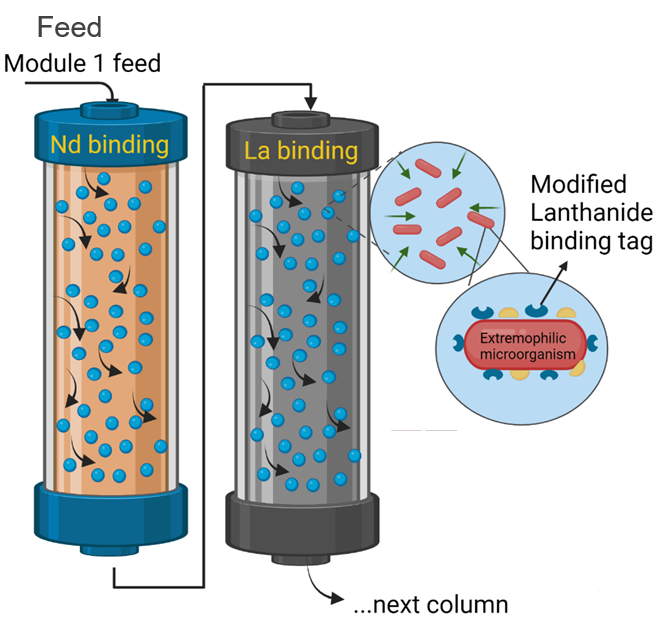
Source: Battelle
Beyond its REE selectivity, other key benefits of the protein-based system include the absence of solvents and the ability to re-use the immobilized-protein columns repeatedly over many purification cycles, even in harsh processing conditions. “The differentiator here is that the proteins we’re implementing into this process are highly stable in conditions of low acidity, and they have high specificity to bind those various REEs and purify them into pure streams of individual elements,” comments Kucharzyk. “We’re also able to separate some of the elements that are inherently difficult to isolate in their paired states, like praseodymium/neodymium or samarium/europium.”
The team, together with scientists at Columbia University, devised a group of six candidate proteins to process complex REE mixtures in a column outfitted with immobilized proteins and special functionalized resins. Depending on the system pH and other conditions, protein-bound REEs can be released as a concentrated mixture or as individual streams. Higher selectivity and flexibility and the elimination of solvents also help to reduce operating costs and waste creation when compared to typical chromatography-based REE separations.
The team has partnered with mining firms like Mountain Pass Materials (Las Vegas, Nev.; www.mpmaterials.com) and Rio Tinto (London, U.K.; www.riotinto.com) to qualify the technology using real-world mining residue streams. The team currently operates a liter-scale column and has produced gram quantities of REEs.