The complexity of thermal processes is increasing. Rotary kiln testing is an important component of process development for a range of new applications
In today’s industrial processes, rotary kilns are being tasked with more than ever before. No longer confined to cement production, kilns have become central to emerging processes for battery materials, carbon capture sorbents, catalyst activation and the recovery of valuable components from industrial wastes. And in these settings, even small errors in temperature, residence time, or gas-solid contact can lead to off-specification product, excessive energy use, or costly equipment failures. On a commercial scale, these errors can translate into millions of dollars in lost product, unplanned shutdowns, or equipment that simply can’t meet production requirements.
As thermal processes become more complex and capital investments grow larger, the risk of scaling kiln-based processes solely from laboratory data has never been higher. Thorough process development testing has become a critical step in transforming promising thermal chemistry into a reliable, commercially viable operation, pushing rising demand for advanced kiln testing services across a range of industries (Figure 1).
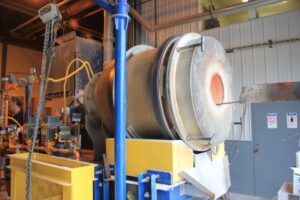
FIGURE 1. Testing on a direct-fired batch kiln is shown in progress here
Why is Advanced Thermal Treatment in Such High Demand?
Several factors have combined to drive demand for testing around high-temperature thermal treatment for both new and existing processes.
Sustainability goals. Industries are constantly developing new and better processes to meet sustainability goals. Given its ability to cause phase changes and chemical reactions, the rotary kiln’s advanced thermal processing capabilities are a cornerstone of facilitating material recovery and alternative use efforts. Rotary kilns are becoming commonplace in recovering valuable metals from spent batteries, electronics waste and industrial waste, as well as processing waste materials for beneficial reuse applications.
Specialized materials. In addition to moving toward a more circular economy, technologies and markets have advanced to the point that they require ever-more specialized materials. Technical products such as catalysts, sorbents and battery chemicals require manufacturing to varied and stringent specifications for optimal performance in increasingly niche applications. The parameters of thermal processing are a determining factor in the ability to meet these highly specialized requirements.
Focus on efficiency. In addition to products becoming more specialized, producers are also fine-tuning their processes to eliminate even the smallest inefficiencies. Advances in technology and materials science have given producers the ability to optimize for reaction completeness, thermal efficiency, emissions control and material yield, all fundamental variables that tie directly into the operation’s efficiency, operating costs and regulatory compliance.
Why Rotary Kilns?
Rotary kilns lend several advantages to thermal processing operations. To understand why, however, it’s important to have a solid grasp on how they work. A rotary kiln uses high temperatures and often a controlled processing environment to elicit a chemical reaction or phase change (Figure 2). Based on rotary-drum technology, a rotary kiln consists of a rotating drum through which material is passed and heated either directly or indirectly. Material is processed at a predetermined temperature(s) for the time required (referred to as retention/residence time) to cause the desired change in material.
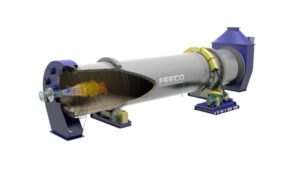
FIGURE 2. This 3-D rendering of a direct-fired rotary kiln shows a cutaway to view the interior
As a fundamental aspect of materials science, the ability to facilitate a chemical reaction or phase change in a material can be used to achieve a wide array of objectives. Commonly tested processes include:
- Removal of bound water
- Separation of components (for example, decarbonization or removal of CO2)
- Modification of porosity
- Chemical decomposition
- Dehydroxylation
- Volatilization
- Oxidation
- Reduction
- Phase conversion/recrystallization
- Sintering (solid-state bonding)
- Curing
These processes lend themselves to an even wider variety of applications, from catalyst manufacturing and activated carbon production, to carbon black recovery and sorbent regeneration.
These capabilities make rotary kilns powerful, but they also make kiln-based processes impossible to design from theory alone.
Testing process criteria. Rotary kilns offer ample opportunity for modification and customization in both process and configuration. And while this allows them to be designed to fit precise thermal requirements, it also requires a careful balance of several process and equipment parameters to reach the most effective solution:
- Material and product flow rates
- Air flow velocity and direction
- Heating mode (direct or indirect)
- Internals to manage bed action
- Temperature profiles and control
- Atmosphere control
- Retention time
Each of these variables interacts with the others, and small changes in one parameter can significantly alter product quality, energy use, or bed behavior— relationships that can only be established through testing.
Establishing feedstock parameters. Rotary kilns can accept a wide array of feedstock types across industries and even within their intended application. This lends itself well to waste-processing settings, which can exhibit variation in moisture content, particle size and composition. For this reason, rotary kilns are the equipment of choice for conducting plastics pyrolysis, allowing the processor to accept a much broader range of plastic types.
This tolerance to variation does not, however, mean that rotary kilns can serve as a blanket solution indiscriminate of feedstock. Rather, testing is imperative to designing a system that operates efficiently and reliably despite this variation.
Without testing, fluctuations in feed characteristics can otherwise lead to non-uniform bed behavior, incomplete reactions, excessive dusting, or fouling that only becomes apparent after full-scale startup, when the changes required to resolve the issue(s) are expensive and sometimes impossible.
So while rotary kilns offer exceptional flexibility, throughput and feedstock tolerance, these same qualities also make them difficult to design from theory alone. The interactions between heat transfer, solids flow and chemical reaction in a continuously moving bed cannot be reliably predicted without pilot-scale testing.
What does the testing process look like?
The testing process can vary considerably from one application and provider to the next. Please note that some of the information found here may vary by testing facility. Depending on how much is known about the process and feedstock, testing typically takes the following steps:
Proof of concept (confirming feasibility). Demonstrating proof of concept confirms that the theoretical process is technically possible. Testing is conducted in a batch-scale rotary kiln to show that the reaction theory is viable in the real world. During this stage, testing may also begin to uncover basic process criteria. If the process is deemed feasible, this information is used in subsequent testing to establish basic temperature profiles.
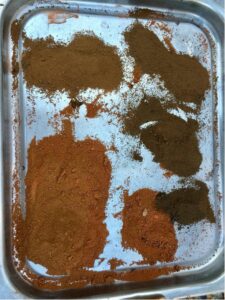
FIGURE 3. This photo shows red mud (bauxite residue) samples taken at variable time intervals during kiln testing
Proof of product. Once feasibility is confirmed, attention shifts from whether the reaction occurs to whether the product can be made to meet quality and performance expectations (Figure 3). This involves a more in-depth exploration of the material’s characteristics and how they influence the process needed to meet quality specifications, often with a focus on:
- Specific heat
- Heat of reaction
- Particle size distribution (PSD)
- Bulk density
- Moisture content
- Thermal conductivity
- Chemical composition
These characteristics will be defined and, if necessary, modified (where possible) to identify the exact parameters required to achieve the desired product quality. This may also include the exploration of feedstock pretreatment options such as drying, particle size reduction or agglomeration.
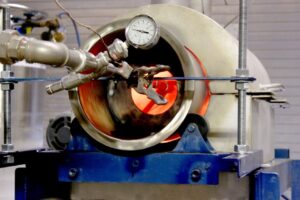
FIGURE 4. In this photo, testing of an indirect-fired batch kiln can be seen happening in the FEECO Innovation Center
Proof of process. After establishing that the product can be made to the desired specifications from the intended feedstock, test work moves on to demonstrate that the process is viable beyond the laboratory. As proof of concept demonstrates technical feasibility, proof of process illustrates feasibility of the process on a continuous scale. Hence, at this stage, work moves from testing in batch-scale units to pilot-scale equipment, which provides a better representation of real-world continuous operation at scale.
Establishing the process at pilot scale is critical, as not all processes are viable beyond small batch trials. A number of new factors are introduced when moving to continuous-scale operation, creating potential for risks such as:
- Ring formation, fouling and material buildup
- Particle degradation and fines generation
- Uneven heat distribution in the material bed
- Poor flowability
Many kiln processes validated in batch-scale testing ultimately fail on a larger scale due to these challenges, making pilot-scale process confirmation the decisive step between theory and practice. During this stage, researchers work with several process variables to establish the viability of continuous operation:
- Feed rate
- Bed depth
- Drum speed and slope
- Percent fill
- Heat transfer
- Gas-to-solid contact
- Material flow
- Retention time
- Internals (for managing retention time and bed action)
It is also at this point that the process economics become more clear, revealing data around:
- Fuel use
- Gas composition
- System pressures
- Thermal losses
- Loss on ignition
- Potential challenges and inefficiencies
- Dust and fines generation
Process/product optimization
After test work has proven that the process is viable on a continuous scale, researchers can shift their focus to optimizing the process for efficiency and product quality. While proof of process determines whether the process is viable, process/product optimization establishes how to make the established process as efficient as possible while producing the highest quality product. Like other stages of testing, this stage builds upon all the data gathered in prior stages. During process/product optimization, engineers work to improve factors such as throughput, energy efficiency, gas-to-solids contact, product quality, material flow and operating costs.
Data gathered during this stage are used to establish equipment sizing, including kiln length and diameter, heated length (indirect only), exhaust gas treatment, and burner arrangement (Figure 5).
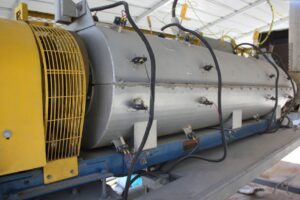
FIGURE 5. This pilot-scale, indirect-fired rotary kiln is used for testing
Concluding remarks
As industries push toward greater sustainability, tighter product specifications and more complex material transformations, rotary kilns are taking on roles that go far beyond their traditional applications. From activating catalysts and producing battery-grade chemicals to regenerating sorbents and recovering valuable components from waste, modern thermal treatment demands a level of precision and reliability that cannot be achieved through theory or laboratory testing alone. Comprehensive kiln testing, ranging from proof of concept through process and product optimization, provides the engineering-grade data needed to bridge the gap between laboratory feasibility and commercial reality. By capturing the interactions between heat transfer, gas-solid reactions and material handling in a continuous system, pilot-scale testing reduces technical risk, informs equipment design and ensures that new thermal processes can be scaled efficiently and consistently. In an era where performance, sustainability and capital discipline are equally critical, rotary kiln testing has become a cornerstone of successful process commercialization.
Edited by Scott Jenkins
Author
 Alex Ebben is a Process Sales Engineer at FEECO International, specializing in high-temperature thermal processing applications, including both equipment design and process development.