R3 Lithium (Covington, Ga.; www.r3lithium.com) today announced initiation of operations to produce lithium carbonate from 100% recycled battery materials at North America’s first proven commercial-scale lithium carbonate recovery facility in Covington, Georgia. The company, which also announced that it has secured $15M in Series A funding, from investors including Integral GlobalTech Partners, TDK Ventures and Axial Partners, acquired the 154,000-square-foot facility in July 2026 and retained the leadership team that first demonstrated commercial-scale recycled lithium production at the site in 2025. R3 Lithium holds approximately $1 billion in signed offtake agreements and is investing to bring the plant to continuous commercial operation.
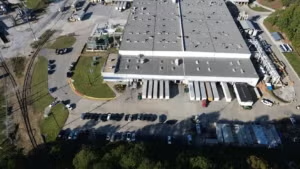
The new funding will be used to upgrade the existing lithium carbonate production line, which was the first in U.S. history to produce 99% purity lithium carbonate from 100% recycled content at production scale. The company projects that the Covington facility will account for more than 50% of the US total production of lithium carbonate in 2027.
R3 Lithium will recover, refine and return lithium carbonate to the domestic battery supply chain through a calciner-based crystallization and water-based precipitation process that extracts lithium directly from recycled black mass on a single site, without primary mining or non-domestic refining. The plant provides 30,000 metric tons of shredding capacity and a 2,500-metric-ton lithium carbonate production line, with space allocated for an additional 2,500-metric-ton line.
“The U.S. has spent years discussing critical mineral independence while the vast majority of lithium processing has remained overseas,” said Linh Austin, President and CEO of R3 Lithium. “R3 Lithium is here today, with a proven facility that has already produced the product, the team that made it happen, and the capital needed to upgrade the line and keep it running, at commercial scale. R3 Lithium is setting a new pace for domestic lithium production, starting now.”
The need for lithium carbonate is widespread and growing, with increasing demand from the defense sector, EV manufacturers, consumer electronics companies, data center operators and other segments. Global battery storage demand rose 51% in 2025, past 300 gigawatt-hours of installations, as data center construction accelerated¹, and global battery energy storage capacity is projected to expand sixfold between 2025 and 2030 at a 42% CAGR². Every gigawatt-hour of grid-scale battery storage consumes approximately 880 tons of lithium carbonate³.
R3 Lithium has secured approximately $1 billion in offtake contracts from customers including Trafigura. “Battery manufacturers, the Department of Energy, and OEMs are increasingly seeking reliable sources of domestic lithium to support the growing U.S. battery supply chain and improve security of supply. To date, however, domestic supply has remained relatively limited,” said Tim Wood-Dow, Battery Metals Trader at Trafigura. “R3 Lithium’s Covington facility helps address that gap in the physical supply chain by producing lithium carbonate from recycled feedstock on U.S. soil.”
A Parallel Pathway to Domestic Lithium Supply
The United States imports most of its lithium, with between 85 and 95 percent of battery cell and component production capacity currently occurring outside U.S. and European borders⁴. Federal policy, including the Inflation Reduction Act and critical mineral designations, is directing substantial resources toward closing that gap, but the timeline for primary extraction remains measured in years, not months. New domestic lithium mines can take seven to ten years to be permitted and more than 20 years from first discovery to first production⁵.
R3 Lithium operates on a different timeline. The Covington facility will produce lithium carbonate from batteries already in circulation, without new mining or foreign refining. A previous owner built the site with approximately $150 million investment; R3 acquired it with no liabilities, fundamentally resetting the economics of domestic lithium production.
R3 Lithium’s growth plan calls for a network of lithium carbonate and black mass shredding facilities across North America and Europe, each engineered in modular 5,000-metric-ton-per-annum units and deployed only with underpinning offtake agreements in place. This approach enables phased capital allocation, early revenue, and repeatable deployment across sites without concentrating risk in a single buildout.
From Black Mass to Lithium Carbonate on a Single Site
Most battery recyclers split their operations across multiple facilities or geographies. R3 Lithium’s Covington plant processes battery materials from shredding through finished lithium carbonate production in one location. The facility’s shredding lines will produce black mass from both manufacturing scrap and end-of-life batteries. Lithium is then extracted on-site through R3’s calciner-based process, and the remaining concentrated metal oxide (CMO), rich in nickel, cobalt, manganese, and graphite, is sold separately, often at or above the original purchase price of the input feedstock.
This vertically integrated model gives R3 Lithium multiple revenue streams from a single feedstock and positions the company to supply both lithium carbonate buyers and downstream cathode material producers.
Experienced Leadership, Proven Technology
R3 Lithium’s leadership team combines deep battery materials expertise with large-scale industrial operating experience. CEO Linh Austin brings more than 30 years of experience directing U.S. and international energy businesses, including senior roles at McDermott International, BP, and ARCO. CTO Eric Gratz, Ph.D., who also co-founded Ascend Elements, is the inventor of 43 patents in battery materials and lithium-ion recycling technology and a member of the Technology Committee of the U.S. Department of Energy’s Li-Bridge public-private partnership.
“Every battery already in service in this country is a lithium deposit,” said Gratz. “It is above ground, it is concentrated, and nobody has to dig for it. What has been missing is the ability to get lithium back out of it, at commercial scale, in the United States. That is the thing we have now demonstrated — not in a laboratory, and not as a pilot.”
R3 Lithium operates North America’s first commercial-scale lithium carbonate recovery facility, located in Covington, Georgia. Using a lithium-first extraction process, the company recovers, refines, and returns lithium carbonate from recycled black mass into the battery supply chain for energy storage systems, defense applications, and electric vehicles.