The $14 million expansion on RTI’s campus, in the heart of Research Triangle Park, gives innovators access to pilot infrastructure, engineering expertise, independent scientific validation and commercialization support to help bridge the gap between laboratory innovation and commercial deployment. The 25,000-square-foot facility doubles RTI’s commercialization infrastructure and is designed to generate the performance data and operational experience needed to move technologies closer to market.
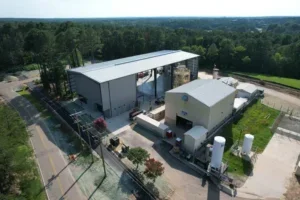
An aerial view of the expanded RTI Pilot Xcelerator
“The RTI Pilot Xcelerator reflects our commitment to helping innovators move breakthrough technologies from the laboratory to the marketplace,” said Tim J. Gabel, president and CEO of RTI. “It’s an investment in innovation, commercialization and the future growth of our region and beyond.”
The expansion strengthens RTI’s ability to support technology commercialization in North Carolina—the Pilot Xcelerator is the only privately owned industrial pilot laboratory in the state—and provides startups, commercial companies and government partners with access to pilot-scale infrastructure that can be difficult and costly to build independently. Beyond pilot testing, RTI helps innovators navigate the path to commercialization through independent validation, market insights and deployment planning. This support is designed to reduce risk and accelerate adoption across a range of sectors from energy to sustainable chemicals and materials to industrial biotechnology.
“Access to pilot-scale infrastructure can be one of the biggest barriers to commercialization,” said David Dausch, Ph.D., vice president of engineering and advanced technology at RTI. “The Pilot Xcelerator gives innovators a place to prove performance, generate real-world data and reduce risk without having to build that capability themselves.”
RTI supports demonstration and scale-up efforts across industries including sustainable aviation fuel, carbon capture, critical minerals and advanced recycling for plastics and other materials. RTI Pilot Xcelerator examples include: