Technology spun out from the University of Birmingham (www.birmingham.ac.uk) and developed by the startup PeroCycle Ltd. (Cambridge, U.K.; www.perocycle.com) is aimed at low-cost decarbonization of blast-furnace and direct-reduced-iron (DRI) steel-making operations, along with other furnace-based industrial processes, like glass-making.
The technology effectively uses commercial gas-separation technology to generate a high-concentration (~85%) CO2 stream from blast-furnace, basic-oxygen-furnace or DRI-plant exhaust gases. The CO2 is processed through PeroCycle’s thermochemical reactor at around 800°C to convert CO2 to CO using a proprietary active material. The CO can be injected into the blast furnace as a reductant. “By doing this, we create a sustainable carbon loop that, at full implementation, can abate up to 87% of carbon emissions from an integrated steel mill,” says Grant Budge, PeroCycle CEO.
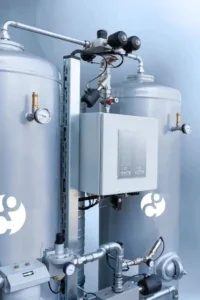
Source: Perocycle
The company initiated works on a pilot module this year and plans to begin testing the scaled technology in the second quarter of 2027. “We already have a prototype which we’ve tested on synthesis gases,” says Budge. PeroCycle recently secured funding that allows it to build a mobile pilot module. “There are currently three steel mills that want us to bring the system to their site to test it during the first half of 2027,” Budge says.
The catalyst, Budge explains, is a perovskite-based catalyst that operates inside the thermochemical reactor. “It allows us to split the CO2 into CO and oxygen through a redox reaction,” he says. “We put nitrogen gas through it, which effectively releases oxygen from the structure, so, when we put CO2 back through the system, the catalyst then wants to take the oxygen back into its structure.”
The catalyst is regenerated every cycle, and because of “how we integrate it into facilities, both on blast furnace applications and DRI applications, what we’re seeing is the potential to decarbonize on a DRI up to 100%, on the blast furnace up to 87%, and to do that with net reduction in energy consumption,” says Budge. And the company says it can accomplish this without the need for carbon taxes, subsidies or other government incentives.