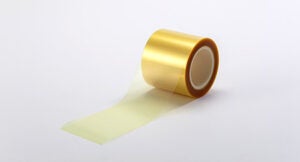
Negative photo definable polyimide sheet (Source: Toray)
This company has developed a negative photo-definable polyimide sheet for glass-core substrates in used to connect chips to printed circuit boards in semiconductor manufacturing processes. This sheet makes it possible to simultaneously microfabricate the redistribution layer (a multilayer structure comprised of extremely fine copper wiring and insulating layers, such as polymers or oxide films) and fill through-glass via electrodes (TGVs) with resin. This material shortens processes and cuts costs because it enables void-free resin filling of TGVs with conformally plated copper. Conformal plating forms a copper or other metal plating layer that follows the surface of a substrate, enabling uniform plating thickness even on parts with complex shapes. Substrate manufacturers have started evaluating samples of the new materials, and mass production is anticipated to begin in April 2026. Conventional semiconductor packaging mounts multiple chips on glass-epoxy substrates using silicon interposers with fine wiring. Higher chip integration makes substrates larger and wiring denser. Glass-core substrates are garnering attention for their superior size flexibility, flatness, and electrical properties. It is increasingly important to integrate interposers and package substrates into single units. Still, glass core substrates present challenges. Such conventional techniques as laser processing epoxy resin layers have made it hard to finely process rewiring layers. Another issue is thermal stress-induced glass cracking. On top of that, filling fine vias 50 microns or smaller in glass core substrates with copper requires prolonged low-current plating, driving process costs up. This new new sheet makes it possible to form fine wiring with photolithography. Filling TGVs with resin slashes copper plating costs. Also, proprietary polyimide design and photopolymerization reaction control technology reduce the elastic modulus by around one-third from conventional levels, suppressing glass cracking from thermal stresses. The sheet additionally supports microvia processing below 10 microns in diameter. This lowers costs in combination with conformal plating, which applies copper plating only to the TGV walls. — Toray, Inc., Tokyo, Japan