Technology never stands still and so it goes for the semiconductor industry. As the devices we rely on every day become more powerful, more efficient and more interconnected, the chips inside them must keep pace. Manufacturers are constantly pushing to develop the next generation of semiconductors to meet the demands of everything from smartphones and electric vehicles to the AI components in data centers that are scaling at a staggering rate right now.
Semiconductor chips are at the heart of these technologies. They also make the next iteration of these technologies possible. But before a single chip ever reaches a production line, a fab (fabrication plant) must be built. A fab is a specialized manufacturing facility where silicon wafers are processed into integrated circuits through numerous precise steps performed in ultra-clean controlled environments.
Clean zones in semiconductor manufacturing are some of the most tightly controlled environments in any industry. These zones are designed to aggressively limit contaminants so that chips can be produced without defect. A single particle out of place or an unplanned electrostatic event can compromise an entire production run.
The clean zone is the essential area in any fab. Keeping the different areas within the clean zone running without interruption is not just important. It is the difference between staying competitive and falling behind.
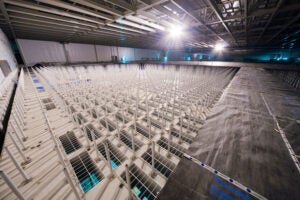
Elevated floor in a semiconductor plant
Every decision that feeds into uptime, contamination control, and facility durability matters. That includes the coatings that protect the floors, walls, and substrates throughout the fab.
Every fab is different, and that changes everything
There is no one-size-fits-all approach to the chemicals used inside a semiconductor fab. Every facility runs a unique combination of acids, bases, solvents and specialty chemistries depending on its processes, its product mix, and the specific steps involved in etching and cleaning wafer surfaces.
The chemical exposures involved may differ from fab to fab, but one thing stays consistent across the board: the need for protection against those chemicals. Every facility takes steps to ensure that potential chemical spills or leaks do not damage the surrounding infrastructure to the point of slowing, or at worst, stopping production entirely.
Contamination control inside these clean zones is managed down to the smallest detail. Everything from airborne particulate concentration to temperature and humidity to air pressure and airflow patterns are monitored and regulated with precision. The floors and walls where these delicate processes take place are part of the system themselves. If a coating fails, if a chemical penetrates the substrate, if a surface begins to degrade, the consequences ripple outward.
Why coatings selection slows things down
If chemical-resistant coatings are so critical, why do they so often become a pain point in the fab construction process? Part of the problem is complexity. With so many variables at play, from the specific chemicals in use to the environmental conditions in each zone to the mechanical wear from foot and cart traffic, selecting the right coating system can feel overwhelming.
Too often, coatings decisions get pushed later in the project timeline. They are treated as a finish rather than a system. By the time those decisions are made, the project schedule has already been set, and any misalignment between the coatings specification and the construction sequence creates friction. Over-specified systems add unnecessary cost and complexity.
Under-specified systems introduce risk that does not reveal itself until the fab is operational, and the stakes are at their highest. The result, in too many cases, is a reactive cycle. Problems surface after installation. Repairs eat into commissioning timelines. And the fab pays the price in lost production days.
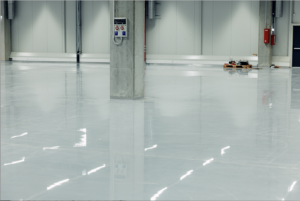
Semiconductor fab floors require specialized coatings
A simpler path forward
There is a better way to approach chemical-resistant coatings selection. It starts with viewing coatings as a functional part of your facility, not just a finishing coat. Any facility owner’s approach should be built around three core principles.
1. Start with understanding the exposure
Every project begins with a clear-eyed assessment of what the coating system needs to stand up to. Because every fab is unique, that assessment must be specific to the facility in question. It is about understanding the full picture of exposure: the chemical environment, moisture mitigation needs, traffic patterns, UV exposure and static control requirements. Getting this right at the outset is what allows every downstream decision to be made with confidence rather than guesswork.
2. Match performance to need
Once the exposure profile is clear, the next step is developing a coating system that delivers enough protection to ensure safety, durability, and uptime, without over-engineering the solution. This is a critical balance. Over-specifying a coating system introduces unnecessary complexity, drives up cost, and can extend the project schedule. Under-specifying it creates failure risk and durability concerns that may not become apparent until the fab is already running. The right answer is the one that matches the actual demands of the environment during construction as well as operations. Not more. Not less.
3. Partner from start to finish
Engaging early means that coatings decisions can align with the broader project sequencing from the beginning. Schedule conflicts get identified and addressed before they become problems. Late-stage changes and the rework that comes with them are minimized. The coatings partner becomes part of the project team rather than a vendor brought in at the end to check a box.
Early collaboration also opens the door to something that is harder to quantify but just as valuable: shared knowledge. When the coatings team understands the full scope of the project, they can flag potential issues that might not be visible from the design documents alone.
The bottom line
Semiconductor fabs are among the most complex, demanding and high-stakes facilities in the world. The chemicals inside them are aggressive. The tolerances are unforgiving. And the cost of getting it wrong is measured in millions of dollars per day of lost production.
Chemical-resistant coatings are a small piece of the overall fab construction puzzle, but they play an outsized role in protecting the infrastructure that makes everything else possible. The selection process does not have to be complicated. It does not have to be a source of schedule risk or cost overruns. With the right approach, built on understanding the exposure, matching performance needs, and partnering early, it can be one of the smoothest decisions in the entire project. ♦
Edited by Mary Page Bailey
Acknowledgement
All images provided by author
Author
 Mark Wafford is a Construction Solutions Executive dedicated to the Semiconductor Manufacturing market at Sherwin-Williams Protective & Marine (SWPM; Emil: mark.j.wafford@sherwin.com). He has been in the coatings industry with Sherwin-Williams for 23 years, with the last 10+ years working with protective coatings, and he is an AMPP Senior Certified Coatings Inspector. The primary responsibility in this role is to focus on building relationships with the general contractors, architects and engineers who participate in this market.