Polyphenylene sulfide (PPS) is a high-performance thermoplastic with excellent mechanical and thermal properties commonly used in automotive glass-fiber-reinforced components and materials. Recycling waste PPS is challenging because separating impurities is difficult, and conventional mechanical recycling can lead to polymer degradation. Now, Toray Industries Inc. (Tokyo, Japan; www.toray.com) has developed industry’s first solvent-based recycling process for recovery of PPS from automotive waste.
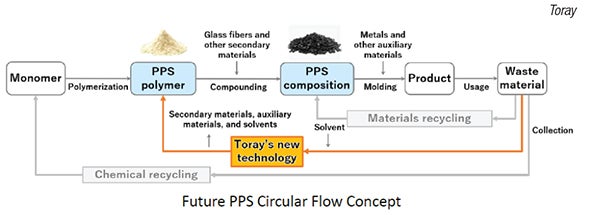
Responding to demand for recycled PPS materials resulting from end-of-life vehicle regulations like those recently introduced in the E.U., Toray capitalized on its decades of experience with PPS manufacturing to develop the process.
Because it selectively recovers PPS in its polymer form, Toray’s solvent-based recycling process is expected to provide substantial energy savings over chemical recycling routes that require depolymerization and repolymerization. The process takes advantage of the unique solubility characteristics of PPS, the company says, first using a proprietary solvent to dissolve the PPS-containing waste materials. Insoluble materials, including the glass fibers in the case of PPS composites, and metal contaminants, are separated by a solid-liquid separation step. Finally, the PPS is recovered by crystallization.
Compared with conventional mechanical recycling, a key advantage of the Toray process “is its ability to remove glass fibers, metals and other impurities from waste materials. This enables the recovery of higher-purity PPS while maintaining its polymer structure,” Toray says.
In studies of the PPS recovered using its process, Toray found that the molecular weight of the recovered PPS polymers is similar to that of virgin PPS, and their melting point and crystallization temperatures are comparable to virgin material. A preliminary lifecycle-analysis study by Toray suggests that recycled PPS made using its technology may reduce cradle-to-gate greenhouse gas emissions compared with PPS made from virgin materials.
Toray is now evaluating additional application-relevant properties for the PPS and verifying continuous operation of the process. To move the technology into commercial-scale production, Toray sees three key challenges: securing supplies of waste feedstock for recycling, demonstrating continuous operation at larger scale and establishing customer acceptance for recycled PPS.
The company aims to start commercial supply of recycled PPS in 2030. Toray says it will also explore reuse of the recovered glass fibers in the future.