World-scale ammonia-production plants based on the Haber-Bosch process supply the ammonia for most of today’s agricultural fertilizer industry. But building new capacity for ammonia production is economically difficult because of the high capital expenditures needed for plants large enough to take advantage of economies of scale. The startup company Ammobia Inc. (San Francisco, Calif.; www.ammobia.co) has developed a process that changes the operating conditions for ammonia production, allowing ammonia to be produced in regional modular facilities at low cost.
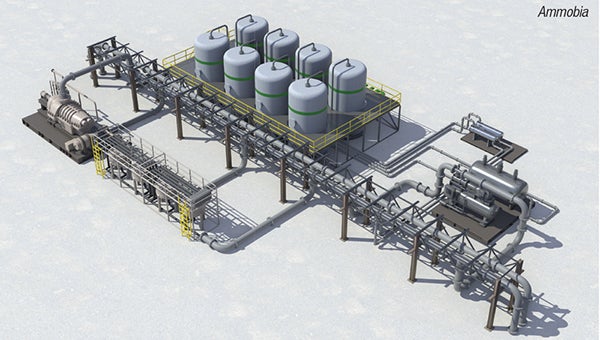
“Ammobia’s system produces ammonia at much lower pressure and temperature than the conventional Haber-Bosch process, so we can use standard equipment that lowers the capital costs for adding ammonia capacity,” says Guido Radaelli, Ammobia’s chief engineering officer. Ammobia’s process runs at 20–60 bars, compared to 120–300 bars for conventional ammonia production, which means that lower-cost hardware can be used, including thinner walls for pressure vessels and smaller compressors.
The Ammobia process is similar to the well-known Haber-Bosch process, but instead of a synthesis step followed by a separation step, as in conventional production, Ammobia’s process combines the synthesis and separation in a single step. “By pulling the ammonia out of the reactor as it forms, we avoid the thermodynamic equilibrium that forces the process to operate at high pressures and limits conversion rates,” explains Tristan Gilbert, a co-founder of the company who serves as chief technology officer.
To continuously remove the produced ammonia, Ammobia uses a sorption-based system. The company developed a proprietary adsorbent material for the process using substances that can currently be manufactured economically at scale. “The sorbent concentrates the ammonia at low pressure, pulling it away from the catalyst material, so we are able to achieve higher conversion rates at lower-pressure conditions,” Gilbert says.
In pilot testing, Ammobia’s reactor achieved 65% ammonia conversion at 30 bars for 1,000 hours, compared to typical 15–30% conversion for the conventional Haber-Bosch process, the company says.
Following pilot operation, Ammobia is now designing a 10-ton/d demonstration facility and a 250-ton/d commercial plant, both based on skid-mounted, modularized and standardized equipment. The company recently partnered with Lummus Technology LLC (Bloomfield, N.J.; www.lummustechnology.com) to implement Ammobia’s designs.
“We want to allow localized, medium-scale ammonia production for new-energy applications and demand growth for fertilizers,” Gilbert says.