Mimicking enzyme-like behavior for synthetic chemistry is a growing field of exploration in sustainable chemical production, unlocking potential new reaction routes that eliminate waste and unwanted byproducts. A team of chemists from Penn State University (State College, Pa.; www.psu.edu) has generated a synthetic mimic for the oxygen-activating enzyme extradiol dioxygenase, enabling the production of certain chemicals using oxygen as an input and water as the sole byproduct.
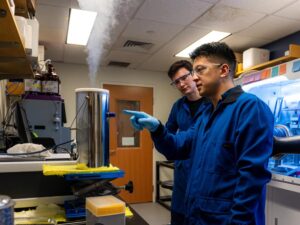
Credit: Jaydyn Isiminger/ Penn. State Creative Commons
The Penn State team tailored the mimic to break open extremely stable six-carbon aromatic rings and insert an oxygen atom. This creates a relatively reactive seven-member ring that can be more readily cleaved, thus unlocking a varied range of chemical building blocks for manufacturing plastics, pharmaceuticals and other materials using a more sustainable route than traditional petrochemical processes. “The particular reaction we promoted in this work cannot be performed by any synthetic method, to my knowledge,” says Jonathan Kuo, assistant professor of chemistry at Penn State. “The BTX chemicals — benzene, toluene and xylenes — have a special designation in industry because their reactions are so different from the reactions of other petrochemicals. The chemistry is overwhelmingly dominated by a property called aromaticity, where six pi electrons bond in a synergistic arrangement and result in an unusual, but well documented, stabilization. Most reactions that process the BTX chemicals don’t really disturb this arrangement, but the reaction we promoted does. As a result, it becomes possible to convert the BTX chemicals into other families,” he adds.
Where the natural oxygen-activating enzymes would normally include cobalt, iron or manganese, the mimic incorporates iridium. This improves the selectivity against unwanted oxygen side reactions and builds a foundation for longer-lasting synthetic mimics. The researchers were also able to incorporate some important enzymatic features into their enzyme, such as a hypothesized functionally important protic residue, notes Kuo. This work was detailed in the Journal of the American Chemical Society.