Fast-growing power densities within the server racks at new data centers often generate enough heat to quickly overwhelm legacy air- and liquid-cooling methods, and managing the thermal load is becoming a constraint for the data-center infrastructure that supports AI.
A new thermal management system launched recently by Karman Industries (Los Angeles, Calif.; www.karmanindustries.com) offers a way to lower energy consumption for data-center cooling while shrinking the mechanical footprint of cooling architecture significantly.
Source: Karman
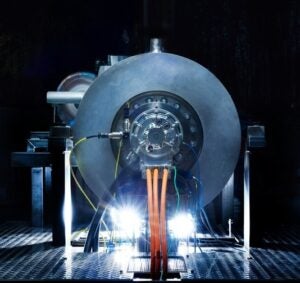
In January, Karman released its Heat Processing Unit (HPU), a modular, shipping-container-sized, 10-MW cooling platform that increases cooling efficiency, speeds deployments and eliminates water consumption. At the heart of the HPU is a compression-based refrigeration system using supercritical carbon dioxide as the refrigerant. “The HPU cuts energy waste by recovering about 30% of the compression work through a turbine, instead of a standard expansion valve,” explains CJ Kalra, a thermal-fluids engineer and co-founder of Karman Industries. “The thermodynamic properties of CO2, including a critical temperature near ambient (32°C), make it ideal for efficient heat transfer and partial power recovery,” Kalra adds.
The compressor design approach took inspiration from aerospace engineering and electric-vehicle technology. Karman engineers borrowed recent innovations in rocket turbomachinery, including metal 3D-printing and electric-vehicle innovations like high-speed motors and silicon-carbide power electronics technology, the company says.
Energy for cooling accounts for 20 to 40% of data-center electricity use, explains David Tearse, Karman CEO. “For systems within the data center that require lower cooling loops for operations, HPUs repurpose high-temperature waste heat from GPU [graphics processing unit] clusters into cooling at less than 30ºC,” Tearse says. “Similarly, in colder ambient conditions, HPUs process waste heat from compute racks to provide electricity for operations or high-grade heat for district heating and other use cases.”
“Also, the system reduces external the mechanical infrastructure footprint by 60 to 80%, simplifying installation and shortening delivery timelines,” Tearse notes.
Although the initial market for HPUs is thermal management in the data-center industry, the Karman HPU systems could also find uses among several other chemical process industries (CPI) sectors, such as chemicals, petroleum refining, food and beverage and minerals and materials.