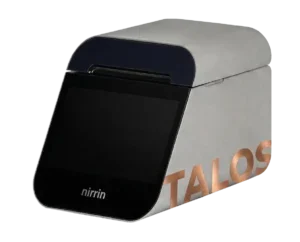
Source: Nirrin Technologies
This company’s Tunable Laser Near-Infrared (TL-NIR) bioprocessing platform combines a common hardware foundation with software-enabled analytical workflows, including TALOS™ rapid protein quantitation and ATLAS® multi-analyte quantitation. It is available as an at-line or in-line system, both of which support multiple software workflows. The in-line system can be configured with either a flow cell or in situ probe modality.
Designed to enable analytical methods to scale and transfer across the bioprocessing workflow, the TL-NIR platform provides a consistent architecture from process development through pilot, clinical, and commercial manufacturing. This approach can reduce analytical redevelopment during scale-up while maintaining continuity across unit operations, scales, and sites.
TALOS™ rapid protein quantitation is the platform’s single-analyte workflow for rapid, direct protein measurement across a broad concentration range. TALOS™ is designed to measure 0.5 to 250 mg/mL from a 15 µL sample in seconds, without dilution, sample preparation, or pathlength adjustment. Its fixed-path architecture supports consistent measurement across workflows and deployment configurations.
ATLAS® multi-analyte quantitation workflow extends the platform beyond single-analyte measurement to broader bioprocess analytics, supporting quantitation of sugars, surfactants, buffers, and other bioprocessing components. The multi-analyte capability is designed to support a broader range of process measurements while using the same underlying TL-NIR platform.
As biomanufacturing becomes more automated and connected, analytical measurements increasingly need to be available closer to where and when process decisions are made. At-line measurements can shorten the interval between sampling and results, while in-line and in situ configurations can bring measurement directly into the process.
This creates an opportunity for analytical systems that do more than document process performance; they can provide data and new insights to support process optimization and control, including measurement-based endpoints for operations such as ultrafiltration/diafiltration. — Nirrin Technologies, Billerica, Mass.