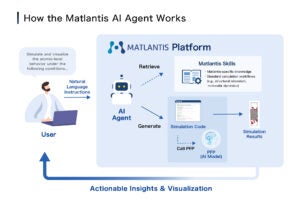
This company has announced that a new AI agent is integrated into its universal atomistic simulator, and that is allows researchers to build and run simulations using natural-language instructions. The release includes a public Skills library on GitHub, available immediately, and an upcoming installer that will run Anthropic’s (San Francisco, Calif.; www.anthropic.com) Claude Code directly inside the company’s terminal environment. Atomistic simulation has long required a combination of computational chemistry knowledge, programming fluency, and environment expertise, a barrier that has kept the technology in the hands of specialists even as the rest of materials R&D has become more cross-functional. This release targets the last remaining barrier: the scripting layer that sits between a researcher’s question and a working simulation. By embedding Claude Code inside the technology and giving it access to a domain-specific Skills library, this company is connecting general-purpose agent capability to the specialized procedures and application programming interfaces (APIs) that simulation work actually requires. Running the agent in-context means researchers can describe what they want to simulate in plain language, generate or edit the underlying scripts, run the calculation, and interpret outputs, all without leaving the workflow. For experimental researchers who lack programming fluency, this opens up simulation as a practical tool. For computational specialists, it removes the repetitive scripting work that typically sits between hypothesis and result. — Matlantis, Tokyo, Japan