Aboveground storage tanks (ASTs), cased pipelines and insulated surfaces are all common sights in the chemical processing industry (CPI) landscape. They also have one thing in common: void spaces that are vulnerable to corrosion, yet are difficult to protect due to limited accessibility. While vapor corrosion inhibitors (VCIs) have been employed for protection of difficult-to-reach voids for decades, many facilities have yet to apply VCIs for holistic infrastructure maintenance and integrity. Whether or not a chemical engineer, facility manager or pipeline maintenance crew has heard of the workings of VCI technologies, taking time for a closer look at how far this technology has come and where it could potentially bring the industry is a worthwhile activity that could lead to enhanced maintenance and asset-management techniques.
From general acceptance to industry standard
VCI technology now has an “official” stamp of approval for use in tank-bottom protection, thanks to its formal reference in industry standards just a few years ago. Interestingly, technical standards are often slow to catch up with general industry trends and may take years to reflect what has already been discovered in the field.
Insights from Shane Baker, a VCI application expert (currently serving with CGS; Cortec Global Services) who has applied VCI to hundreds of tanks and cased pipeline crossings since 2006, underscore the potential to extend the benefits of VCI to many varied industrial sites
Back in 2008, Baker was already applying VCI to dozens of tanks owned by a leading oil and gas company. However, it wasn’t until the 2020s that VCI was listed in industry standards — first in API TR 655 (2021) [1], followed by AMPP SP21474-2023 [2] — as a viable option for tank-bottom protection alongside the much longer established practice of cathodic protection (CP).
Understandably, it takes many years of field application and testing to first gather data on VCI performance, publish results and integrate these methods into industry standards. In one sense, therefore, VCI adoption reflects a major milestone of success and acceptance. This “standardization” can subsequently be an impetus for further use, especially as tanks, pipelines and CP systems age and new construction continues. Whether as a backup to CP or as a standalone treatment (in areas where CP is not mandatory), VCIs offer considerable advantages — not only for corrosion protection of tank bottoms, but also for pipeline crossings and insulated metal surfaces.
Advantages of VCI mechanisms
VCIs excel in enclosed spaces. Available in powder or liquid form, VCI carriers release corrosion-inhibiting vapors that diffuse until they are trapped within a void — whether that be a pipeline casing, a tank bottom or an insulated surface. Because of their natural attraction to metal, they begin to adsorb onto enclosed surfaces of the tank, casing or equipment. This adsorption creates an invisible molecular layer that inhibits water, oxygen and chlorides from interacting with the metal and inciting a corrosion reaction. As long as the void remains closed with a sufficient supply of VCI material, protection continues, reducing (if not completely preventing) corrosion. Vapor action also increases the ease of application in difficult-to-reach spaces (Figure 1).
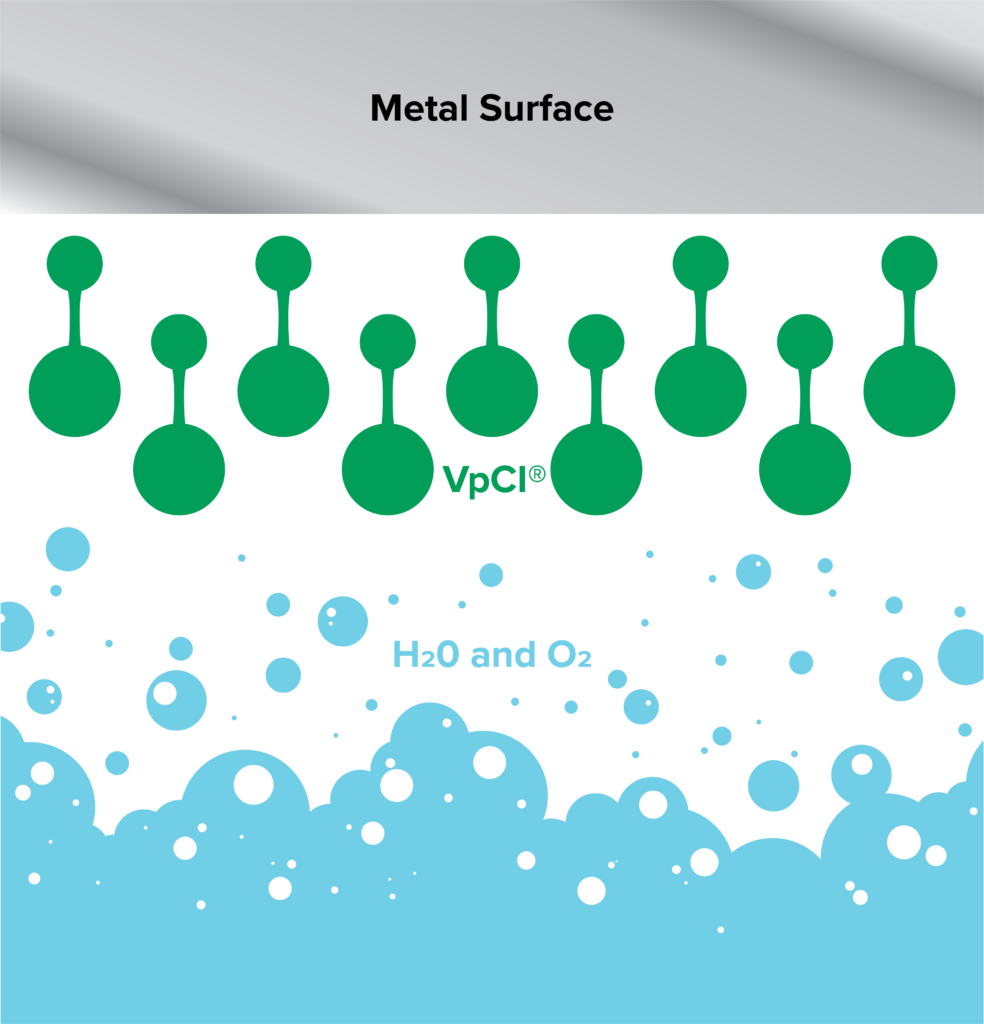
FIGURE 1. VCI adsorbs on metal surfaces, forming a protective molecular layer that inhibits corrosion reactions with oxygen and water (Cortec image by Kim Sapp)
Under-tank advantages of VCI
AST bottoms are enclosed and difficult to reach, making them ideal candidates for VCI protection. But what about the well-established method of CP? A closer comparison of how CP and VCI work reveals significant areas where VCI can support or potentially replace CP.
1. VCIs can reach all accessible surfaces under the tank floor. The impressed-current cathodic protection (ICCP) current runs through the sand pad underneath the AST, providing enough electrical current to offset the normal flow of electrons from anode to cathode in a corrosion cell. Unfortunately, tank floors are uneven and not in perfect contact with the sand, leaving air pockets where the metal floor is out of contact with the current. Injecting VCIs in conjunction with CP can make up the difference by allowing corrosion inhibiting vapors to diffuse to these unprotected surfaces and adsorb, eliminating the “spots,” as Baker put it, where corrosion can otherwise take hold (Figure 2).
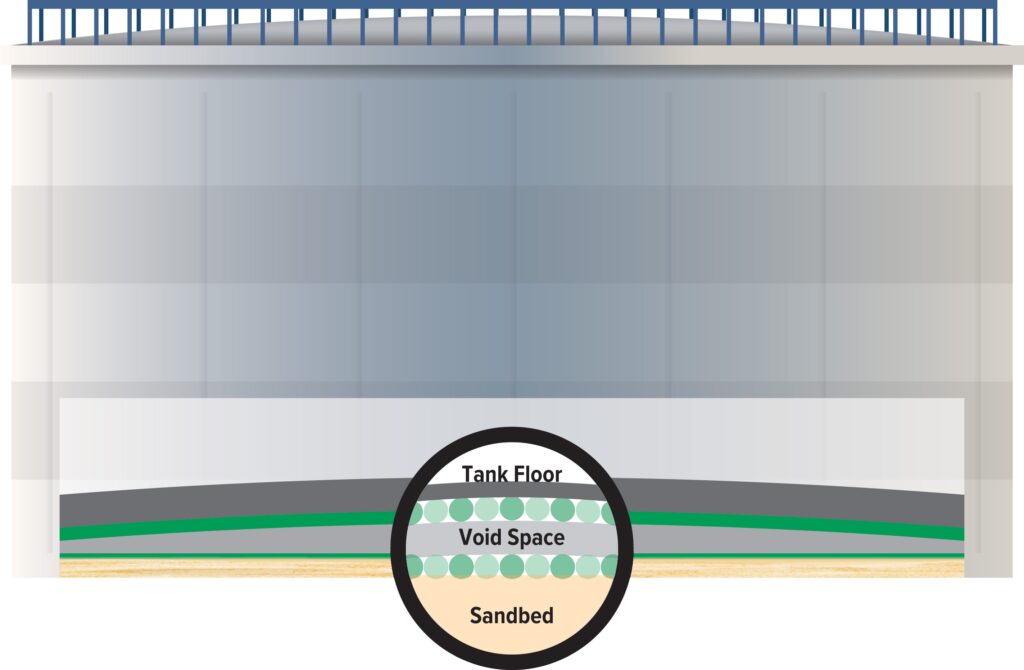
FIGURE 2. VCI, represented by the green dots, fills the void beneath a storage tank and adsorbs on the bottom of the tank floor, inhibiting corrosion reactions with oxygen and moisture (Cortec image by Kim Sapp)
2. VCI can require less maintenance and works without power. ASTs must be monitored regularly to check for metal loss or a faulty ICCP current, which is sometimes mitigated by current adjustment. However, if power fails or must be turned off temporarily, protection is simultaneously taken away. In contrast, VCI protection continues with or without a constant source of power, making it a smart backup to CP that does not need to be turned up or down depending on the rectifier reading.
3. VCI can be easier to apply than CP. CP is usually much more difficult to add after a tank has been built. Baker has a long history of applying CP and VCIs under tank bottoms and has seen both sides of the equation. From under-tank ground beds and ribbons to lattice-works and mesh systems, he has seen and tried many methods of CP application. Some of the challenges he has faced include the difficulty of maintaining the directional-drill head signal under extremely large tanks, leaving him “boring blind.” He added that “We’ve done it, but it’s not ideal.”
In the case of double-bottom tanks where a new floor is being installed, Baker pointed out that directional drilling for CP installation is not even an option. It is a key reason that one major oil company asked him to apply VCIs to numerous double-bottom tanks across the U.S. in 2008 as part of a two-year contract. Adding a second floor above the first floor means that the new metal is completely out of contact with the original CP current, hence the need for VCIs.
When asked to rank the different means of applying corrosion protection to a tank bottom, Baker replied, “I’d say going through the tank floor with VCI is the easiest. Dot right there.” Applying VCIs through the side of the tank or ring wall is his next preferred method for ease of application (Figures 3 and 4). CP wire mesh anodes, latticework, and ground bed systems follow in order of relative increasing difficulty.
Below, Baker ranks the methods for installing AST tank-bottom corrosion protection from easiest to hardest, based on his field experience:
- Injecting VCIs through tank floor
- Injecting VCIs through tank/ring wall
- Installing wire mesh ICCP anodes
- Installing ICCP grid
- Installing ICCP ground beds
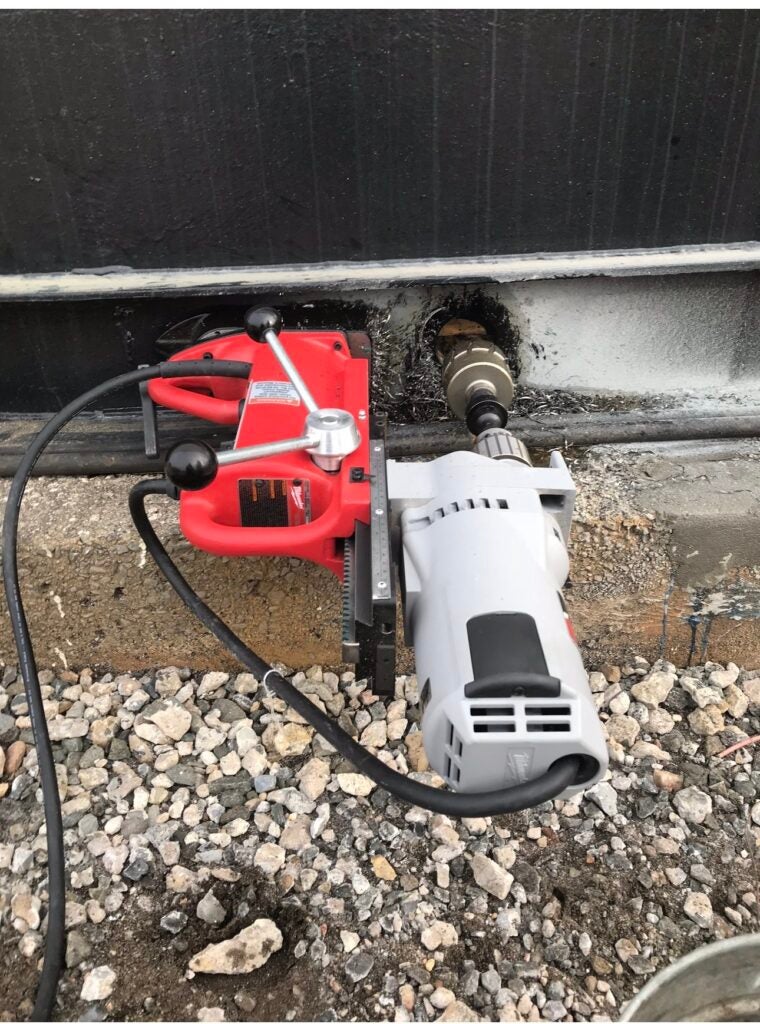
FIGURE 3. Drilling through a tank wall is one method to apply VCIs in a double-bottom tank The two horizontal metal rims indicate locations of the old and new floor (Shane Baker image)
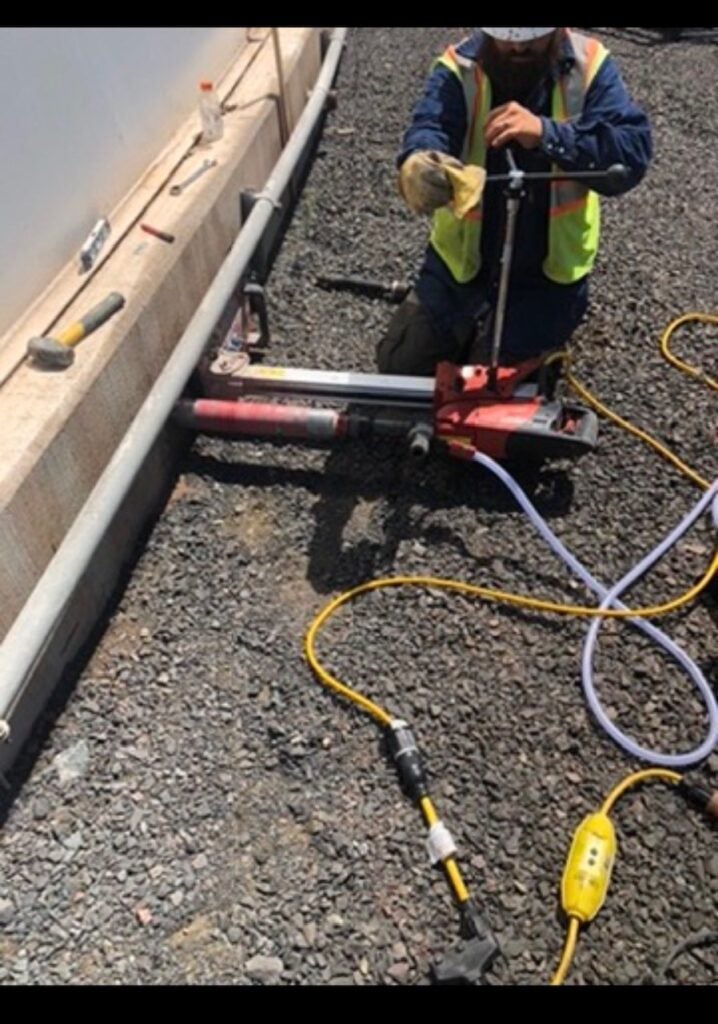
FIGURE 4. Going through a concrete ring wall is another viable option for VCI application (Shane Baker image)
4. VCIs potentially extend inspection intervals. Current industry standards call for tank inspection once every 10 years [3]. Eric Uutala, a technical sales manager at Cortec Corp. who has been heavily involved in the testing and analysis of VCIs for AST protection, explained that inspection activities usually involve draining the tank, reserving another tank to temporarily store the liquid, cleaning the floor and performing floor scans to see if any of the plates are thinner than 6 mils and need replacement. Even if the CP system does not need to be retrofitted, inspection itself is a costly activity when adding up labor costs, downtime, cleaning, and repair materials. However, Uutala and other industry experts see trends on the horizon indicating the strong possibility that VCIs may soon extend the interval required between inspections, which could save substantial time and money.
Applying VCI to cased pipeline crossings
Another vulnerable area where VCI comes in handy for CPI operators is inside pipeline or piping crossings. These cased crossings (Figure 5) are found in rights-of-way where pipelines pass under roads or railways, or at tank farms where intraplant piping systems need extra mechanical protection under a gravel path or berm.
Specific conditions are unpredictable. Throughout the course of hundreds of applications, Baker has encountered a range of situations — from casings filled with water, to shorted systems sapping CP current from the carrier pipe, to two-carrier pipelines housed in the same casing.
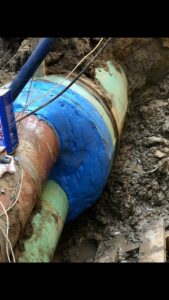
FIGURE 5. This cased crossing had two carrier pipes running through it. Baker sealed the ends before treating the void space with VCI gel (Shane Baker image)
Making up for wax filler and CP deficiencies
Sometimes, Baker has been asked to apply VCI to a casing to make up for CP current deficiencies. Often, he has to flush out debris, which is difficult in the case of failed wax fillers. He noted that while these are still a go-to for many, he does not see them as viable because the wax does not completely fill the void. Furthermore, it is practically impossible to remove the wax once installed. In contrast, VCI can fill in the gaps left by wax or other debris in the casing, simultaneously providing a backup for deficient CP systems.
VCI casing filler
Baker’s typical VCI application routine for cased pipelines is to flush as much debris out of the casing as possible, install seals and make sure there are not any leaks. Then, he typically combines VCI with gel to serve as a VCI carrier, filling the casing void and emitting corrosion inhibiting vapors to protect all accessible metal surfaces. Except for casings in Texas that experienced heavy flooding, Baker observed good gel longevity in 2021 when he did an informal survey of cased pipeline crossings filled over the previous five years. He has never received any negative feedback about VCI performance and has often been called back to do additional work (whether VCI or CP) for the same customers.
VCIs for insulated surfaces
Another place that VCIs offer a protective advantage is under insulated surfaces. Rather than removing and replacing insulation to apply a coating — a costly and impractical task — workers can simply inject VCIs into the existing insulation, allowing the corrosion inhibitor vapors to travel to the surface of the metal and form a protective molecular layer.
Expertise and understanding
Despite their proven performance in many settings, VCIs alone do not guarantee a quick in-and-out application job. When adopting VCI for protection of a tank floor or cased pipeline crossing, it is important to select a knowledgeable, approved applicator. Baker has seen firsthand what a quick, clean application looks like versus an application that requires a caravan of equipment and leaves the site in an uproar. He knows how important it is to keep equipment minimal, with clean and speedy application.
While VCIs have already made their mark on the industry, many do not yet enjoy their benefits. Increased popularity will continue to unfold with the ongoing development of standards and guidelines, giving users a better grasp on the true potential of VCI. For now, it remains for CPI decision-makers to investigate and adopt the potential advantages of VCI for their own facility or pipeline. The “secret” is out and waiting for discovery. ♦ Edited by Mary Page Bailey
Acknowledgements
Special thanks to Shane Baker (CGS) and Eric Uutala (Cortec) for technical support.
References
- API TR 655: Volatile Corrosion Inhibitors for Storage Tanks, April 2021
- AMPP SP21474-2023: External Corrosion Control of On-Grade Carbon Steel Storage Tank Bottoms, May 2023.
- API STD 653: Tank Inspection, Repair, Alteration, and Reconstruction, November 2014.
Author
 Julie Holmquist (Email: jhomquist@cortecvci.com) has been a content writer at Cortec Corp. for more than 10 years. She specializes in writing about corrosion-inhibiting technology for a variety of industries, including manufacturing, oil and gas, power generation, and water treatment.